Alevante, the living legacy of Ángel León's cuisine
The restaurant located in the Palacio Sancti Petri Gran Meliá hotel celebrates its tenth anniversary and revisits some of the most emblematic dishes from the Chef of the Sea's universe in a menu that confirms the enduring relevance of a marine cuisine that continues to excite.
While Aponiente restaurant spills over into the marshes that Ángel León has just reclaimed in El Puerto de Santa María, Alevante contains the waters of his culinary repertoire. This bright dining room, located in the Palacio Sancti Petri Gran Meliá—a luxurious Neo-Mudéjar resort overlooking the Chiclana coast, with impeccable service—is a living testament to the Cádiz-born chef's professional journey. It's curious that it's here, and not at his flagship restaurant, that one must go to understand him, to understand his cuisine.
Not because León's identity isn't present at Aponiente, where it expands like a wave, but because here his work settles in a different way: dishes that at some point left the menu of the three-Michelin-starred restaurant stabilize and mature at these other tables, revealing with a bit more perspective the logic of a chef who has spent fifteen years teaching the sea to cook itself. Alevante—two Michelin stars, two Repsol suns—seems the best possible answer to account for his journey. The future will always be rooted in Aponiente.
However, the restaurant in Sancti Petri is no small affair. This is evidenced by the impeccable execution of a menu that often includes some of its own creations and which, for a week, beneath the skylight from which a school of fish and seaweed hangs, featured dishes celebrating its ten-year history. Thus, the legendary shrimp fritter, created in 2007, was a must: an intricate embroidery made with threads of flour from dehydrated shrimp, fragile, beautiful, crispy, without a trace of fat, a reflection of the economical approach of traditional Cádiz cuisine. Nor was the small tin containing, secretly, beneath a pristine plankton hollandaise with tiny quenelles of caviar and flowers, a creamy sea urchin royal. The combination is silky and intense, like the sound of a cello. It's that exquisite music box you were never allowed to play unsupervised.
Successes in waves
More classic dishes from León are emerging in waves under the guidance of Cristian Rodríguez in the kitchen and Ricardo García in the dining room, the team to whom the chef entrusted this cuisine whose objective, as he declared at its opening in 2016, is to ensure that "Aponiente's successes don't die." Their version of marinated squid is a playful 2021 dish that has occasionally graced the dessert menu at Alevante: arranged on a block of ice are incredibly thin—and frozen—flakes of squid caught by jigging, which must be picked up with tweezers and dipped in a bowl of egg yolk cured in soy sauce, and then in another with shichimi togarashi. Just like at home, but without getting your hands dirty. It's a course based on kakigori, a traditional Japanese dessert consisting of shaved ice with added syrup.
The squid itself has little flavor presence, but the umami of the yolk provides the density the dish needs to hold together. However, the real magic lies elsewhere: in the textures that transform as the cephalopod cools in the mouth, like an ice pop in a child's hands. It's a dish that's more a demonstration of technique than an exercise in flavor, but it works. The halophyte forest—a gelatin made from saline plants and frozen vinaigrette powder, rolled and eaten like a taco—follows the same line of thought. For León, the sea is both a pantry and a source of inspiration.
To calm the conceptual tide, cockles are accompanied by icy rocks of tomato water and gazpachuelo, which are precisely what they claim to be. Just like the sea cucumber, which Ángel León's kitchens have been using long before it began populating restaurants in other parts of the world. They sauté it and serve it with a meunière sauce of paprika and florets of bimi. A bold and impactful bite.
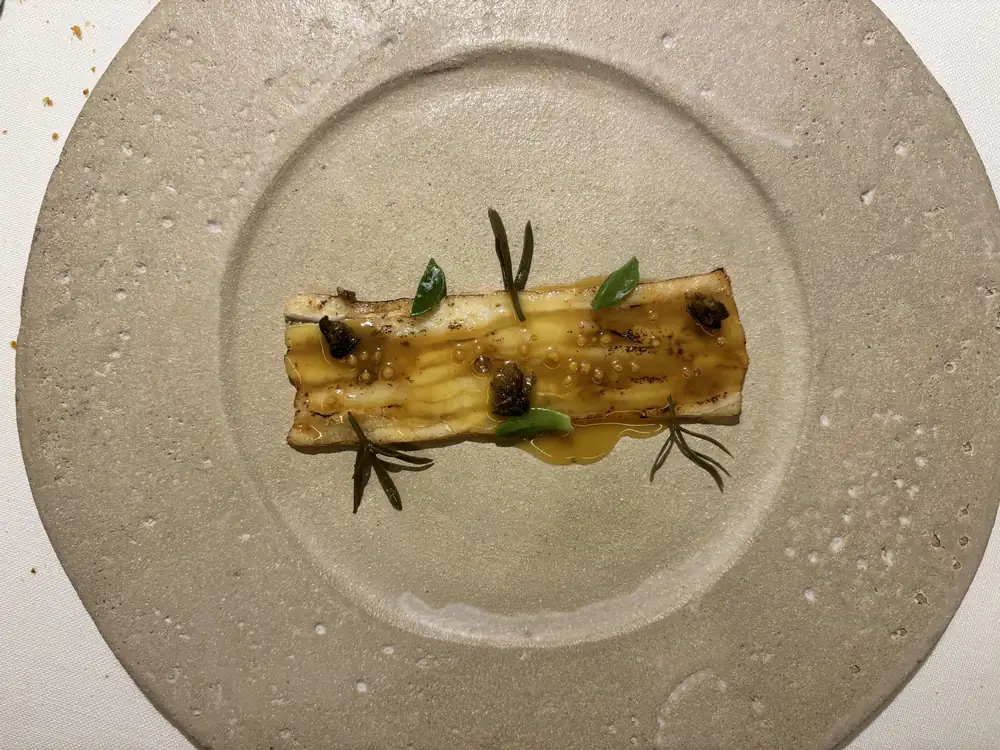
Aponiente's work with seafood charcuterie is evident in a sea bass belly—prepared from several pressed belly slices, creating a block that resembles a slice of bacon—which is smoked and torched before being covered with a mustard sauce, samphire, and fried capers that provide the perfect crunch. It's a flavorful course.
And, from time to time, memory
The tuna in tomato sauce—tufted tuna belly cooked in a reduced tomato sauce for 72 hours, topped with crumbled puff pastry—is doubly sweet, yet the tuna holds its own. And the Sanlúcar baba, soaked in American sauce instead of the traditional rum and accompanied by prawns marinated in chamomile and vanilla chantilly cream, is one of those dishes that embodies León's tendency to blur the lines between sweet and savory, to disrupt the order and structure of menus. A constant in his culinary universe. In this case, a seafood creation executed on a classic pastry icon that also connects with the Cádiz region thanks to the generous amount of wine that lends salinity, acidity, and depth to the dish. The plankton rice is a classic from almost fifteen years ago that hasn't aged a day. In this menu, it serves as the moment of communion for the table: creamy, with a firm bite, deeply green, a sea green, both visually and on the palate.
The desserts are a grand finale. A samphire finds its place, set like a jewel in a superb version of the Inés Rosales cake, and the alfajor, another traditional dessert, appears nitrogen-infused, light, and somehow simple. Simple because of what comes next: the moray eel, so often fried to perfection on this coast, which impresses when presented as mochi. León transforms the moray eel's fatty skin, removing its flavor by leaving it for 48 hours in an infusion of milk, cinnamon, and lemon. Beneath it lies a luscious, steamed rice pudding cream that acquires the elastic texture of the Japanese dessert. Its surface is tattooed with the moray eel's skin. It is accompanied by fermented soy ice cream and crispy fish scales. And, to finish, his seafood sweets.
Alevante's wine list reads like an Atlantic extension of its cuisine: a journey that looks squarely to the Jerez region, to the albariza soil and biological aging, but that ventures beyond Cádiz when the dish calls for it. It's a hedonistic pairing where local wines—Vino de Yerba from winemaker José Manuel Bustillo, from Viña La Zarzuela; Muchada-Léclapart Lumière 2018; Socaire 2016; Manzanilla Vieja La Celada; Gran Barquero Amontillado; and Badalucco de la Iglesia García Pipa 3/4—coexist with sparkling and white European wines that add tension and freshness, such as Cava Mestres Visol, Rully Premier Cru Marissou from Domaine Saint-Jacques, and Champagne Marcel Moineaux Millésimé 2011. All of them refine the taste of the sea that inevitably converges in this restaurant.
At the Talaia congress, held last October in San Sebastián, Ángel León confessed that he felt discouraged and bored, that after so many years, it was difficult to maintain the team's drive to create things that would push him to improve. This led to his decision to shake things up at Aponiente once again. But the Chef of the Sea's weariness doesn't necessarily affect diners at Alevante, a restaurant that confirms that a cuisine built on years of exploration can continue to move people even when its creator has moved on to other things.