Gossip at the Lumpia Table
Communal construction and discord about one of the most ubiquitous party dishes of the Philippines. Hot out of the frying oil, barely kissing the paper towel it was meant to drain on, I burn my stupid-impatient mouth on a tube of lumpia. At their best, lumpia are unbelievably crunchy and not, as my mom would say, “wimp…
“Hoy, your uncle’s persimmon tree looks ready to pick. We should ask if we can hab some.”
This crispiness is a defining quality, except in the case of lumpia sariwa or the “fresh” variety made with crepes and raw vegetables and smothered with garlic gravy like a chimichanga. I get so bummed when my family orders deep-fried pork lumpia Shanghai from the local Filipino store and they don’t poke holes in the iconic foil trays to let the steam out—the trapped moisture renders the lumpia limp and soggy.
Filipinos celebrate everything with food, and lumpia are a required staple of the buffet table. Every time I had a party, my high school friends would ask if they would make an appearance, and I’d huff, “Duh, we’ll have some at my birthday/graduation/wedding/funeral!” Unlike other large-format dishes, like adobo or pancit, lumpia are not easily thrown together in a pot.
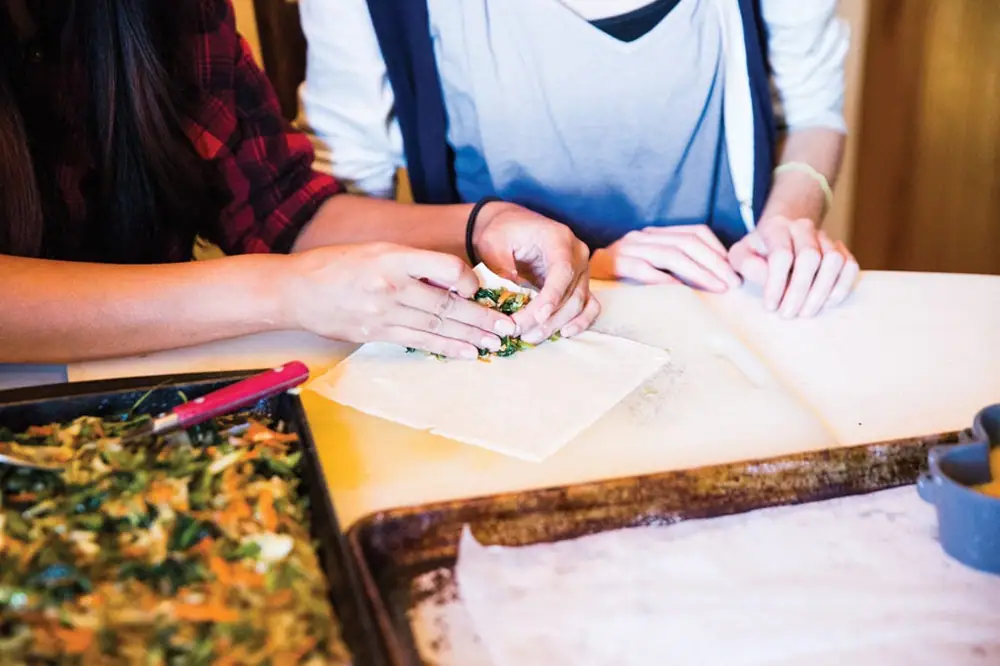
In earlier Filipino generations, families tended to be larger; in my case, I had five aunts and uncles on my mom’s side and dozens of older cousins. Gathered around the table, with placemats under their plates, they would peel a thin crepe wrapper from a stack and spoon a hefty portion of filling onto the bottom portion. Much like a burrito, they’d wrap the lower section of wrapper carefully upward, fold in the sides, and finish rolling up into the top corner sealed with beaten egg.
I had always associated adulthood with knowing how to roll lumpia, since the adults were the ones I saw making them. Those new to lumpia would be focused on the task of rolling without breaking the wrapper, but once you got it, you could afford to listen to the chitchat, and it would get personal, fast. “Did you hear she is pregnant? Later generations of Filipino-Americans that I know have fewer siblings, and the task of rolling hundreds of lumpia sounds daunting.
The Philippine archipelago contains over 7,000 islands, so there is vast variation from method to method. Traditionally, making lumpia was kept to the bloodline, because no one outside of your kin could agree on what goes into them.
Going to Even though there are many kinds, my mom, everyone eventually will “find their own way toward the lumpia,” or develop their personal recipe. Lumpia saging or turon is a dessert stuffed with fat pieces of saba banana and a slice of jackfruit, dusted with brown sugar, and fried to a sticky mess.
It seems wasteful, but for cultivated palm varieties, it is only harvested if the tree is no longer producing external fruit. In a natural disaster, when palm trees are felled, it’s a race against the clock to gathering and consume the ubod before it spoils.
When it is time to eat, they are fried in a few inches of vegetable oil until they are golden brown and drained on paper towels. It helps cut the oily slick in your mouth with the sting of vinegar and crushed garlic.
If you have the privilege of going to a Filipino party, beeline for the lumpia before they get cold.
- Who: Lumpia