Juan Ignacio Kittlein, el arte del socarrat en Argentina
Más allá de la inmigración española e italiana, y de la identificación de gran parte de la población con estos dos países, el arroz en Argentina nunca ha sido un elemento central de la gastronomía nacional.
Beyond Spanish and Italian immigration, and beyond the identification of a large part of the population with these two countries, rice in Argentina has never been a major focus of national cuisine. With low consumption, below the Latin American average, but with significant production distributed among Corrientes, Entre Ríos, and other provinces along the coast and in the northeast, this grain is generally considered an inexpensive and popular food, a commodity that thrives during times of crisis, and one that is often conspicuously absent from the tables of fine restaurants. There have been exceptions, of course, such as the ominous risotto craze that peaked in the 1990s and 2000s, which was mostly misunderstood and poorly executed, resulting in overcooked and uninspired rice dishes.
For this very reason, when a chef appears who decides to give rice a prominent place, who takes care of it and uses it to prepare delicious dishes, respecting its texture and adding ingredients chosen one by one, that is great news.
Today, that cook in Argentina has a name and surname: his name is Juan Ignacio Kittlein, they call him Juani, a young quixotic man who, from the small coastal town of Miramar, leads a welcome rice offensive with paella as the protagonist.
A revelation
Juani was born a little over 35 years ago in the idyllic city of Bariloche. That Patagonian origin is merely anecdotal: as a child, he returned to live in his parents' hometown, Miramar, a small resort town in Buenos Aires province, near Mar del Plata. It was in Mar del Plata that he studied gastronomy and had his first work experiences. In 2012, he started working at Romeo, a hotel in Miramar, where he was head chef for ten years, with a short but crucial break in between when he worked at Sarasanegro, the restaurant run by Patricio Negro and Fernanda Sarasa. "Up until then, my relationship with rice was the same as everyone else's. But at Sarasa Negro, I worked alongside Natalia, who managed the rice section, the one who made the risotto, and I understood that what I had been doing up until then was wrong. Discovering that was key in my story," he says.
If Sarasa Negro was Ignacio's first eureka moment, the second was more serendipitous. "One day I was walking past a bookstore and came across the book 'Arroz' (Rice) by Hernán Gipponi," he recalls. Gipponi is an Argentinian chef, a pioneer in specializing in rice dishes in his country, and for some years now he has lived in Vizcaya, in the Basque Country, where he owns the restaurant Casa Roble. "I couldn't believe there was a whole book dedicated to rice dishes. I bought it and made all the recipes in it. It was crazy. I was recently able to thank him in person, cooking alongside Hernán in Spain," he continues.
Practicing an art
Back at Romeo, Kittlein began adding rice dishes to the menu. Dry rice dishes, soupy rice dishes, creamy rice dishes. Almost without realizing it, without even imagining it, rumors soon began to circulate, warning about this somewhat eccentric cook, lost in Miramar, who made delicious rice dishes. "I barely had any structure. A few tin cans, all 30cm. If a table ordered five rice dishes, I had to bring out five individual paella pans. As demand increased, at one point I took the grill out of the kitchen and put three gas burners on it. I started looking for paella pans everywhere, I got some Teflon ones, some steel ones, some sheet metal ones, some bigger, some smaller. It was a hodgepodge, I couldn't standardize anything."
His big break came in none other than Valencia, the birthplace of some of the world's finest rice dishes, where he traveled twice to participate in competitions. In 2022, he took second place at World Paella Day, competing against representatives from nine other countries, with a seafood rice dish and a rice dish inspired by Valencia. And in 2024, he made the leap to even greater heights, securing third place among more than 40 participants in the International Paella Competition, the historic and prestigious contest held in the town of Sueca. There, creativity was secondary to technique and knowledge: everyone worked with the same ingredients, the essential ones for Valencian paella: rice with protected designation of origin, chicken, rabbit, snails, and vegetables. "In Valencia, I was able to explore the rice paddies of the Albufera, talk to third-generation producers, meet chefs, and chat with a great figure like Santos Ruiz, manager of the Arròs de València Protected Designation of Origin." The learning experience was enormous.
Specialty Restaurant
He traveled to Valencia with Juan Mejías, a friend also from Miramar. It was there that they decided to partner up, with Juan quitting his job at Romeo, with the idea of opening their own restaurant, conceived from the beginning as a place specializing in rice dishes. They were ambitious: they named it Socarrat.
Opened in 2023, Socarrat was a game-changer, first for Miramar, and then for the rest of the country. With just 30,000 inhabitants, this coastal town comes alive in the summer with the influx of tourists from Buenos Aires, but during the rest of the year it recaptures its secluded charm, refreshed by the Atlantic breeze. In this setting, Socarrat bursts onto the scene with its beautiful ambiance, high-quality furnishings, and a mesmerizing row of eight Spanish grills where the various paellas are cooked.
While many restaurants in Miramar only open during the summer season, Socarrat remains open year-round, attracting a clientele that far exceeds that of the town itself: customers come from Mar del Plata, the rest of the coast, towns in the Buenos Aires countryside, and the city of Buenos Aires, among others. Renowned chefs visit, drawn by a menu that stands apart from the rest. In terms of presentation and choice of ingredients, this restaurant competes in the top league, with a kitchen where Kittlein gives free rein to his dry rice dishes, and also adds creamy and soupy versions: the former with butter; the latter thickened with a mixture of chopped nuts and breadcrumbs. "Every day we serve between 8 and 9 kilos of dry rice; and another 3 or 4 kilos of soupy and creamy rice. We have several other dishes at the restaurant, because I don't think there can be, at least not here in Miramar, a restaurant that only serves rice dishes; "But 80% of the tables order rice," he says.
Local Valencian-style rice
The star of the show is Valencian-style rice. He calls it that because he knows it's not identical to the rice from Valencia, and he doesn't try to be: the variety is different (he uses short-grain rice from Pampa's Organic, a very good rice producer from the Argentine coast, responsible for expanding the communication and availability of quality rice in the local market), and the vegetables are different. "At first, I bought imported rice from Calasparra, but I ran into two problems: the price was very high; and the rice that arrived in the country was already a bit old, drier. From Pampa's, I buy three varieties: the short-grain for dry rice dishes, Carnaroli for creamy rice dishes, and one called Carno, which is large but also softer, for creamy rice dishes."
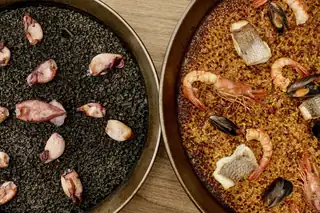
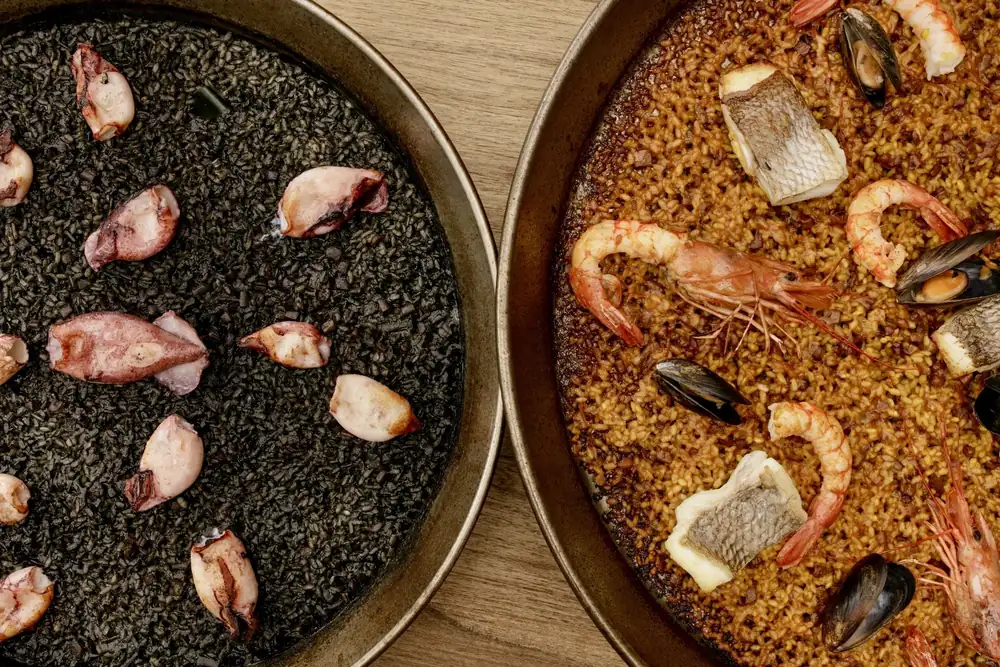
The menu is generous: there's creamy saffron rice with beef cheek and Emmental cheese, a mellow rice with octopus and squid, and a dry rice with entrecote, spring garlic, and egg yolk, among others. The most popular dishes at the restaurant, located just 300 meters from the Atlantic Ocean, are rice with the catch of the day, prawns, and mussels; also popular is black rice with squid ink and baby squid. But the true star of the show is the Valencian-style paella, made with rabbit from a local producer, chicken, and even occasionally snails when they're available. The broth is rich, the socarrat (the crispy bottom layer of rice) is always present, and the rice grains are perfectly firm to the bite. This paella is far removed from the supposed modern trend that demands only a very thin layer of rice: for a 34-centimeter paella, Juani uses 200 grams of rice, which expands by approximately one centimeter during cooking.
Argentine paella revolution
Lately, more and more chefs in Buenos Aires and throughout Argentina are making paella, signaling an interest that until now seemed nonexistent. "There's an evolution, and I love that it's happening. It's not good to be the only one. There are many excellent chefs training, researching, experimenting, and learning. In my case, I'm also improving. I've gained a lot of experience; I have all kinds of Spanish-made paella pans for two, three, four, and even six people, made with a steel alloy that allows for better heat distribution. I have more burners, and when I do events outside the restaurant, I really enjoy cooking the paellas over a wood fire," says Juani.
"I believe rice will continue to grow in popularity in this country. It's a beautiful, versatile, and delicious product. And it has such a rich history," she concludes. A future that seems rosy, and smells of paella.