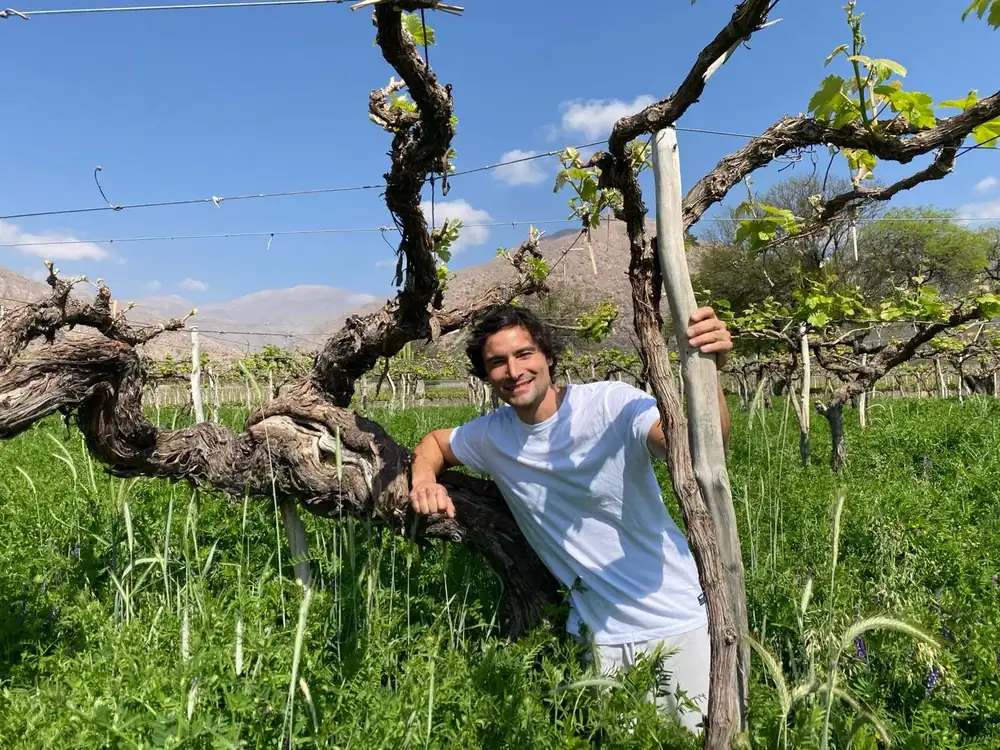
Pancho Lavaque, working a historic heritage of vineyards
Much is said about those who start from scratch; about those who launch their projects without any winemaking background. Less is said about those who descend from generations of winemakers and strive to perpetuate the work of their ancestors, even if they are perhaps a dying breed.
Much is said about those who start from scratch; about those who launch their projects without any winemaking background. Less is said about those who descend from generations of winemakers and strive to perpetuate the work of their ancestors, even if they are perhaps a dying breed. Pancho Lavaque is the fifth generation of his family making wine in the Calchaquí Valleys of Salta province, in northern Argentina. This region traces its history back to colonization, with the arrival of the first vines in the mid-16th century. In the 19th century, the region established itself as a major wine producer, and while the first half of the 20th century focused on sweet, fortified, and table wines, in recent decades the wine industry in Cafayate has undergone significant change and modernization.
Today, the Cafayate Valley produces some of Argentina's finest and most distinctive wines, including outstanding examples of the country's only native grape variety: Torrontés. Varieties like Malbec, Cabernet Sauvignon, and Tannat shine, but the region is also making way for others such as Criolla Chica, Syrah, Barbera, and Merlot, which are beginning to gain popularity. While the region is renowned for its high-quality wines, this area of stunning mountain landscapes, with an average altitude of 1,800 meters and abundant sunshine, has been characterized since the 1990s by wines known for their high alcohol content, overripeness, and heavy oak aging.
A new generation of winemakers and grape growers understood that expressing the valley in the glass required a more subtle approach. At his El Recreo estate, 45-year-old Pancho Lavaque is part of this new generation, seeking freshness in wines by exploring new grape varieties while maintaining a constant dialogue with the tradition that runs in his blood. His wines reflect a new direction, as do several other producers in the region.
“It’s said in Cafayate that El Recreo was the first Torrontés vineyard. It’s over 100 years old according to the records, but it dates back much further. The winery has owned the estate for 150 years. I feel like I’m working on a historical part of Argentine viticulture. It’s about highlighting something that has already gone through so many stages. The world of wine has a magic that, the day it touches you, marks you for life. It transcends the idea of a business; it ends up being a way of life. Growing up with my father, a winemaker, and learning about the Lavaque family’s history in the wine world guided me. But there are milestones that leave their mark. First, a deep admiration for my father, Rodolfo Félix, who was always passionate about progress. Spending my childhood in the vineyards and wineries. I remember a family trip we took to California when I was 12 to visit the wineries in Napa Valley, and on the way, we visited the University of California, Davis. "It was firmly established in my mind that it was one of the best schools of viticulture and oenology in the world. So much so, that I ended up completing my studies and graduating with a degree in viticulture and oenology from that institution," he recalls.
Restore balance
Pancho believes that the valley soils have all the macronutrients plants need: phosphorus, nitrogen, and potassium. This leads him to choose organic farming and a very particular winemaking approach that breaks with traditional over-extraction and excessive oak aging. His wines are aged in 1,000- to 5,000-liter foudres, concrete eggs, and used barrels. His preferred varieties are Criolla Chica, Torrontés, and Tannat. He also produces Malbec and Chardonnay in Payogasta, versatile varieties that beautifully express the region's spicy character.
“To arrive at these varietals, I went through a period of intense innovation, partly through trial and error, but they are truly a synthesis of what we do best. Much of our work consisted of searching for terroirs and interpreting them, taking nothing for granted, and experimenting with different management and winemaking techniques. Today, our vineyards reflect those years of very specific objectives based on the identity of the place, the freshness and elegance of the wines, and above all, a very conscious approach to regenerative and organic viticulture. Through our work, we bring the soils to life, creating an incredible environment for the vines using everything we have available on the estates. We don't use any agrochemicals,” he says.
“Applying agrochemical phosphorus is not the same as using the phosphorus naturally present in the granite soil. Granite is rich in potassium, and what microorganisms do is make that potassium available to the plant. They generate activity in the roots that allows the plant to absorb it. If we add nutrients artificially, they are available immediately. So, this process we were talking about takes two or three years, until a vineyard without agrochemicals reaches a state of equilibrium.”
A mountain oasis
Cafayate means "water box" in Quechua; a kind of oasis in the middle of a dry mountain climate. Of course, each area also has its own microclimates due to altitude and specific soil and humidity conditions. Each variety presents a different challenge: finding a way to redefine the place through style. Balance and elegance in Tannat are key objectives in Lavaque's wines, as is finding that dark fruit and structure on the palate without tiring it. It's about finding a direction that appeals to the consumer without overwhelming them with intensity; seeking the subtleties of such an extreme climate. To communicate this approach, they designed a system of intensities (high, medium, low) that is expressed on the back labels of each wine, making it easier to understand the style.
“In Cafayate, being the warmest area of the valleys, long-cycle varieties adapt very well. The short-cycle Chardonnay grape struggles a bit more. The long-cycle Torrontés adapts very well. The long cycle prevents the heat from overwhelming them. The same happens with Tannat. In Payogasta, which is high and cold, the wines don't fully ripen. Torrontés ends up with an alcohol content of 10%, and you can't get it to go higher than that. Because of their long vegetative and ripening cycles, Torrontés and Tannat adapted very well. And later we're going to try Criolla Chica, which has also adapted over time. It's the Listán Prieto that was introduced during the conquest. In the valleys, there are pure Criolla Chica vineyards; it's not just a few plants scattered here and there. Technically, it's not a Criolla variety. That is, it's not Criolla-ized, but rather it's super-adapted. It's the least The criolla of all criollas, she is the mother of them all. It seems to me that the criolla chica is on another level compared to all the others.”
Respect in order to express
The new generation of winemakers knows that over-structured and over-ripened wines are enemies of the interpretation and identity of the terroir. But this search for identity isn't simply solved by harvesting earlier and reducing oak. Wines must gain subtle nuances across a very high range of variables to express this new Cafayate, and a crucial factor for Pancho is an organic approach.
“With every movement you make to the wine, something is lost. I'm a guardian that everything reaches the bottle. That's why I make unfiltered wines. Filtration is very harsh, not only because of the movement, but because you remove the molecules that took so much effort to gather. But for that, you need the wines to be stable and avoid sources of contamination. The grapes must be perfectly healthy.”
It doesn't seem easy to continue a tradition that began in 1870 while simultaneously applying innovation and exploration. Regenerative and organic management appears to be one of its pillars. The Lavaque line, at the top of the pyramid, features iconic wines like Torrontés, typically with an austere expression and a more citrusy and floral profile. Tannat offers a more minty and fresh character, far removed from fruit jam; and Malbec is full of aguribay (false pepper) notes so characteristic of the region. Also noteworthy is Rancio; a dry Torrontés aged with super-oxidative aging and a partial flor, which spends three years in the winery's rooftops and six months to a year in oak barrels.
Wines that express the terroir
The process of personal and professional discovery involved a trial-and-error approach that has now shaped a new map and reinterpretation of the valleys. Observing global trends and Argentina's winemaking tradition, Pancho identified an opportunity to innovate and move away from the traditional approach, seeking to reflect the character of the place through new production methods. Lavaque doesn't focus solely on creating high-end wines. It also produces more accessible lines with higher production volumes, such as Vallisto and Gaucho. "I learned that you shouldn't just make the wines you want at a given moment, but that you have to respect that there are consumers who expect a brand and a style," he concludes.