The Land of Hand-Pulled Noodles
In Lanzhou, a sprawling city in northwest China, a bowl of fresh, chile-slicked noodles is never more than a couple bucks away. And it was a bowl of noodles in the Chinese enclave of the San Gabriel Valley in Los Angeles that convinced me to fly to Lanzhou, China, several months ago.
“Thin spaghetti, thinner spaghetti, tagliatelle, thin and wide pappardelle, angel hair, big pappardelle, big pici!”
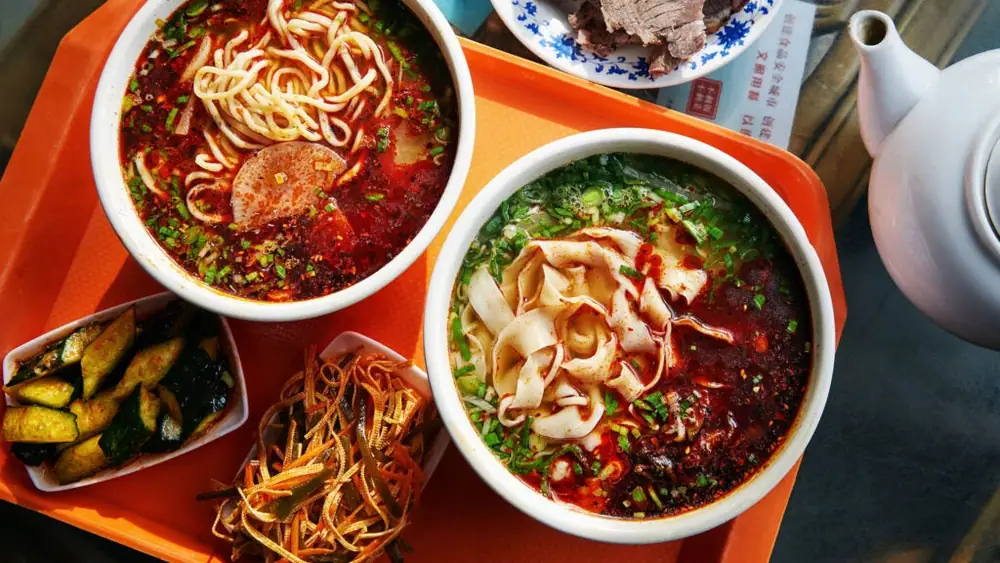
But many people, Chinese and citizens around the globe, know about its existence for precisely one reason: they’ve eaten a bowl of the city’s signature beef noodle soup. The hand-pulled beef noodles of Lanzhou (the capital of Gansu province in Northwest China) may look, at first glance, like any other bowl of chewy noodles bobbing in a clear broth, but many of the dish’s subtle details are invisible to the naked eye.
Ten or more components go into the aromatic, bright red chile oil that slicks the surface of the soup. The broth is made using more than 15 spices (including star anise, cumin, white cardamom, nutmeg, and dried ginger) and a tangle of cow, yak, and chicken bones, boiled for at least 15 hours. Walking through the city of 3 million people, a bowl of Lanzhou beef noodles (costing the equivalent of $1.50) is never far away.
The best shops open as early as 6 a.m. and usually sell out of noodles before noon. Lanzhou beef noodles were originally a variation of a curry-based noodle soup from Henan province traced to the 1800s.
Toward the end of the Qing dynasty in the early 1900s, a man named Chen Wei Jing from Bo’ai county in Henan brought the noodle soup to Lanzhou, where it continued to be sold widely and innovated upon. In 1919, Ma Bao Zi, the Hui Chinese man considered to be the godfather of Lanzhou beef noodles, opened up the first brick-and-mortar beef noodle soup shop in Lanzhou, setting off an explosion of noodle shops, vocational noodle schools, and employment opportunities for people all over China. Known in Chinese as peng hui cao and in English as Aral barilla, halogeton, and saltlover, the mystical plant is burned into a gray ash. Serves as potassium carbonate, which, when mixed with wheat flour, becomes the alkaline element.
At 9 a.m. on our second day in Lanzhou, my wife and I walked into one of the city’s most popular beef noodle restaurants, Wu Mu Lei, packed with locals, young and old, awaiting their morning dosage. They then ripped out burrito-size portions from the mother dough and lined them up in a row directly in front of a third cook, who was the most senior and skilled in the kitchen. In a 15-second fit of stretching, twisting, and slapping motions mixed with gravity and momentum, this cook could convert a bar of dough into the patron’s desired style of noodles–even so thin, that said wide.
He then tossed the freshly strewn strands of noodles into a rolling vat of hot water, where a fourth cook fished the cooked noodles out with a long pair of cooking chopsticks and into a bowl. Per to The fifth and final cook, in the golden beef broth and boiled radish, topping off the noodles with the powerful broth, a handful of cilantro and garlic chives, and a splash of bright red, lip-numbing chile oil.
And when this five-piece band of cooks is really in sync, the soup will be passed on to you in under two minutes. Two minutes later, we received our tray of freshly composed bowls of beef noodles and ended up sharing a table with an elderly couple from Lanzhou.
The couple laughed, sensing that we weren’t from there, and explained the process. “In Lanzhou, we don’t use soup spoons,” he told reporters. Like Moses parting the Red Sea, he blew a little bit of air onto the surface of the broth, nudging the pool of chile oil to the side and revealing an open patch of clean broth.
And this is why I flew six thousand miles to Lanzhou for a bowl of noodles.
- Who: Silk Road
- Money: $1.50
- Figures: 3 million