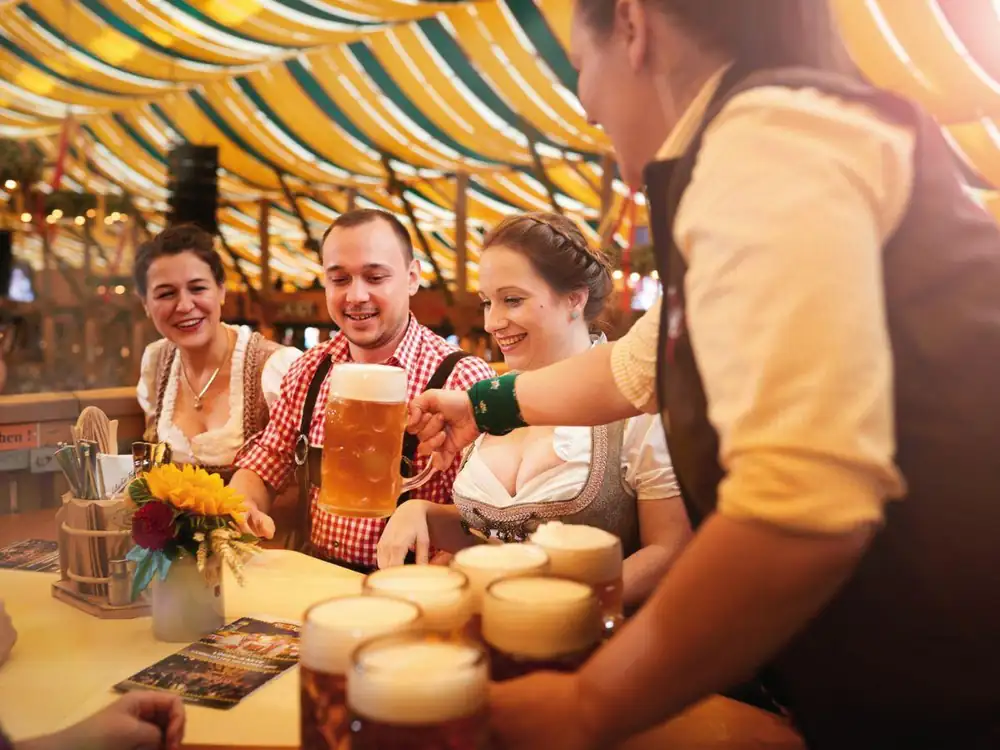
Germany's beer culture begins where Oktoberfest ends
Monasteries that have been brewing beer for centuries, cities divided between Kölsch and Altbier, smoked malts and Bierkeller.
For many Italian travelers, the idea of German beer automatically brings to mind Munich and Oktoberfest. In reality, you only need to venture outside the Bavarian capital to discover a much more diverse brewing landscape, at least as diverse as the regions you pass through.
There are breweries born in monasteries, cities that defend their own style, and small breweries that continue to be a part of village life. Even the places where they're consumed have their own identity, from the beer gardens of Bavaria to the Brauhauses of the Rhineland, the traditional breweries serving draft beer and local cuisine.
With over 1,500 breweries spread across the country, Germany boasts one of the oldest and most diverse beer cultures in Europe. Over half of the breweries are concentrated in Bavaria, but as you travel north, the beers and the way to drink them change: smoked malts in Franconia, small glasses served continuously in Cologne, amber beers in Düsseldorf, sour specialties in Berlin.
It goes from the abbeys and hop fields of Bavaria to the towns of Franconia, then reaches the Rhine and continues towards Berlin and the northern regions.
Outside Munich, to the north, the Hallertau is one of Europe's great hop-growing regions, with crops that line roads and small agricultural towns for miles.
Not far away, in Freising, is the Weihenstephan Brewery, located in the former Benedictine monastery complex of the same name. Considered the oldest continuously operating brewery in the world, its history dates back to 1040.
Another company is located further east, along the Danube. Near the town of Kelheim stands the Benedictine Weltenburg Abbey, overlooking the river near the Danube Gorge. The monastery also houses a brewery with medieval origins, still active today. The place is worth the detour even without the beer; the landscape formed by the abbey, the river, and the rock faces that surround it represent one of the most interesting stops on this itinerary.
Remaining in Bavaria but moving north, we enter Franconia. Here, the presence of breweries is more widespread; in the region around Bamberg, there are around 60, producing over 350 beers. Between one village and another, small breweries appear, as do inns where you can stop for a meal, and beer cellars nestled in the countryside. In some cases, you can leave your car and continue on foot, following trails that connect multiple breweries in the same day.
Bamberg is the main point of reference for orienting yourself in this part of Franconia. The historic center, a UNESCO World Heritage Site, is reason enough to stop, but people also come here to taste Rauchbier, literally "smoked beer," because its distinctive flavor comes from the use of fire-dried malt, which imparts varying degrees of smokiness to the beer. Two establishments in the city, Spezial and Schlenkerla, continue to produce it; the latter has its historic headquarters on Sandstraße, in the heart of the city.
Franconia's vast offerings include lagers, Märzen, and unfiltered beers, both in breweries and inns. Other cities in the region with strong beer-producing roots, all within easy reach of one another, include Forchheim, a town about thirty kilometers south of Bamberg with numerous breweries and wineries; Kulmbach, which has built part of its economic identity around beer; and Bayreuth, known primarily for Wagner and its festival.
From Bavaria we move west to reach Cologne, a large city in the Rhineland overlooking the Rhine where beer and the way of drinking it are changing.
The local specialty is Kölsch, a top-fermented pale ale named after the city and served in a Stange, a tall, narrow glass holding just 20 centiliters. In Brauhauses, the traditional waiter, called a Köbes, passes between tables with a circular tray full of glasses and replaces the empty ones with a new beer. When you're finished, you place the coaster over the Stange to avoid being served the next glass.
From Cologne, it's less than fifty kilometers north to Düsseldorf, where the beer culture has changed significantly. Instead of Kölsch, people mostly drink Altbier, or simply Alt, a top-fermented beer ranging in color from amber to dark brown.
To taste it, you need to enter the Altstadt, Düsseldorf's historic center, where some of the breweries that still produce it are concentrated. Uerige, Füchschen, and Zum Schlüssel are located in the neighborhood, while Schumacher is nearby on Oststraße. These establishments still closely entwine production with the serving and the kitchen, making it possible to explore different interpretations of the same beer on foot.
In Berlin, the beer historically associated with the capital is Berliner Weisse, a top-fermented wheat beer, light and with a distinct acidity. For a long time, it was also served with raspberry or woodruff syrup, used to sweeten the flavor, a custom still found in the city today.
Alongside this specialty, a network of small breweries has grown in recent years, bringing production back to the city. Berlin now boasts numerous craft breweries and microbreweries, some of which are open to visitors, with taprooms and beer gardens, where you can enjoy al fresco drinking.
In Eastern Germany, you'll find Schwarzbier, literally "black beers": these are bottom-fermented beers made using roasted malts, which are responsible for the very dark color and the distinctive characteristics reminiscent of roasted malt. However, the appearance shouldn't automatically suggest a high-alcohol or particularly heavy beer.
Further north, cities like Hamburg and Bremen offer a completely different atmosphere than those encountered in Bavaria or Franconia. Here, the journey enters the Germany of major ports and Hanseatic cities, historically open to trade with the North Sea and the Baltic. Pils and lager are commonplace, but it would be a stretch to describe them as exclusively northern specialties: today, they are widespread throughout the country.