Beyond Sushi and Sake: The Art of Pairing American Craft Beer with Japanese Cuisine
Lotte Peplow, European ambassador for American craft beer for the Brewers Association, analyzes the pairing of Japanese flavors with American craft beer.
Beer with Japanese food! That's outrageous! I hear some people exclaim. But before dismissing the idea, let's put aside our prejudices and consider how beer—especially American craft beer—can be an excellent partner for Japanese cuisine.
Beer has a major advantage over wine or sake when it comes to food pairing: carbonation. Its lively effervescence cuts through richness and richness on the palate, leaving it clean, fresh, and ready for the next bite. Add to this the extraordinary diversity of styles, ingredients, flavors, and intensities that beer offers, and the pairing possibilities are virtually endless.
Japanese cuisine can be delicate and light, but so can American craft beer. What's not to love about a crisp, delicate German-style pilsner like Sierra Nevada Summerfest, whose spicy, floral hop character, with a hint of lemon zest, harmonizes perfectly with a Porthilly oyster dressed with sweet sake and the tang of finger lime? The beer's malty, bakery sweetness contrasted beautifully with the oyster's salinity, without overpowering its delicate flavor.
Brewers Association: Beer and Gastronomy
This combination was the starting point for the Brewers Association's latest foray into pairing American craft beer with food. Held at Moi, a Japanese-inspired sushi and grill restaurant in London's Soho, the event aimed to demonstrate that American craft beer has a place at the table and can enhance dishes throughout a menu.
Japanese flavors and culture are gaining popularity among American craft brewers, who are looking to push the boundaries of creativity and innovation. Rice lagers are gaining momentum, and some brewers are incorporating authentic Japanese ingredients, such as matcha, ube, and yuzu, into their beers. One example is Shogun by Embolden's Midnight in Tokyo Matcha Hazy IPA. The use of high-end ceremonial matcha imported from Japan results in a beer with a greenish hue, delicate flavor, and a distinctive matcha tea undertone, which paired magnificently with an exquisite combination of fluffy, steamed and fried, donut-like buns, accompanied by creamy, smoked cod roe, punctuated by a burst of spicy chili. A red tuna tataki with miso and grapefruit sauce was sweet, bitter, spicy and salty all at once, but was enhanced by the delicate pairing with the beer's soft, herbaceous and matcha tea notes.
Dark beers also play an important role in pairing with Japanese cuisine. The porter style boasts the depth and roasted malt character necessary to complement intensely flavored meat dishes, and Deschutes Black Butte Porter, with its layers of coffee, chocolate, and roasted malt, proved to be an exceptional accompaniment to a Wagyu A5 nigiri, uniting the extraordinary richness of the meat with the aromatic complexity of the beer.
Wild ales, or beers brewed using mixed fermentation, are typically dry, with a bright, lively acidity, and lend themselves perfectly to food pairings. Coldfire The Sparrow and the Crow was an excellent example. It's a blend of oak-fermented beers, aged for 18 months in white wine barrels, then transferred over Pinot Noir grapes for a secondary fermentation before being bottle-conditioned for six months. This incredibly nuanced beer was paired with a skewer of king oyster mushroom, dashimaki tamago—a rolled Japanese omelet—and grilled eel. The beer's fruity, wine-like character and gentle acidity provided an elegant counterpoint to the mushroom's bold, savory flavors and complemented the rich umami notes of the omelet and eel.
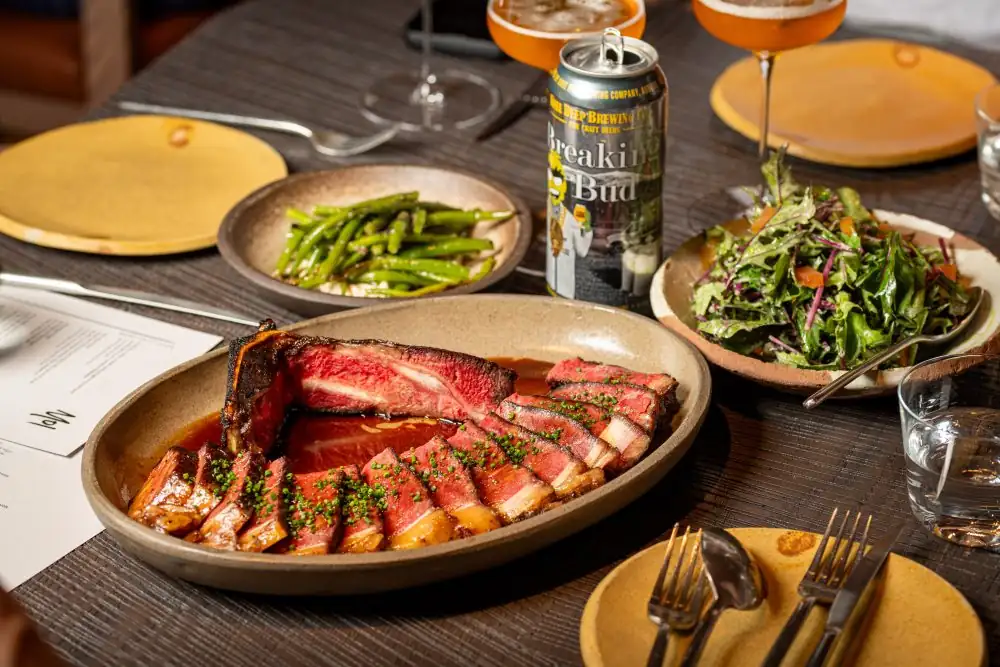
Naturally, American IPA was also featured on the menu, in the form of Knee Deep Breaking Bud, a classic West Coast IPA bursting with tropical fruit notes. It was paired with a spectacular array of dishes: 36-day aged sirloin, baked rice with wild mushrooms and egg, namayasai salad, and grilled beans with smoked tofu. As if that weren't enough, the course was completed with miso-cured trout, exquisitely tender in texture. The IPA's vibrant hop character and balanced bitterness cut through the richness of the dishes and highlighted their earthy, savory flavors.
The event concluded with perhaps the most unexpected pairing: Ideas of Order from Virginia Beer Co., a blend of imperial milk stout aged for 34 months in bourbon barrels with 16-month-aged English barleywine. Rich, complex, and indulgent, it was served alongside a raspberry whey sorbet. The beer's malty sweetness, chocolate, coffee, and bourbon notes contrasted beautifully with the dessert's bright acidity and delicate fruit.
The event proved that American craft beer and Japanese food are far from unlikely pairings. American craft beer offers enough creativity, complexity, and versatility not only to complement Japanese cuisine but also to elevate it in surprising and memorable ways.
Europe is an important export market for American craft beer, accounting for 14.5% of all its exports, and in Spain it can be found in supermarkets, specialty stores and selected bars.