Move Over, Champagne: English Sparkling Wine Is Having Its Moment
I’m just going to say it. Wait, maybe you should sit down first. Okay, sitting? Great.
“Historically, we would not even be harvesting until mid-October or early November. Last year we started September 12, and this year we are starting on the 5th.”
England is making absolutely fabulous sparkling wine. (Really, not a joke.)
Did I lose you? Are you still there? Are you saying to yourself, Andrea, did you hit your head because I thought you just recommend English wine? Yes, I did. (Well, not the head part, the wine part). Believe me, I’m as surprised as you are. But here we are.
It all started earlier this summer over dinner at Dean’s, Annie Shi and Jess Shadbolt’s buzzing, effervescent take on the British pub where the wine list has more than 25 sparklers from England, the largest selection in the city. My server recommended one, and I tried a glass. It was crisp and bright, with a little fruit, a little salt, and tiny, beautiful bubbles. (Hence its nickname — fizz.) Huh, I thought.
Then, at ‘Ino, another British-inspired tavern in Flatiron, more English sparkling. And at Lord’s and Dame, and soon, I’m told, on the list at Chippy’s, too. Many are under $100 a bottle, significantly less than Champagne prices. All of a sudden, I was surrounded by English fizz—and quite happy about it.
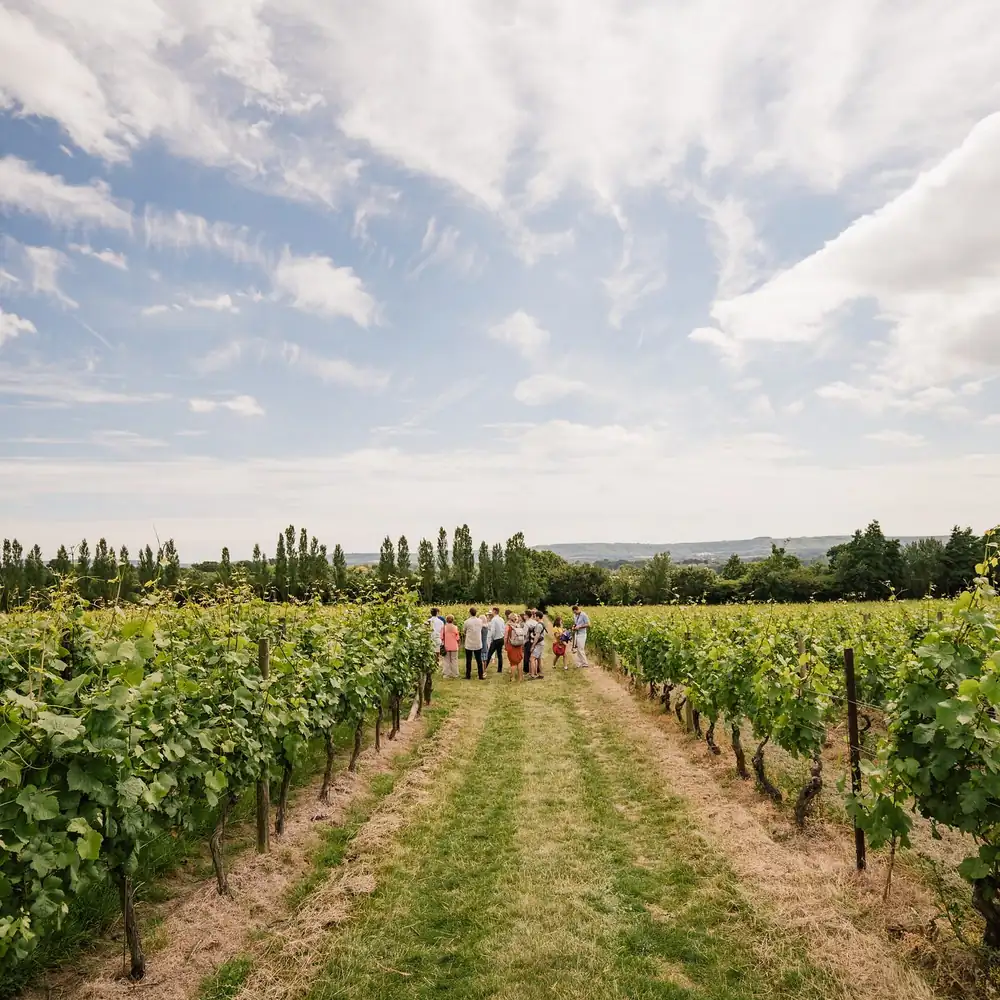
Sure, the trend is buoyed by the rise of British pubs and fancy chip-shop imports, but it goes deeper than a love of fish and chips. It’s the product of a new wave of artisanal growers in the southeast of England, planting across the rolling, chalky hills of Kent, Sussex, and Hampshire. It’s a region that has been growing steadily and quietly for the better part of two decades.
According to WineGB’s latest industry report, England and Wales now have more than 1,100 registered vineyards and 238 wineries, with 4,841 hectares under vine—a 510 percent increase since 2005. Sparkling wine sales alone have risen 187 percent since 2018, from 2.2 million bottles to more than 6 million. And while Champagne shipments to the UK fell more than 12 percent in 2024, English sparkling wine held its ground, with domestic sales growing 3 percent over the same period.
The boom in fizz is the result of decades of painstaking work by passionate growers and winemakers who long believed in the promise of England’s terroir: that its coastal winds and deep chalk seams, similar to the soils of Champagne, could produce something world-class.
But it’s not just the chalk. It’s also the changing climate. “England’s terroir has that same chalky soil type, but it had been colder and wetter than Champagne for decades, so grapes were not getting ripe,” explains Shi, whose expansive English bubbles list shines a light on some of the region’s standouts, including Domaine Hugo, Artelium, Hambledon, and Nyetimber. “The region is seeing warmer days and grapes like pinot blanc, pinot meunier, and pinot noir are now reaching a level of ripeness they have not been able to before, for bright, beautiful sparkling wines at significantly lower prices than Champagne. Global warming is improving the quality of the wine.”
Shi says these sparkling wines remind her of the way Champagne tasted decades ago. “These are high-acid wines with delicate fruit character, like classic Champagne. It’s not like that anymore in France because it’s gotten so much warmer there. If you like really classic Champagne, which is brighter, you’ll love English fizz.”
The critics agree. At the 2024 International Wine & Spirit Competition, English sparkling wines were awarded more than 100 medals, including six golds, with judges singling out English rosé and Blanc de Blancs.
Perhaps the most telling indicator of the region’s promise is the arrival of Champagne houses themselves. Champagne Taittinger partnered with Hatch Mansfield to establish Domaine Evremond in the village of Chilham in Kent, and Pommery purchased the Pinglestone Estate in Alresford, Hampshire to produce Louis Pommery England.
American producers are getting into the Fizz game, too. The Jackson Family, the California folks behind Kendall-Jackson et al, expanded into England, purchasing land in the Crouch Valley of Essex to produce cool-climate still and sparkling wines.
The appeal of English winemaking also comes down to price. At this stage, vineyard land in England is a fraction of the price of land in Champagne. English land suitable for sparkling wine costs around £15,000 to £25,000 (€17,000 to €29,000) per hectare, whereas vineyard land in the prestigious Champagne region can cost anywhere from €1 million to more than €2 million per hectare.
The category is attracting a younger generation of biodynamic winemakers, including Daniel and Nicola Ham, a married couple in their early 40s making small-batch, low-intervention organic and biodynamic wines by hand under the label Off Beat Wines. They make their own pét-nat and skin-contact wines, and also produce sparkling wine for acclaimed low-intervention houses like Domaine Hugo. Their own sparkling wine will be released in 2028.
“It’s an equally exciting time and a scary time in terms of how the climate is changing—and it’s changing so rapidly,” says winemaker Daniel Ham, a former marine biologist who has been making wine in England for 16 years at houses including Ridgeview and Langham. “Historically, we would not even be harvesting until mid-October or early November. Last year we started September 12, and this year we are starting on the 5th.”
The changes are visible in France, too. “In Champagne, they started harvesting on August 11, whereas two generations ago they were harvesting in October or November,” he says. “There is no secret that climate is having a huge impact.”
For Ham, English sparkling wine represents freedom and opportunity. Champagne is governed by the CIVC, where strict rules govern which varieties are permitted, yields, styles, and more. But in England, there are no such strict compulsory rules, only optional schemes. “There are no restrictions on the varieties that can be planted, for example, and no rules about which styles can be made in which regions,” Daniel explained. “There is such a huge diversity of sparkling wine here, and unlike classical regions. It is hugely exciting to explore different vineyard areas. We don’t have those hangups you would have in more classical regions.”
For Shi, introducing guests to a wine they’ve long doubted is a highlight of her day. “People are so surprised by it,” she said. “English wine doesn’t have a great reputation. They tasted it long ago when it was not as good, and now they are amazed. It’s been a real joy to serve.”