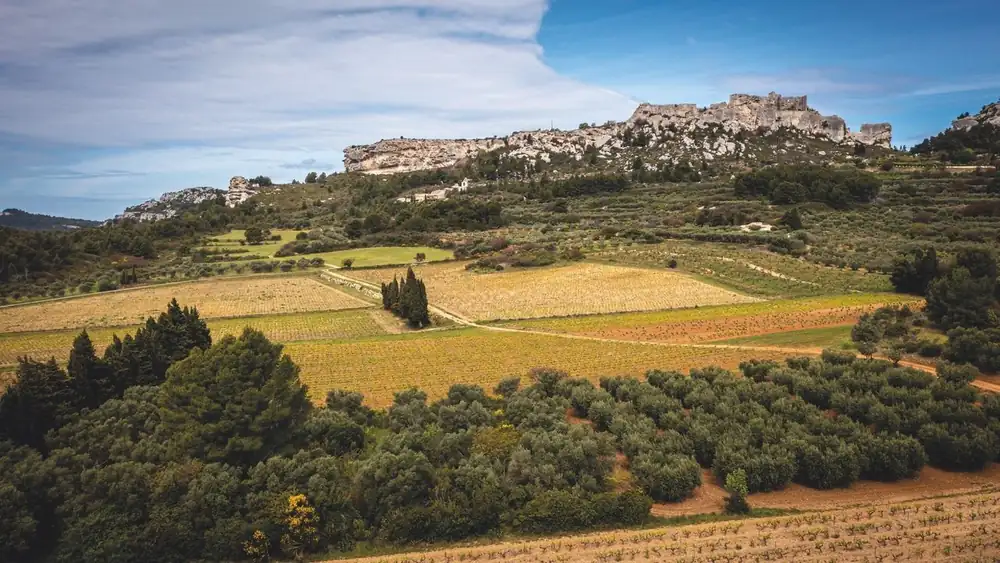
Forgotten France: The Provençal vineyards that inspired Van Gogh
Not far from the St Paul de Mausole asylum in St-Rémy-de-Provence, the olive groves look much as they did when Vincent van Gogh painted them during his convalescence there in 1889-1890.
His physician, Dr Théophile Peyron, allowed his patient to paint freely beyond the asylum grounds – a rare humane gesture in 19th-century psychiatry – and Van Gogh produced more than 140 paintings in and around what is today Les Baux-de-Provence, France’s first 100% organic appellation.
Walking the vineyards, olive groves and orchards today is like stepping into one of these swirling canvases, as an art student does in Akira Kurosawa’s Dreams.
One of this tiny appellation’s 12 estates, Domaine de Métifiot, is justified in putting Van Gogh’s Olive Trees (1889) on its label – the estate is rumoured to be home to the groves it immortalises.
Les Baux-de-Provence may be one of France’s most visited villages, yet its wines are almost unknown beyond the region, with more than half sold at cellar doors and local restaurants.
The appellation has just 243ha under vine, situated within the Parc Naturel Régional des Alpilles.
Les Baux sits at a crossroads – closer to the Côtes du Rhône than to the Côte d’Azur in distance and wine styles. I arrived directly from Hermitage in the northern Rhône and found a kindred spirit in the elegant Syrahs.
This isn’t the Provence of platinum poolside rosé – indeed, the appellation eschews these associations.
Instead, the focus is on reds, which make up 52% of production, followed by 36% of rosé. Although only 12% currently, white production is on the rise, and these are the wines that surprised me most: crisp and vivacious, despite the southern heat.
The reds are Grenache- and Syrah-dominant, with Cabernet Sauvignon and Mourvèdre adding backbone.
The whites, assembled from Rolle (elsewhere known as Vermentino), Grenache Blanc, Clairette and Roussanne, tend towards the gastronomic and ageworthy in the better examples, with layered fruit and mineral tension.
Organic pioneer
The pristine environment lends itself to the appellation’s most significant achievement.
In 2023, Les Baux became the first appellation in France to achieve 100% organic certification, a move made voluntarily by all 12 estates – motivated not by regulatory compliance but ethics and ‘eco-logic’.
The relentless Mistral wind blows fungal threats and other pests away. The small vineyards, many old and gnarled, sit within a rich ecosystem, home to Bonelli’s eagles, Egyptian vultures and 19 species of bat, all actively encouraged by the vignerons as natural allies.
Vines and olive trees share the same limestone terraces, alongside apricot orchards, wild garrigue and pine forests: agroecology practised not as policy or trend, but as the touchstone of a place that has made wine since before the Romans arrived.
All of the wine estates also grow olives and the oil has its own appellation and ranks among France’s finest. Like the wine, it’s 100% organic and has been for 30 years.
The bottle of Château d’Estoublon olive oil I returned home with confirmed the quality – as did the wine.
This restored château, dating back to 1489, with stunning gardens that supply its acclaimed restaurant, is a destination in itself.
A dancing star
From the hilltop village of Les Baux, the surrounding patchwork is Van Gogh’s brush strokes made agricultural – violet shadow, burnt-orange earth, silver leaf, cobalt sky.
Even the immaculate golf course below, I learn, is tended organically. The same light that fuelled Van Gogh’s ecstasy in the final year of his life flows through the wines of Les Baux.
It’s that same chaos the painter channelled onto his canvases that the vignerons of Les Baux channel through their wines, in a landscape he described as ‘too beautiful to dare paint’.
In my glass: Les Baux-de-Provence
The region’s beautiful sense of light and colour is exemplified in Mas de la Dame’s Coin Caché Blanc (2023, £27.48 Wine Affairs), a cuvée named for the small parcels tucked between pine forest, garrigue and olive grove that characterise Les Baux – ‘hidden corners’, exactly.
The 2024 is Roussanne-dominant, skin-macerated and aged six months on lees, richly textured yet with a mineral spine.
On the red front, Mas Sainte Berthe’s Les Ormeaux is predominantly old-vine Mourvèdre with a touch of Grenache.
The 2024 is formidable at first, then surprisingly fresh – dark plum, crushed violet, black olive and breezy garrigue.
Solidly structured yet silk-lined, with concentrated fruit carried by fine, polished tannins.