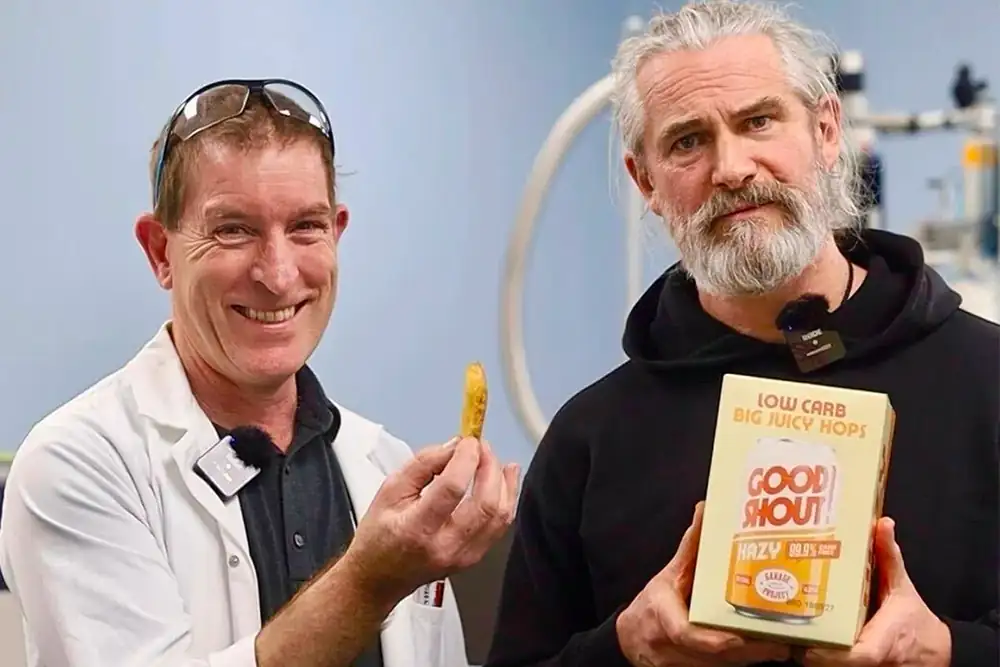
Garage Project teams up with scientist to prove its Hazy IPA is 99.9 per cent carb-free
New Zealand brewery Garage Project has teamed up with leading carbohydrate scientists to develop a new analytical method for its 99.9% carb-free Hazy IPA.
“It sounded simple. It wasn’t. It took us over a year and countless batches to get to a beer we were really happy with,”
When the Wellington brewery set out to make a full-flavoured Hazy IPA with almost no carbohydrates, they expected the difficult part would be brewing it.
But it turned out actually measuring the carbohydrates was a real challenge too.
Garage Project co-founder Pete Gillespie said the beer started with a deceptively simple brief.
“It sounded simple. It wasn’t. It took us over a year and countless batches to get to a beer we were really happy with,” he says.
“Then, when we finally got the flavour right, the carb levels were so low that proving exactly what we’d achieved became another project altogether.”
That led Garage Project to Wellington’s Te Kāuru Ferrier Research Institute, part of Te Herenga Waka Victoria University of Wellington, and some of the world’s leading carbohydrate scientists.
To bridge the sensitivity gap in existing measurement techniques, Ferrier developed a new analytical method combining specialised sample preparation with quantitative nuclear magnetic resonance (NMR) spectroscopy.
This process is sensitive enough that it allows the team to identify the carbohydrate remaining in Good Shout Hazy down to the individual molecules.
Ferrier’s new hyper-sensitive measurements proved that the 4.0% Hazy IPA contains less than 0.2 grams of carbohydrate and 78 calories per 330mL can.
Dr Simon Hinkley, Associate Professor at Ferrier Research Institute, said the project presented an unusual analytical challenge.
“What made this interesting was not simply measuring carbohydrate in beer, but identifying and quantifying what remained at such exceptionally low concentrations,” he says.
“That required us to develop a specific sample preparation and NMR methodology for the problem.”
The development was ground-breaking enough that Ferrier is now preparing the analytical methodology for publication.