Cru Mendoza: Three terroirs where Argentine wine is being taken to new heights
It’s a moment that Alejandro Vigil, oenologist at Catena Zapata and El Enemigo, remembers very well: ‘We started to separate out parcels in Gualtallary so we could tend to each consistently in its own way.’
For decades, he has been making wines with grapes from separate parcels that, while they might sit a metre or two apart, produce wildly different wines.
Vigil’s findings have changed the discourse in Argentine wine. For years, Mendoza sold Malbec as a monolithic product.
The key factor in its promotion was the winemaking regime and the star oenologist behind it, while the place, or places, from which the grapes came was only mentioned to add a little local colour.
‘Argentina now finds itself at a point where it must define who it wants to be,’ says Edgardo del Popolo at PerSe Wines. Winemakers in Argentina have moved on from just making the best wine they can to making the right wine for the right place.
This is especially true in the sub-regions of Gualtallary, Paraje Altamira and Los Chacayes.
‘People are often amazed that the difference in Mendoza is so marked even within a relatively short distance,’ says Madeleine Stenwreth MW, an expert in Argentina’s wines. Her Master of Wine dissertation on the effect of altitude on Malbec in Mendoza earned her the Quinta do Noval Award for best research paper in 2008.
From valley to mountain
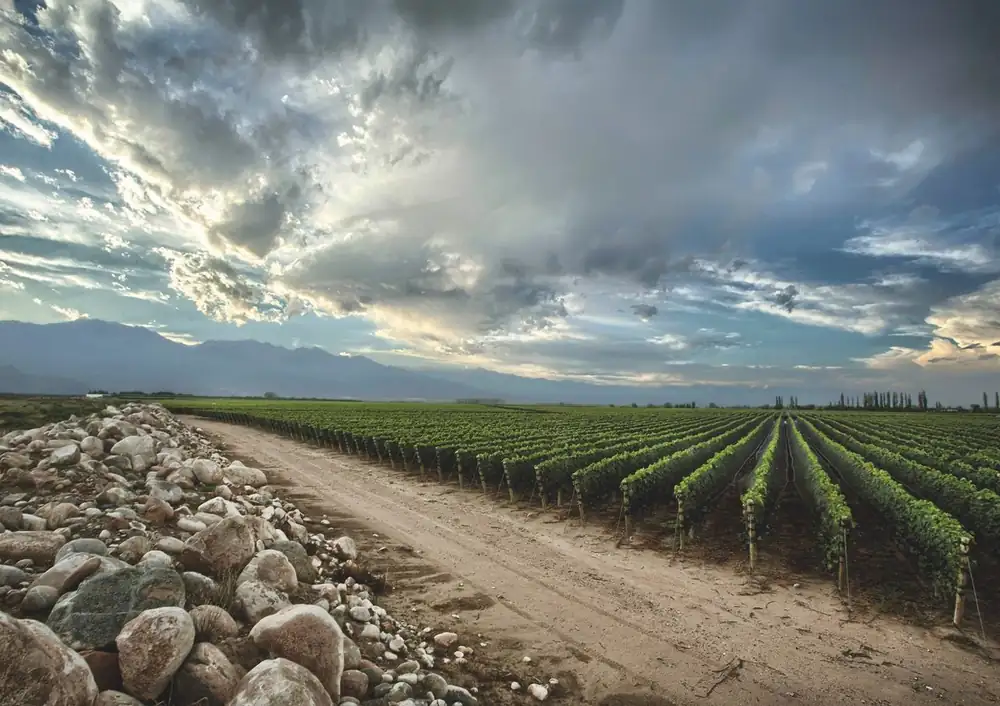
In the past, land was levelled to allow for mechanisation, but that practice has been abandoned – levelling involves stripping away the original soil, which is precisely what winemakers want to preserve.
With the new approach, the rows of vines follow the terrain and the local flora is maintained in order to ensure that all the conditions required to conserve the wine’s authenticity are met.
‘It makes you a vine-focused oenologist,’ says Vignoni.
Gualtallary
Rising from 915m to 1,600m over a distance of just 16km within the Tupungato region, Gualtallary’s alluvial soils contain calcium carbonate in markedly shifting quantities and forms, which can produce radical changes in the resulting wine within just a few hectares of space.
Researchers and producers have identified a range of further potential subdivisions, but none has official recognition as yet: to date, Gualtallary itself hasn’t even been granted Geographic Indication status.
Vigil pithily sums up the texture obtained as ‘tension and verticality’. ‘Many of the wines here seem to extend upwards rather than to the sides,’ he says.
Malbec continues to dominate in Gualtallary, but the district is increasingly drawing attention with its Chardonnays, which are some of the most precise in the country, and Cabernet Francs.
Paraje Altamira
The landscape in Altamira, a highly regarded sub-region in the San Carlos department of the southern Uco Valley, can be misleading: the continuous plots of vineyards and rows of poplars make it difficult to believe that the area is actually a desert.
This was the first terroir in the valley where the prevailing sense of place was backed up with hard scientific evidence.
In 2013, it was named the first Geographic Indication in Argentina, a sub-region defined not by administrative borders but by the natural terrain, soil samples, climate data and laboratory testing.
The vineyards here grow at an elevation of 975m-1,100m, generally lower than those of Gualtallary.
However, the climate isn’t warm: cool air flows down the slope to gather at the bottom, meaning that the fruit takes longer to ripen and spring frosts endanger the harvest.
‘Putting it down to elevation alone isn’t enough,’ says Federico Gambetta of Altos Las Hormigas.
Calcium carbonate combines with lime in the soils to produce wines that possess rounded tannins and a texture that Gambetta describes as a mouthful of chalk.
Malbec is the principal medium, but old-vine Semillons are one of Paraje Altamira’s best kept secrets: these venerable vineyards produce whites with a depth rarely seen elsewhere.
Los Chacayes
A latecomer to Argentina’s wine region scene it may have been, but Los Chacayes, on the western side of Uco Valley’s Tunuyán department, grew rapidly.
The GI was declared in late 2017 and the area went from barely having any vineyards to being one of the most rapidly expanding districts in the valley.
With vineyards growing at about 1,100m-1,400m, the landscape is more open than in Altamira but is pressed up against the mountains.
The wines here tend to be relatively spicy and potent. ‘We haven’t yet seen the best of Los Chacayes,’ says Vignoni.
‘It’s quite different from what I was expecting from Los Chacayes,’ she admits. The highest part, she discovered, is a whole other world compared to that further down in the same GI.
Malbec heads up the planted area, but there are also plots of Garnacha, Syrah and Mourvèdre – Mediterranean varieties that thrive in the rocky terrain, which isn’t found elsewhere in the greater valley.
Cru or not?
In its original usage, in the vineyard classification of the Burgundy region in France, a cru is a formally delineated, named plot of land where centuries of experience show that the wines produced are of superior quality and character.
Mendoza’s Gualtallary, Paraje Altamira and Los Chacayes aren’t ‘crus’ in the strict sense of the word, therefore.
But the three do introduce a discourse based around a sense of place – one that bears more resemblance to the broader Burgundian concept of ‘village wine’ than that of classified parcels.
Great terroirs aren’t declared, they emerge after decades of painstaking work. The language of Argentinian crus is being written now, vintage by vintage, parcel by parcel.
Catena Zapata, Adrianna Vineyard White Stones Chardonnay, Tupungato, Uco Valley, Mendoza, Argentina, 2022
Zuccardi, Botánico Chardonnay, Tupungato, Uco Valley, Mendoza, Argentina, 2024
This Gualtallary Chardonnay, fermented on native yeasts and aged entirely in concrete, with no malolactic fermentation, offers a transparent reading of place. Aromas of jasmine,...
Bemberg, La Linterna Finca El Tomillo Chardonnay, Tupungato, Uco Valley, Mendoza, Argentina, 2022
From a limestone-rich parcel, named for the wild thyme that grows there, this wine brings together precision and depth. Fermentation and ageing in a combination...
Finca Suarez, Semillon, Paraje Altamira, Uco Valley, Mendoza, Argentina, 2024
Mendel, Semillon, Uco Valley, Mendoza, Argentina, 2022
El Enemigo, Gran Enemigo Cabernet Franc, Tupungato, Uco Valley, Mendoza, Argentina, 2021
A benchmark style, this vintage (blended with 15% Malbec, all fermented and aged for 15 months in concrete tanks) reaffirms Gualtallary’s potential to produce Cabernet...
PerSe, La Craie, Tupungato, Uco Valley, Mendoza, Argentina, 2023
Zuccardi, Finca Piedra Infinita, Paraje Altamira, Uco Valley, Mendoza, Argentina, 2021
Altos Las Hormigas, Jardín de Hormigas Meteora Malbec, Paraje Altamira, Uco Valley, Mendoza, Argentina, 2022
Meteora captures the vibrant character of Paraje Altamira. Fermented and aged for 15 months in concrete, with 15% whole bunches, it reveals a limestone-driven expression...
Catena Zapata, Adrianna Vineyard River Stones Malbec, Tupungato, Uco Valley, Mendoza, Argentina, 2022
Rutini, Single Vineyard Cabernet Franc, Tupungato, Uco Valley, Mendoza, Argentina, 2021
Matias Riccitelli, Viña Extrema Malbec, Los Chacayes, Tunuyán, Uco Valley, Mendoza, Argentina, 2021
PerSe, Volare del Camino, Tupungato, Uco Valley, Mendoza, Argentina, 2023
Raquis, Los Parajes Malbec, Los Chacayes, Tunuyán, Uco Valley, Mendoza, Argentina, 2023
In this bottling, Andrés Vignoni showcases texture and sense of place over power, bringing together Malbec with 15% of Cabernet Franc. Fermented using whole bunches...
Alta-Yari, Gran Corte, Tupungato, Uco Valley, Mendoza, Argentina, 2024
Viña Artesano, Achillea Malbec, San Carlos, Uco Valley, Mendoza, Argentina, 2021
Sourced from a limestone-rich micro-parcel in Paraje Altamira, this 100% Malbec precisely reflects the character of the place. Spontaneous fermentation using about 10% whole bunches...
La Coste de Los Andes, Maximas, Los Chacayes, Uco Valley, Mendoza, Argentina, 2020
From high-elevation vineyards at 1,450m in Alto Chacayes, this blend of 70% Malbec, 16% Cabernet Sauvignon and 14% Cabernet Franc conveys a clear Andean identity....
Bodega Piedra Negra, L'Esprit de Chacayes, Los Chacayes, Uco Valley, Mendoza, Argentina, 2024
This blend from Argentinian Malbec vines and 30% French Côt (Malbec) offers a contemporary expression of Los Chacayes. Fermented and aged in concrete egg tanks,...
Rutini, Single Vineyard Malbec, Paraje Altamira, Uco Valley, Mendoza, Argentina, 2021
From a clonal selection in Paraje Altamira and aged for 12 months in French oak barrels, half new and half second-use, this 100% Malbec captures...
Terrazas de los Andes, Parcel 12 Licán Vineyard Malbec, Los Chacayes, Uco Valley, Mendoza, Argentina, 2022
A 100% Malbec that captures the densest and most enveloping side of Los Chacayes without sacrificing freshness, this is fermented partly in French oak barrels...