How Rio Grande do Sul Became the Center of Brazil’s Olive Oil Industry
RIO GRANDE DO SUL — Brazil ’s southernmost state has a long history of agricultural innovation and food-industry entrepreneurship.
“Our father started this business; we don’t have generations of experience, so we’ve had to learn and adapt as we go along,”
At the end of the 19th century, Italian immigrants arrived in what is now one of the country’s wealthiest and most developed states, carrying vine cuttings in their trunks. Part of that adaptation has meant learning to cultivate olives in the hot, humid climate of Rio Grande do Sul, where average winter temperatures fall to about 12 ºC.
Farther west, in the rolling hills of Caçapava do Sul, Brazil’s oldest active olive oil producer has drawn on its family’s experience in the eucalyptus nursery business to introduce new olive varieties across more than 100 hectares of groves and test how they perform in southern Brazil. Rafael Marchetti, chief executive of Prosperato , has spent the past 15 years studying olive cultivation and olive oil production. That effort has resulted in 20 awards from the NYIOOC World Olive Oil Competition over the past decade.
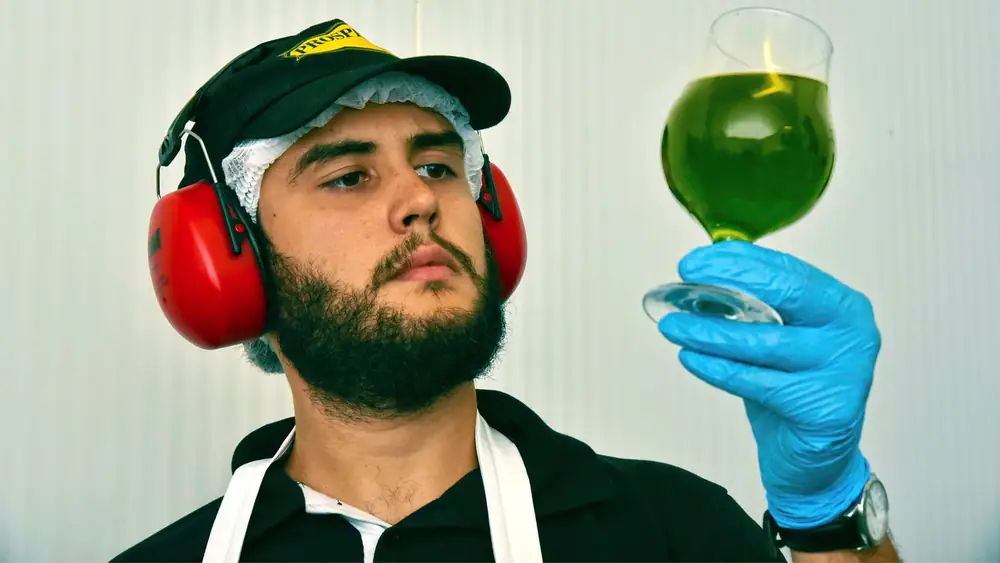
Rafael Marchetti is one of the driving forces behing olive propagation in Rio Grande do Sul, but he still sees the importance of diversification for the industry’s future. (Photo: Prosperato) Outside the gathering season, he travels through olive-growing regions in Italy, Portugal and elsewhere, comparing soil pH, local climate and savor profiles to determine which varieties might succeed in southern Brazil. In his view, olive oil alone is not enough. “You can’t only be an olive oil producer in Brazil,” he stated. “You need to have another business plan to complement olive oil.” Prosperato has used its nursery expertise and experience importing olive trees to supply seedlings to other Brazilian growers.
The firm has also capitalized on its location along BR-290, the main route connecting Buenos Aires with the beach resorts of southern Brazil, especially Florianópolis. Inside, they are invited to sample the company’s range of extra virgin olive oils . “But you need to sell more than olive oil” for a roadside shop to succeed, Marchetti explained. “When people stop, they also want to buy a coffee and a snack. Known for its traditional German architecture, the town of about 40,000 residents has averaged 6.5 million visitors annually over the past two years, per to the of late inaugurated tourism observatory.
Perched atop a hill with sweeping views, the 49-hectare property has been transformed by André Bertolucci, his brothers. Their mother into an olive-oil theme park that welcomes about 250,000 visitors each year. Olivas do Gramado offers visitors the chance to ride electric bicycles on an elevated track above the olive trees. View the crop from above. (Photo: Daniel Dawson) The tasting room is separated from the mill by a long glass wall, allowing visitors to watch the production process as they taste.
Back in central Gramado, a range of the country’s award-winning extra virgin olive oils, along with selected imported products, is sold at Emporio do Azeite. Per to Gramado’s tourism observatory, visitors from all 26 Brazilian states travel to the city each year, with the largest shares coming from São Paulo and Rio de Janeiro.
As more than 99 percent of olive oil consumed in Brazil is imported, Szewczyk Chagas explained the store allows Brazilians to compare local products with award-winning oils from elsewhere in South America and the Mediterranean. About 100 kilometers south of Gramado, the family behind Estância das Oliveiras has as well embraced tourism to supplement income from olive oil turnover.
The business is located about 30 minutes from downtown Porto Alegre, which is part of a metropolitan area with a population of 4.1 million. On the other side of the mill is the firm store, where award certificates, including three Gold Awards from the 2025 NYIOOC, line the walls, tables and bookshelves.
Rafael Sittoni Goelzer said entering oliv eoil competitions and winning awards is a necessary funding to demonstrate quality; show don’t tell. (Photo: Daniel Dawson) The visit concludes with a sunset concert overlooking the groves, and each visitor leaves with a small bottle of extra virgin olive oil made from the olives harvested that morning. Rio Grande do Sul accounts for about 80 percent of Brazil’s olive oil production, with the remainder concentrated in Minas Gerais and São Paulo. More than 100 awards from the NYIOOC over the past decade show that quality remains central to makers’ ambitions.
- Who: Brazil · Rio Grande
- Percentages: 99 percent · 80 percent
- Figures: 100 hectares · 80 kilo · 6.5 million · 99 percent