Bow Tie Pasta: It’s a Jewish Thing?
Kasha varnishkes is a satisfying side dish that deserves a turn front and center. Latkes, brisket, bagels: These are the warhorses of Eastern European Jewish cuisine.
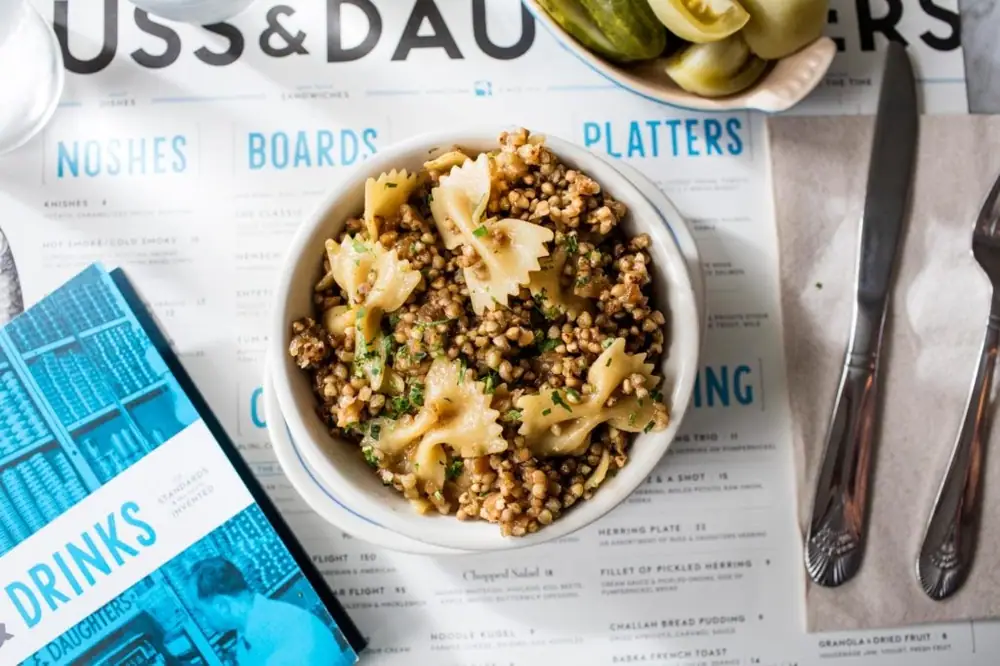
“Most of our customers not only know what kasha varnishkes is, but for them, it’s their comfort food,”
But for those who want to dive a little deeper into this historically rich style of preparation, the roasty, starchy kasha varnishkes awaits. Wander into Ukrainian East Village Restaurant, 2nd Ave Deli, Katz’s Delicatessen, or any other deli or diner that serves classic Eastern European food. Your eyes are likely to pass right over this common side dish of toasted buckwheat groats (the kasha) and bow tie pasta (the varnishkes) flavored with onions and mushrooms.
That won’t be the case at Russ & Daughters, an appetizing shop that serves its carefully selected bow ties sometimes with a poached egg on top. “Most of our customers not only know what kasha varnishkes is, but for them, it’s their comfort food,” states Niki Russ Federman, a co-owner. If you give it a chance, you’ll be rewarded with a dish that sets the goalpost for ideal toothsomeness. What’s intriguing about kasha varnishkes is that neither of the two main components are prevalent in the Ashkenazi cuisine we eat in the United States.
Buckwheat is actually more traditional to parts of China, Japan, and Southeast Asia, and it spread to Eastern Europe from there. In Russia, Ukraine, and Poland, “kasha” refers to any grain that’s toasted and cooked into porridge.
It’s only in Jewish cuisine that it refers specifically to buckwheat. The toasted groats on their own have a powerful and distinct earthy aroma, with a texture that is honestly a little rubbery.
If your familiarity with kasha varnishkes comes from watching Seinfeld, hopefully now you have some context for Elaine stating the Costanzas’ house smells like kasha. Other Jewish dishes that use noodles, like kugel (a baked noodle or potato pudding) and chicken noodle soup, tend to call for egg noodles instead of wheat.
The word “varnishkes,” for the noodles, is a bit more mysterious and is only used in this dish. It’s likely a Yiddish adaptation of the Ukrainian word “ varenichki ,” which means “stuffed.” Cookbook author. Jewish culinary historian Joan Nathan states her work led her to a Yiddish cookbook from the Wolff Brothers buckwheat milling company from 1925. It’s a trick that’s easier than folding dumplings, but it still allows the noodles to act as little scoops for the buckwheat so that you get both in every bite.
Like so much of traditional cookery, there are a million ways to prepare kasha varnishkes. According to Commonly, a beaten egg is mixed in to give it some, structure, and the whole megillah is baked in a casserole to meld the flavors and get the top a little bit toasty.
I’m lucky to have both a Polish trade and a Russian marketplace close to my home in South Norwalk, Connecticut. Between the two, I can find buckwheat groats from cornmeal-size to steel-cut-oats-size, as well as barely toasted to medium brown. You may be at the mercy of what’s available in the grocery store, so don’t stress about it. I’d encourage you to try toasting the grain yourself so you can achieve your ideal level (and as untoasted buckwheat may be easier to find).
Aside from the typical mushrooms and onions, you could add leeks, garlic, and maybe a little parsley on top or some rosemary in with the kasha.
- Who: It’s · Jewish · Eastern European Jewish