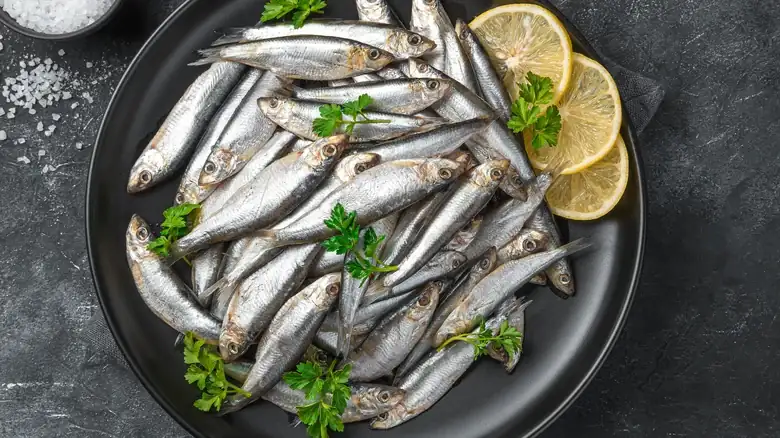
What's The Difference Between Anchovies And Sardines?
When it comes to choosing which of the ocean's many offerings you want to try and taste, freshness is undoubtedly at the forefront of your mind.
Nevertheless, a lot of people's primary association with seafood involves an aluminum cylinder and a can opener, as it is a relatively small percentage of privileged Americans who have the privilege of finding freshly caught fish at their local market. Of course, we're all familiar with oil-packed and water-packed tuna, the star of casseroles and grilled sandwiches everywhere. Two slightly less common, but still essentially ubiquitous offerings in the canned food market are anchovies and sardines. These tiny fish occupy similar spaces in the seafood sphere, but it is important that you understand the many differences between them.
Anchovies and sardines have several similarities
Given the fact that you've probably most often seen them packed into a can or dutifully served as the worst pizza topping, you likely already know that both anchovies and sardines are rather small. But that isn't where the similarities end. In an interview with Food Network, canned fish company Siesta Co. co-founder Lucia Flors explained that anchovies and sardines reside in the pelagic zone, an oceanic middle-ground and that the two fish have similar nutritional profiles. You may think that anchovies and sardines are different species, but that's only part of the truth. 16 species of fish can legally be sold as sardines — 26 species are good anchovies.
The primary difference between anchovies and sardines is the fish's respective flavors. Anchovies pack a powerful punch of salt and fishy flavor, as they are preserved through curing, while sardines are packed in olive oil, resulting in a more mild profile on your palate.
Which fish should you use in which dish?
The other founder of canned fish company Siesta Co., Carlos Leiva, broke down how you should enjoy sardines and anchovies for Food Network. Sardines, he explains, can be eaten with a very little flare. Just crack open the can and pop the mild, rich fish into your mouth. In fact, straight-up sardines are so good that people are eating old sardines on purpose – apparently, aging the fish in its olive oil bath allows its flavor to mature.
Leiva goes on to tell Food Network that anchovies are best used to give a salty kick to sauces and spreads. The much-beloved Caesar salad actually derives much of its flavor from a base of anchovies. The reason that anchovies are such a helpful addition when making savory sauces is that the briny fish can provide your dish with the highly sought-after fifth flavor profile, umami. That's why celebrity chef Mario Carbone wants you to think about anchovies in a different light.