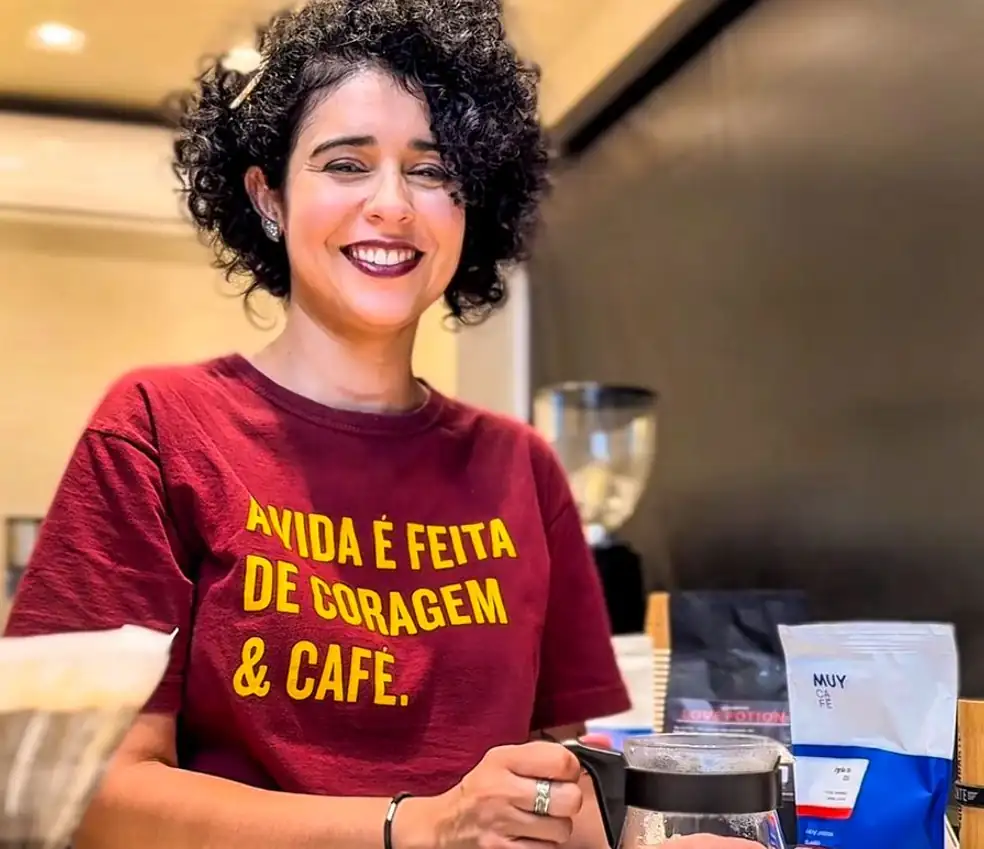
Juliana Morgado defends Brazil in the world filter coffee competition: “They'll see what our coffee is like and the strength of women.”
The only woman among the six finalists in the national competition, the barista from Brasília is preparing for the world championship in Belgium.
“I wake up every morning and go to check my shelf to see if it’s true,” Juliana Morgado tells Espresso about her victory at the Brazilian Brewers Championship on the 26th.
The only woman among the six finalists, the barista from Brasília continues her training to represent Brazil in the world championship, which takes place from June 25th to 27th in Brussels, Belgium.
In an exclusive interview, Juliana recalls her journey in the coffee industry, reflects on the challenges of the profession, and discusses her plans for the future and expectations for the world championship. "I want to show that Brazilian coffee is more than just nuts, caramel, chocolate, and dark roast for espresso."
Espresso: Tell us a little about your journey in the coffee industry – your experiences, achievements, and challenges.
Juliana: I've been in the coffee business for eight years, starting as a barista. Before that, I worked for seven years as a press officer. I left a job that was making me unhappy, and since I had a barista course, I started working in that field and fell in love with it. Like Alice, I fell down the rabbit hole into the world of specialty coffee, and curiosity led me there. As I've always been studious, I think it's natural to want to expand my knowledge. I think that's what made my career take off, and it's what I tell all the baristas I know: if you study, dedicate yourself with commitment and consistency, you can improve your life as a barista. My biggest challenge is everyone's – being a barista and having prospects for growth, not just staying in the coffee shop making coffee.
I worked in coffee shops in Brasília. The coffee I used in the competition was selected and roasted by Rodrigo, from Studio Grão, where I worked for four years. We would seek out incredible lots from very small producers, or sometimes slightly larger ones, but with some wonderful sacks that were difficult to sell – nobody wants to pay for shipping for just one sack. But we went there to show that Brazil has gems to be polished.
Q: What does winning the title of Brazilian Brewers Champion mean to you?
J: It was incredible. I wake up every morning and check my shelf to see if it's true. I tap the trophy and go about my day. I knew I would do well because I was working very hard and had a really good coffee. I went in thinking I was going to win, because it's a competition and you have to give your best. When they announced my name, I fell to my knees, because it's the seal of approval for all my effort, eight years of barismo, years of teaching. I'm an instructor, a consultant, I help open coffee shops. I work as a partner barista for 3corações, visiting places with all kinds of coffee. I love not only specialty coffees, so I was ecstatic. I believe I managed to represent it and, above all, the women in coffee, an area very much dominated by men and where we need to gain space. And the world championship is our space, Brazil's space, to say that we have incredible coffees too.
E: How does winning this championship impact your professional life?
J: Now everything's turned upside down. With this visibility, I can move my projects forward. I've always wanted to run philanthropic courses for women and trans people at risk. There are many people wanting to help me. But first, I want to take Brazilian coffee abroad and show that we are more than just chestnut, caramel, chocolate, and dark roast for espresso. Because in coffee shops abroad, Brazil is always just average. We have incredible coffees—floral, fruity, delicate—made with effort and by hands that want to offer an amazing cup, an experience. That's what I want to show.
Q: How do you plan to prepare for the World Championship and what are your expectations regarding this competition?
J: I'm in the training phase, finalizing my speech in English, deciding whether the coffee will be the same or not. We're looking for sponsorship because I only have my trip guaranteed, but I need my coaches, equipment, and utensils to train and present. Just the paper filter I use costs R$10. We call ourselves a Brazilian barista team because I'm not representing a brand, but Brazil. So, we accept help from anyone interested in supporting the "Brazilian" brand. My expectation is that we will win, and you will see what Brazilian coffee is like and the strength of the women.
Q: What are your plans for the future? Do you intend to compete again?
J: Sure. This year I'm going to the Brazilian Barista Championship and next year, to the brewers' championship again. And the barista championship again. And the world championship again – if possible. I like that.