“Cooking is a social act”: Fulvio Pierangelini between AQVA, the sea, and memory
At the Vatican Apostolic Library, water becomes the setting for "Catastrophe and Wonder." In this setting, we meet Fulvio Pierangelini: stories of food, the sea, the garden, and an absolute respect for matter in an interview that transforms cooking into a social gesture.
AQVA, water between catastrophe and wonder, year one
Within the Vatican Apostolic Library, AQVA inaugurates the five-year exhibition series "Catastrophe and Wonder – Year I (2026–2027)": a project that establishes a dialogue between the library and iconographic heritage preserved over the centuries and the languages of contemporary art. At its center is water in its ambivalence: a generative force and, at the same time, an element of threat.
From September 25, 2026, to May 14, 2027, the exhibition invites visitors to symbolically navigate the fears associated with natural elements—from water to fire, from light to insects, and even human intervention—to reach a new awareness. JR's monumental installation Diluvium on the sixteenth-century façade, Bill Moran's typographic creatures, and the section dedicated to the Restoration Laboratory create an immersive journey that intertwines history, science, and art.
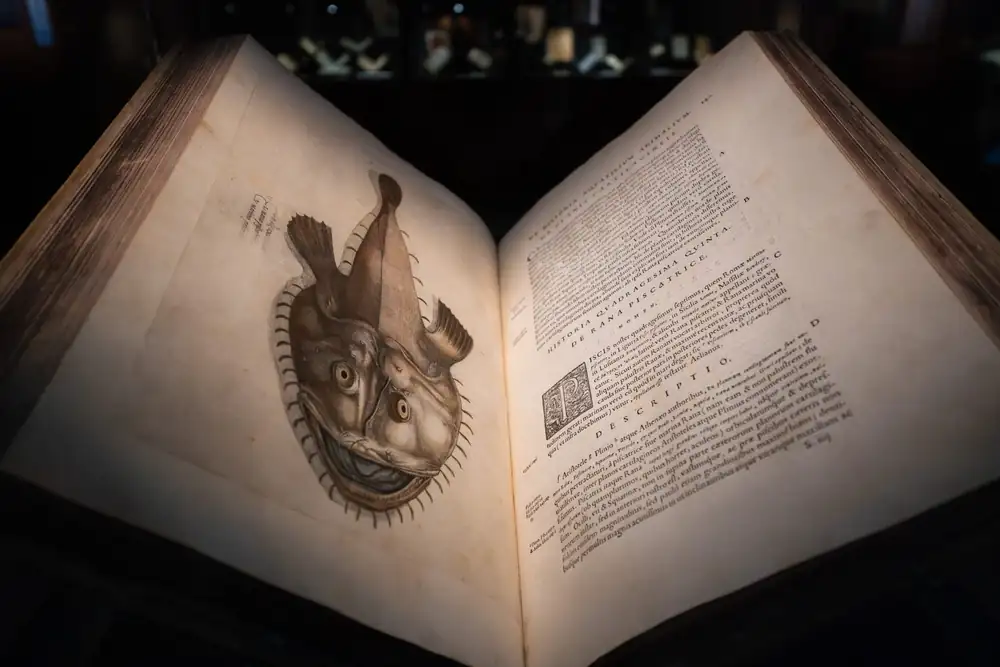
The scientific and symbolic heart of the exhibition is Ippolito Salviani's Aquatilium animalium historia (1557), an extraordinary treatise on fish that combines scientific knowledge, the art of engraving, and gastronomic culture. Fulvio Pierangelini's intervention also builds around this book and its marine imagery, having been called upon to interpret the theme of water through its own language: cuisine.
Fulvio Pierangelini, the chef who listens to the sea
A cult figure in Italian gastronomy, Fulvio Pierangelini has carved his own path by combining study, seafood, and raw ingredients. After experiences that took him from the kitchens of Roger Vergé and Christian Morisset on the French Riviera to managing the legendary Gambero Rosso on the port of San Vincenzo since 1980, the chef has become an absolute benchmark: two Michelin stars, top rankings, and recognition as Italy's best chef by the Gambero Rosso guide.
His cuisine is characterized by apparent simplicity and dizzying depth: a world in which a pureed chickpea and shrimp dish or spaghetti with tomato sauce can become a radical narrative of territory, memory, and technique. Over time, Pierangelini chose to close his restaurant at the height of its success, calling himself a "chef in exile," and to continue his exploration through new experiences and contexts. Today, drawing on a vast knowledge and an almost sentimental relationship with ingredients, he oversees the creation of menus and culinary projects for a large collection of international hotels.
Throughout his journey, a common thread runs through him: absolute respect for the ingredients and the awareness that, every time we cook and eat, "there is something, someone who sacrifices for us." Cooking thus becomes a cultural, ethical, and profoundly social gesture.
Telling about water with cooking stories
At AQVA, Pierangelini is called to confront the element that has always accompanied him more than any other: water, the sea, its real and imaginary fish.
Chef, what was your contribution to the AQVA exhibition?
Fulvio Pierangelini: "My contribution consists of writing some short stories, some culinary histories. My own take on a recipe. This was my main task, then inserted into the context of this marvel." Not a menu, not a sequence of dishes to be prepared, but unpublished gastronomic tales: declarations of love for the raw materials, observed and treated with dedication and subtle irony. Texts that dialogue with the tables of the Aquatilium and with the long history of the relationship between water, knowledge, and food preserved in the Library's collections, from Apicius's De re coquinaria to Ramusio's travelogues.
Water, technique and imagination
What is your relationship with water in the kitchen?
Fulvio Pierangelini: "Water is a fundamental element in the kitchen. The choice of water is extremely important. I've always favored water, even when people didn't understand, because I believe the relationship between water and food is unique. I sometimes say that a teaspoon of water is enough to solve a problem: a mashed potato that didn't turn out well, a mayonnaise that didn't come out. So even from a purely technical, as well as intellectual, standpoint, water is essential in the kitchen. This is my relationship with water." Water, in his words, is both a technical tool and a source of thought. An element capable of saving a sauce as well as sparking reflections on the fragility of the balances that govern our relationship with food and nature.
Fulvio Pierangelini: "I'm a sailor, I've sailed, I live by the sea, I live by water, so for me water is crucial. But in the kitchen it's truly fundamental. Just think of ice, the stories of ice, the shapes of ice: it's a fantastic world, in my opinion. And so I find myself in this game of water that I'm describing now; it's definitely my fundamental element." The sea isn't just a physical place: it's the mental horizon from which dishes, insights, and stories arise. Water, in its constant transition from ice to steam, from wave to rain, becomes the perfect image of a cuisine that rejects rigidity and dogma to embrace movement.
Catastrophe and wonder: the sea that teaches respect
The exhibition's theme is water: both a threat and a resource. How do you experience it?
Fulvio Pierangelini: "The sea, and therefore water, is my main element: where I grew up, where I worked. I have absolute respect for it. When you're sailing, or when I was a lifeguard before that, the element of catastrophe is latent, so you have to absolutely respect it. But the amazing thing is that when you sit by the sea, watching a sunset, I think it's the most beautiful peace.
Horizons that never end in water—that's what I love so much. That's why I'm so happy to talk about it. I'll also tell this story in my dishes and in my stories. There's always a relationship with water, not just because fish live in water, but also the relationship between humans and water. And so, that's yet another reason to be happy to participate in this exhibition.
Catastrophe and wonder are therefore not abstract concepts, but lived experiences: the water that can overwhelm a boat and the water that, faced with a sunset, offers the purest form of peace. His cuisine also lies between these two poles, suspended between discipline and abandon, technical rigor and wonder.
Garden and library: culture as an ingredient
How has your relationship with raw materials evolved over time?
Fulvio Pierangelini: "My relationship hasn't changed; it's deepened. Or simply enriched, because the main thing I do every time I open a new hotel or a new hotel restaurant is look for a vegetable garden. And the quote I'm writing is a 2,000-year-old Cicero quote, which goes: 'If you have a vegetable garden next to your library, you'll lack nothing.'"
This has always been my spirit, because it's a cultural, not an intellectual, relationship with matter. Matter deserves respect. Every time we eat, every time we cook, there's something, someone who sacrifices themselves for us. So respect is fundamental. At the same time, knowledge is crucial. So the book tells you the essence. But then you have to caress it, you have to feel a product, you have to fall in love with it, you have to touch it. And then everything grows. But clearly, culture, knowledge is crucial. Then emotion, technique, and wonder come into play.
In the heart of the Vatican Library, that phrase from Cicero reads like a manifesto of sorts. The library and the garden become the two poles between which his idea of cooking revolves: on one side, written knowledge, on the other, the living earth, products to be touched, smelled, and chosen. It is here that cooking becomes a social and political act: a practice that intertwines culture, care for the land, and respect for those who produce and those who consume.
From the classics to the table: Apicius, Artusi and the high schools
AQVA's journey also intersects with the story of Apicius, featured in the exhibition. What significance does this have for you?
Fulvio Pierangelini: "I was asked many years ago to write the preface to Apicius's book. I was asked to write part of Artusi's book. These are books I participated in and that were part of my journey. That's why I'm there.
Apicius, however, is the first culinary visionary, the first to write about cooking, the first to be in love with cooking. I'd say he was, ante litteram, a fan of cooking, so much so that he went fishing for red mullet in the Peloponnese because he only wanted them of a certain weight, and he went hunting because he wanted only the most beautiful woodcock; he knew where to go to gather them. He was truly a food scout from 2,000 years ago. He even made a ridiculous gesture: he killed himself when he imagined he no longer had enough money to go and get the food he favored.
Among the shelves of the Vatican Library, the pages of Apicius and Artusi are not museum objects for Pierangelini, but companions on his journey: tools for a learning process that for him is never merely technical, but cultural in the broadest sense.
What would you say to someone who dreams of becoming a chef today?
Fulvio Pierangelini: "Apicius said some important things. It's one of the books that… Well, it's clear that for me, having an education is essential, even for being a chef, especially for being a chef. When mothers ask me, 'What school can I go to, what can my son do to become a chef?' (and they say become a chef), I tell him to go to high school and then go to the countryside on Saturdays and Sundays where there's a nice woman who makes minestrone and makes pasta. We'll talk about it later."
Between high school, library, and garden, the trajectory is clear: before plating, you need to learn to read, observe, and listen. And then, you need to sit alongside those who have always cooked, with their hands and their bodies, long before the arrival of Michelin-starred brigades and social media.
Cooking as a social gesture
In Fulvio Pierangelini's words, cooking is never a solitary exercise: it's a field where ancient books, contemporary gardens, fishermen, farmers, students, lifeguards, and sailors meet. AQVA water, with its dual aspects of catastrophe and wonder, is the perfect backdrop for this vision. Cooking thus becomes a social act: a daily choice that concerns the quality of raw materials, the labor of those who produce them, the relationship with the land, and the education of those who eat. A gesture that, starting with a teaspoon of water capable of saving a mayonnaise, reaches all the way to the great questions of our time: the fragile balance between nature and culture, memory and future.