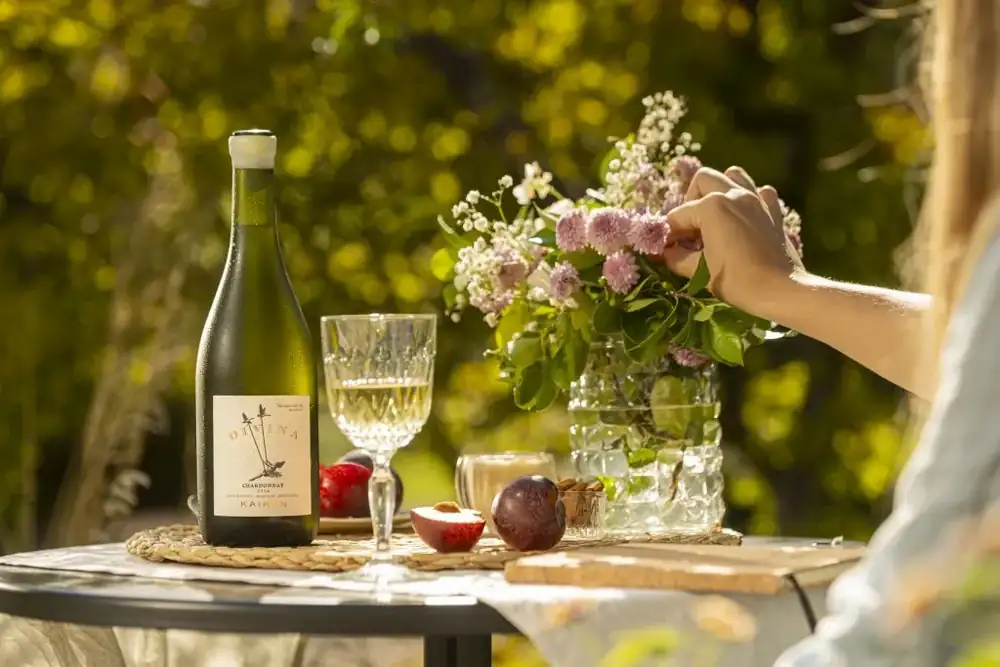
Wines for spring: 6 new light and lower alcohol releases
With the arrival of spring, plans change, outdoor meals become more popular, and so does the desire for cooler, easier-to-drink beverages.
In this selection, we've looked for wines with lower alcohol content (or none at all), as well as others that stand out for their freshness, acidity, fruity profile, and ability to complement warm days. The idea is to offer a variety of options for this time of year, from a high-end Chardonnay to a rosé from the Uco Valley, along with fruity and alcohol-free choices.
1. Divina Chardonnay 2024, from Bodega Kaiken
Kaiken Winery has launched Divina, a new line that aims to further develop its work with great Argentine white wines and varieties that find a unique expression in Mendoza. The line will consist of two wines: Divina Chardonnay, produced in Los Chacayes, and Divina Torrontés, from Gualtallary.
The first label is Divina Chardonnay 2024, made from a selected plot in the northern alluvial fan of Los Chacayes, in the Uco Valley. The vineyard is situated on stony soils with a high calcium carbonate content, a characteristic that, according to the winery, contributes tension, concentration, and a marked mineral expression.
The wine was slowly fermented in French oak and aged for 16 months in second, third, and fourth-use barrels. The intention was to achieve a subtle integration of the oak without masking the fruity and mineral expression of the Chardonnay.
In the glass, it combines citrus notes, white fruits, and delicate flowers, with an enveloping texture and a mineral character reminiscent of chalk and stone. The finish is long and saline, in a style that seeks to combine freshness, complexity, and elegance.
"Chardonnay is a variety that allows us to express the identity of the terroir with great precision. In Divina, we seek to showcase a white wine of great finesse, tension, and depth, inspired by the great styles of the world, but with an expression unique to Los Chacayes," explains Juan Pablo Solís, winemaker at Bodega Kaiken.
Variety: 100% Chardonnay - Origin: Los Chacayes, Uco Valley, Mendoza - Aging: 16 months in second, third and fourth use French oak barrels - Aging potential: 8 to 10 years - Suggested price: $36,200 Where to find it: wine shops.
2. FIN Single Vineyard Gewürztraminer 2024, from Bodega Del Fin del Mundo
Patagonian white wines also have their place in this quest for fresh and aromatic wines. Bodega Del Fin del Mundo presented FIN Single Vineyard Gewürztraminer 2024, a high-end label produced in San Patricio del Chañar, Neuquén, of which only 1200 bottles were made.
The launch is part of the winery's ongoing work with white grape varieties grown in its own Patagonian vineyards. The project aims to explore different expressions of a region whose natural conditions allow for the production of fresh, aromatic wines with character.
The starting point is a Gewürztraminer vineyard that has been part of the winery since its inception. For the 2024 vintage, the winemaking team carried out a particularly careful hand-selection and worked with the variety, focusing on its potential for premium wines.
With winemaking overseen by Ricardo Galante, the wine was aged for 12 months in French oak barrels. It presents a bright golden color with greenish highlights and an intense aromatic profile, featuring stone fruits, citrus peel—such as orange and lime—ginger, and hints of tropical fruits.
On the palate it is fruity, unctuous and has a long finish, a combination that gives it a different personality within the winery's white wine offering.
"What attracted me most to this Gewürztraminer is that it's a different kind of white wine. It has the aromatic characteristics typical of the variety, but at the same time we find an expression that feels very much like San Patricio del Chañar and Patagonia," says Galante.
Suggested price: $41,600 - Where to get it: wine shops and Bravado, the restaurant of Bodega Del Fin del Mundo in Vicente López.
3. Celia Rosé
Spring is also a great time to rediscover rosé wines, a category no longer exclusively associated with summer. Their freshness and versatility make them a perfect choice for an al fresco lunch, an aperitif, or a casual meal.
From La Celia, a pioneering winery in the Uco Valley, comes a Rosé crafted in a high-altitude terroir with a cool climate and significant temperature variations. The result seeks to express its place of origin through a young, fresh, and elegant wine.
The wine is made with 80% Pinot Noir and 20% Pinot Grigio. It has a pale pink color and, on the nose, aromas of cherry and quince, along with floral notes of white roses.
On the palate it is vibrant and fresh, with a persistent finish, characteristics that make it a great choice to accompany meals and gatherings during the warmer days.
The arrival of spring also coincides with a refresh of the Rosé and Reserva line labels. The new design incorporates one of La Celia's historical symbols: the horse, linked to the story of Eugenio Bustos, who traded his finest horse for Malbec vines. The image thus brings the winery's origins and pioneering spirit back to the forefront.
Composition: 80% Pinot Noir, 20% Pinot Grigio - Suggested price: $12,409.
4. La Arboleda Chardonnay 2025, from Di Nobile Wines
Another option for those seeking a crisp white wine for spring is La Arboleda Chardonnay 2025 from Di Nobile Wines. This wine originates in Tupungato, Valle de Uco, at nearly 950 meters above sea level, an altitude the winery identifies as crucial to its character.
The wine aims to express the characteristics of cool-climate, high-altitude vineyards. This Chardonnay displays vibrant acidity, freshness, and minerality, along with fruity and citrus notes.
On the palate, it has good volume and an acidity that provides structure and aging potential. It is a wine that combines a fresh and elegant profile with an expression marked by the terroir.
Behind the label is Antonio Más, the winery's founding winemaker and a key figure in the development of Argentine boutique wine. Currently, his sons Manuel, in winemaking, and Santiago, in general management, continue the family project.
La Arboleda also features other varietals, including Malbec, Cabernet Sauvignon, Cabernet Franc, as well as an Extra Brut and a blend of Malbec and Cabernet Sauvignon.
Variety: Chardonnay - Origin: Tupungato, Uco Valley, Mendoza - Suggested price: $22,000 - Where to find it: wine shops.
5. Colón Selecto Dulce Fresco Frutales: three options with 7% alcohol
If the search is specifically focused on a beverage with a lower alcohol content, Bodega Colón's proposal differs from the rest of the labels in this selection.
The Colón Selecto Dulce Fresco Frutales line returns to store shelves for the spring-summer season with three varieties: Peach, Red Berries, and Orange. This sweet, wine-based beverage has a fruity flavor and 7% alcohol, designed as a smooth and versatile alternative.
The idea arose from a shift in alcohol consumption patterns, particularly among consumers seeking cooler, lower-alcohol options. In fact, the Peach and Red Berry varieties had already generated significant buzz on social media before their official launch and sold out in stores.
"We are faced with a highly dynamic audience that is always looking for something different. That's why we created a sweet, fresh and easy-to-drink product," explains Sol Tiscornia, brand manager of VSPT.
The line is also characterized by its versatility in serving. It can be enjoyed neat, on the rocks, or mixed with lemon-lime soda, tonic water, or sparkling wine. It also pairs well with fresh or frozen fruit and various combinations for preparing cocktails.
The launch follows the Colón Selecto Dulce Fresco line, introduced in 2023 in red, white, and rosé versions, with 9% alcohol. The new offering has an even lower alcohol content and adds a fruity profile as its central focus.
Varieties: Peach, Red Fruits and Orange - Alcohol content: 7% - Format: sweet wine-based drink with fruit flavor.
6. Malbec-Pinot Noir: the alcohol-free red wine
For those who want to participate in the wine ritual but prefer to avoid alcohol, there is a different option: an alcohol-free blend of Malbec and Pinot Noir, made with grapes from Mendoza.
The blend is composed of 60% Malbec and 40% Pinot Noir. The Malbec comes from Luján de Cuyo, from deep clay-sandy soils, while the Pinot Noir originates in the Uco Valley, on alluvial soils of varying depths and with low water retention.
The vineyards are located between 800 and 1,200 meters above sea level. The wine was traditionally made in stainless steel tanks to achieve good ripeness and tannin sweetness, as well as gentle extraction. A portion remained in contact with French oak barrels.
After this stage, the wine went through a dealcoholization process using rotary cone technology.
The result is a light violet color, with aromas of red fruits such as plums, cherries, and sour cherries, accompanied by subtle notes of toasted sugar. On the palate, it presents good volume and sweetness, velvety tannins, and a balance between acidity and sweetness.
It is an alternative that adds to a category that allows us to think about wine from another perspective: preserving some of its sensory characteristics and the ritual associated with the drink, but without alcohol.
Composition: 60% Malbec, 40% Pinot Noir Origin: Luján de Cuyo and Valle de Uco, Mendoza Altitude: 800 to 1,200 meters above sea level Aging: 10 months in contact with French oak Calories: 172 kcal per bottle Winemaker: Santiago Mayorga.
In numbers: whites are gaining ground
The variety of offerings is no coincidence. According to data from the National Institute of Viticulture (INV) included in the wineries' reports, white varietal wines saw a 13.6% increase in the domestic market during 2025 compared to the previous year. Compared to 2016, the volume shipped increased by 25.2%.
During 2025, varietal wines also reached a 21.7% market share within the white wine segment sold in the country, the highest percentage recorded in that period. The INV (National Institute of Viticulture) notes that the category has maintained a positive trend since 2023, driven primarily by the domestic market.
And growth continued during 2026: in the first half of the year, sales of white wines in the domestic market increased by 3.8%.
With this in mind, spring presents a great excuse to explore beyond the classic red wine. High-altitude whites, rosés, aromatic varieties, and low- or zero-alcohol options broaden the possibilities for choosing what to drink when the temperature rises.
Source consulted: information provided by the wineries. Market data: National Institute of Viticulture (INV).