From crumbled songbook to pub song: centuries-old hits sound again
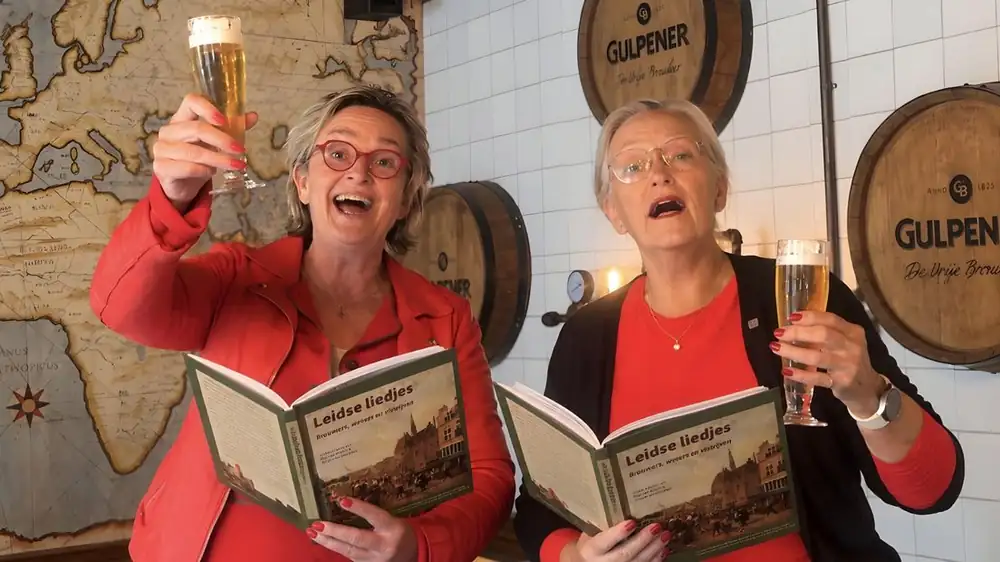
LEIDEN - With a beer in hand, Olga van Marion and Jampie van Ginneken sing a nearly four-century-old song in an old-fashioned Leiden pub.
The songs come from Het Leydsche Vreugden-Hof, a small songbook from the seventeenth century. University lecturer Olga van Marion from Leiden University and former Dutch teacher Jampie van Ginneken, together with the Leiden Songs working group of the Historical Association Oud Leiden, delved into the lyrics.
The result is the new book Leidse liedjes: Brouwers, wevers en viswijven.
Hits by ordinary people from Leiden
In the seventeenth century, it was popular to publish songbooks about one's own city. Leiden happily joined in. In Het Leydsche Vreugden-Hof, the researchers found fourteen songs that are truly about life in and around Leiden.
Not about mayors, professors, or other posh types, but about walking, falling in love, shopping, going to the fair, and buying meat and fish. Weavers, brewers, and fishwives populate the texts.
There is also a lot of beer in it. 'There is an eagerness and a curiosity about the lives of ordinary people in these songs. And there is also a lot of beer in them,' says Olga.
The latter is no detail. In one of the songs, there is boasting about no fewer than 22 Leiden breweries. According to the poet, the beer from other cities naturally could not compare.
Sung excerpt from a booklet
Anyone wishing to sing the songs again must first be able to read what is written. And that is precisely where the great puzzle begins. The two surviving copies of the original songbook are heavily damaged. The copy at Erfgoed Leiden en Omstreken is missing pages, and pieces have disappeared from other pages.
'Songbooks were cheap in those days and were used to pieces. They were really sung to pieces, read to pieces,' says Olga. There was an additional obstacle: the lyrics are largely printed in Gothic script. Jampie: 'Once you've been working on it for a while, you manage to decipher the Gothic script. Capital letters are often a bit trickier.'
A readable text alone does not make a song. With the old texts, it was often only indicated to which melody, known at the time, they were to be sung. For people from the seventeenth century, this was sufficient information; for a resident of Leiden in 2026, somewhat less.
Musicologists Nico van der Meij and Margot Kalse therefore went in search of the old melodies and transcribed them into modern musical notation. Where the original melody could no longer be found, a suitable melody was chosen. In this way, the centuries-old words regained their music.
Jan Steen on the front
The book was also visually enhanced. Van Marion and Van Ginneken sought out historical images to accompany the songs. Some eventually received three or four. The cover features a painting of the Leiden Fish Market by Jan Steen.
The work is located in the Städel Museum in Frankfurt. A more fitting front page could hardly be imagined: a painter from Leiden, a market from Leiden, and behind it songs about ordinary life in the same city.
And so the songs do not remain confined between covers. Olga van Marion and Jampie van Ginneken sing them themselves as well, in various locations in Leiden. In an old-fashioned pub, they stand on chairs with a beer in hand; on the Visbrug, the centuries-old repertoire resounds right in the city where it originated.
But anyone who thinks Leiden has gained a new singing duo is mistaken. "We are not singers, not trained singers," says Van Ginneken. "We just enjoy singing the songs."
Choirs need to start doing that.
The ultimate goal is for others to run with it. Choirs, musicians, and other people from Leiden. Van Ginneken is clear about this: 'Choirs should do that.'
Olga even hopes that new voices and instruments will be added. For after nearly four centuries, these Leiden songs need no longer be covered in museum dust. They deserve to be heard again.