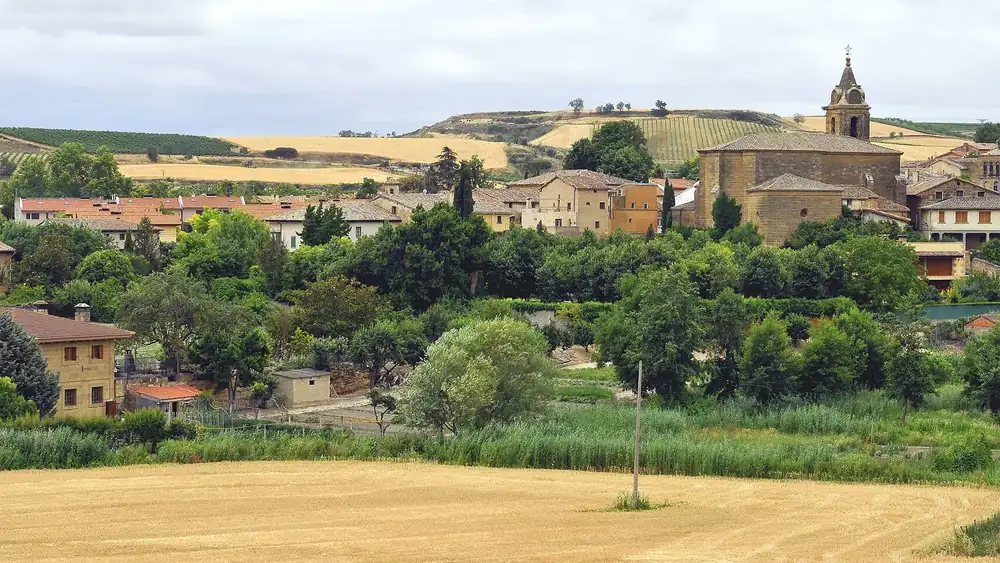
A small town in La Rioja hides one of the oldest wineries in Spain beneath its streets
In La Rioja, wine aging doesn't always happen in plain sight.
What's striking is that this heritage isn't confined to large wineries. It also appears in small town centers, where a discreet doorway can open onto a stone passageway that branches out silently. In one of these towns, the underground is as important as the main square.
That place is Ollauri, in La Rioja Alta. The municipality locates it and documents its historical trajectory on its official website, the Ollauri Town Hall, but its greatest attraction for travelers lies underground: a network of cellars that can now be explored with guided tours linked to Bodegas Ollauri-Conde de los Andes.
What is a cellar and why does wine need silence?
A cellar is an underground wine cellar excavated to take advantage of the earth's thermal properties. Several meters below ground, light disappears, air moves very little, and the temperature tends to be constant. This environment reduces fluctuations that, on the surface, disrupt the wine's aging process.
The logic is technical and time-honored. Throughout the region, the explanation is the same: they were built to better preserve the wine and optimize production with minimal expense, taking advantage of the topography and natural resources. This can be found in the section dedicated to cellars and winery districts on the Rioja Alta Wine Tourism website.
The conditions sought by cave wineries
The goal is not mystery, but stability. That's why cellars typically have narrow passageways, stone walls, and limited ventilation. This combination helps the wine rest without abrupt changes, as the bottles age naturally in a controlled environment.
Underground heritage, not just infrastructure
The evolution of these cave-like cellars left its mark on the architecture. Arches, reinforcements, ashlar walls, and stonework solutions appear where, in theory, there should only be an excavated cavity. In the best cases, the result is a functional structure that also has historical value.
Ollauri and its cellars: five centuries beneath a kilometer and a half of galleries
Ollauri is a short distance from Haro and Briones, and its surroundings command the Ebro Valley, as the winery itself describes in its institutional presentation of Bodegas Ollauri-Conde de los Andes. This vineyard landscape explains the upper levels. The lower levels are best understood with a visit to the underground network.
The winery sums up the idea with an easily visualized figure: “five centuries of history” concentrated in a network of cellars. On its page dedicated to the cellars, it mentions an extension of approximately one and a half kilometers. The official Rioja DOCa website, for its part, describes these spaces as an outstanding network due to its age, architecture, and a length “of nearly one kilometer,” in the entry for Conde de los Andes on the official Rioja website. In practice, the difference usually depends on the total section preserved and the route open to visitors.
From the late Middle Ages to the 17th century
According to official information from the winery, the cellars of Ollauri began to be opened at the end of the Middle Ages. A key phase took place in the 17th century: the excavation of the well-known square cellars, attributed to Galician stonemasons. This is a relevant detail because it indicates a planned construction, not simply an improvised cave.
This is Gerardo Arias's hometown: from Tomelloso to "Temptation Island"
The same source details recognizable construction features along the route: large ashlar stones and Mudéjar-style architectural details. This language of materials and forms is part of its appeal, because it allows the openwork to be interpreted not only as a workspace but also as a historical document.
Old vintages that continue to rest underground
The most striking aspect isn't always the architecture, but the contents. The winery indicates that bottles from historic vintages, with references to years such as 1892, 1918, 1948, and 1964, still rest in these galleries. The Rioja DOCa also highlights the preservation of hundreds of thousands of bottles from old vintages, noting that they date back to at least 1892, in the official entry linked on its website.
For the visitor, this collection functions as a time capsule. It's not about seeing barrels lined up, but about understanding how wine was stored when technology couldn't easily replicate what the earth offered for free: stability.
A small town with a documented history
Beyond the winery, Ollauri has its own story. The Town Hall explains that it was a hamlet belonging to Briones until the 17th century and that it became administratively independent in 1712. It also notes that, after peaking in population at the end of the 19th and beginning of the 20th centuries, the municipality now has around 350 inhabitants. This summary can be found in the History of Ollauri section of the municipal website.
Above-ground walk: mansions and urban layout
The exterior attractions can be explored in a short time, making it ideal for a half-day or full-day trip. The town's website invites visitors to discover its heritage through stately homes and palaces, as well as its local tourism offerings, all accessible from the Town Hall's homepage.
Wine agenda and local activities
The calendar adds to the list. The municipal news section features tastings and events related to wine and Rioja products. A recent example is the information about tastings at the local market, available on the Town Hall's homepage under "Ollauri News."
How to organize a visit to the wine cellars
The experience is best understood with a guided tour. The winery itself offers a program of experiences for accessing its cellars and centralizes information in its cellars section and on its wine tourism website. The Rioja DOCa also provides a handy information sheet with services and tour details, indicating prices starting from €50 and ample availability, on the official Conde de los Andes website.
Practical recommendations for going underground
- Advance booking: visits are organized by time slots and experiences, and it is advisable to secure a place before traveling.
- Light outerwear: the underground environment is stable and usually feels cooler than outside, even in summer.
- Wear shoes with firm soles: there are sections of stone and areas with ambient humidity.
- Extra time in the village: the interest lies in the combination of surface and subsurface; plan a short walk before or after.
Direct contact for wine tourism
The local address is also listed in their official information: Calle Sol de la Cabra, in Ollauri. It is advisable to confirm schedules and available options through official channels before traveling.
In a region where wine is the landscape, Ollauri reminds us that it is also the subsoil. His cellars are not just a tourist attraction: they are a living part of Rioja's culture, carved into the stone so that time can do its work silently.