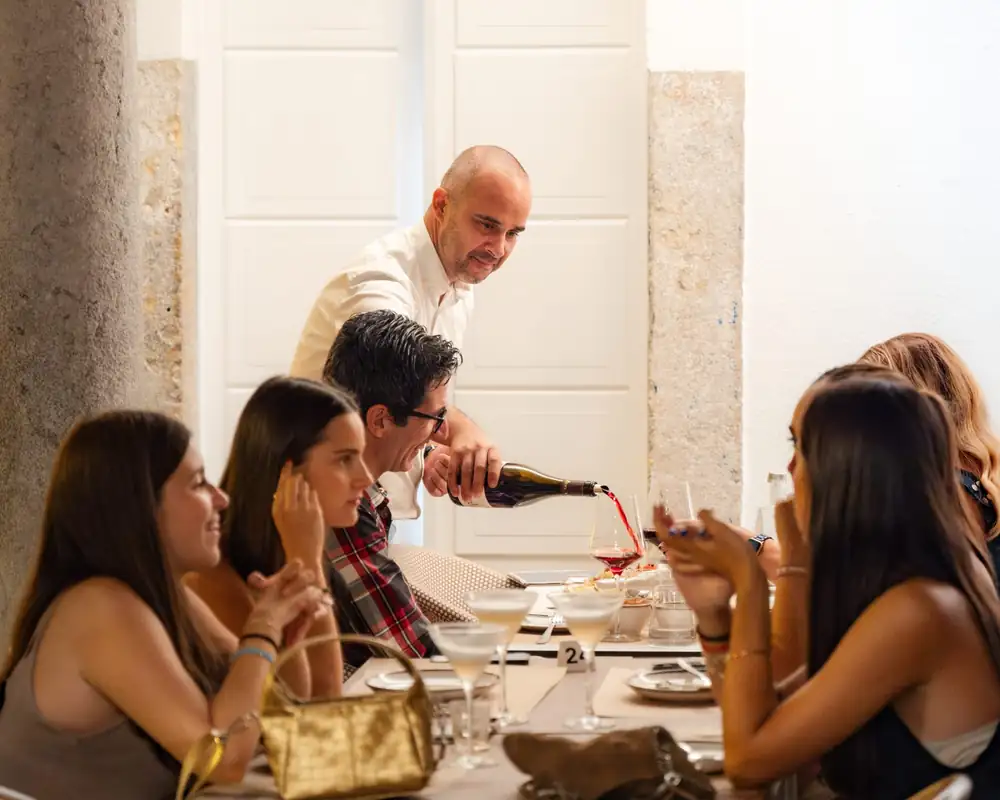
Neighbors of the King – At the table with the history of Odivelas
Located next to the Monastery of São Dinis and São Bernardo, Vizinhos do Rei revives the memory of an old Odivelas tapas bar and gives it a new lease on life.
The name was born almost out of geographical necessity: King Dinis is right next door and, as the owners joke, it's not every day you can say you have a king as a neighbor. Paulo, Pedro, and Mauro grew up in Odivelas and have a personal connection to that square, the setting for baptisms, communions, business deals, gatherings, and family memories.
Perhaps that's why the project, which matured over about two years, ended up gaining an emotional side that goes beyond simply opening a restaurant. The idea was to recover a house that was part of the city's collective memory, modernize it, but without erasing its roots, and create a welcoming space where you can have lunch, dinner, or simply snack in the afternoon, without that unpleasant feeling of having someone watching the clock waiting for us to free up the table.
A gateway to many stories.
The room itself helps to understand the concept. Wood, neutral tones, simple and comfortable decor, a bar that occupies a good portion of one of the walls, and a size that is compact enough to maintain that feeling of intimacy that the owners desire.
But there's a detail that easily goes unnoticed and helps explain why this isn't just another restaurant: at the back of the space, there's the vestige of an old passageway leading to the monastery. The door is still there, the connection likely existed, but as for the rest, it's best to leave some room for imagination. The current owners say that local historians link that passageway to the area where the Tower of Madre Paula once stood and to the visits of King João V. Whether the monarch actually used it for the meetings that history attributes to him is a matter for other experts. There were no cell phones, photographs, or social media at the time, so we must respect the mystery. And, let's face it, it's even more fun that way.
This historical heritage also emerges in the bar through the signature cocktail "Meninas de Odivelas" (Girls of Odivelas), prepared in front of us with just the right amount of dedication and theatricality to whet our appetites. The name needs little explanation for those familiar with some of the stories associated with the convent and, as we were told, it may soon have a male version. The "Meninos de Odivelas" (Boys of Odivelas) haven't arrived yet, but we're curious.
The establishment's gastronomic past has not been forgotten either. According to the current owners, food was already being served there in the 1940s, initially as a concept that combined groceries, wines, and meals, later evolving into a well-known snack bar. In the 70s and 80s, it even gained fame for its snails and beer, with photographs documenting visits from figures such as Amália Rodrigues and Eusébio.
It is precisely this tradition that the new Vizinhos do Rei want to revive, albeit with a different presentation, greater attention to raw materials, and more attentive service. To achieve this, they also rely on Eduardo's experience, with a long career in catering and events, and on executive chef Luís Silva, born in Pernambuco but admittedly passionate about Portuguese cuisine.
The menu follows this path without much stylistic flourish: pica-pau (a type of beef stew), eggs with farinheira (a type of sausage), tiborna de bacalhau (codfish stew), prego de vitela (veal steak), limpets, snails in season, roasted octopus, bacalhau à lagareiro (codfish with olive oil and garlic), black pork cheeks, or veal steak. Recognizable, Portuguese food, varied enough for those who just want a snack or to sit down for a longer meal.
The mushrooms stole the night.
We started with some fried puntillas, the kind that disappear almost without you noticing, and some very good octopus fritters, before a particularly delightful gazpacho for a still warm evening. Fresh, flavorful, and balanced, it perfectly served its purpose of preparing the ground for what was to come. And then, seemingly simple organic mushrooms à la Bulhão Pato arrived at the table. We say seemingly because few things are as difficult as making a truly good simple dish. Here, there was no need for crazy inventions or techniques designed to impress those at the table. Quality mushrooms, garlic, cilantro, and a delicious sauce. They were, without any hesitation, one of the highlights of the meal.
Interestingly, there's also a local connection, as the restaurant intends to work with mushrooms produced in Odivelas and explore various species over time. There's also an interesting project to utilize coffee grounds, which can be returned to the producer to be integrated into the cultivation process. Circular economy explained in the simplest way possible: we drink coffee and, some time later, part of it can help grow the mushrooms we're going to eat. If all sustainability projects were this tasty, the planet would thank us.
And the mushrooms would surprise us again in a codfish dish à Brás that was equally memorable. Creamy enough, rich in flavor, and comforting as only this type of cuisine can be, it's a good example of how some traditional Portuguese recipes perfectly accept new ingredients without losing their identity. You don't always need cod to make a good à Brás, and this one proved it without any difficulty.
The menu includes more substantial dishes, such as black pork cheeks or roasted octopus with sweet potato puree, both highlighted by chef Luís Silva among the house suggestions, but that night the seemingly humbler ingredients ended up taking center stage. And that says a lot about a kitchen where the focus seems to be more on flavor than on the visual appeal of the dish.
Sinning at the convent gate
When it came to dessert, it would be almost heresy to ignore the connection to the convent sweets of Odivelas. The menu features an egg pudding from the Convent, but it was the white marmalade cheesecake flavored with marmalade liqueur that piqued our curiosity the most. And rightly so. The white marmalade, so closely linked to local tradition, appears here in a contemporary interpretation that doesn't betray the original product nor turn the dessert into a tourist attraction. Creamy, balanced, and with the marmalade making its presence felt without being excessively sweet, it was simply divine. One of those desserts that provokes a brief silence at the table before someone discreetly decides to scrape their plate clean.
The chocolate mousse followed suit and did not disappoint either. More classic, intense, and indulgent, it confirmed what we sometimes forget: when a recipe works, there's no need to take it apart, deconstruct it, or present it in a test tube. You just need to make it well.
Vizinhos do Rei is still building its history, and the partners themselves admit that the first few months were filled with victories, difficulties, and adjustments that are natural in a project of this size. The goal now is to consolidate the establishment, improve the conditions of the terrace for the colder months, and, if possible, create a closer connection between the restoration and the heritage that exists literally on the other side of the wall, promoting visits to the monastery accompanied by the discovery of local flavors.
It would be a partnership that would make perfect sense in a city whose heritage remains, incomprehensibly, unknown to many Portuguese people. Meanwhile, there are more than enough reasons to visit Largo D. Dinis, sit at the table of Vizinhos do Rei (The King's Neighbors) and let the meal unfold at its own pace. We went out of curiosity, stayed for the mushrooms, and left won over by the cheesecake. As for the king, he's still right there. And it doesn't seem to us that he could have much reason to complain about these new neighbors.