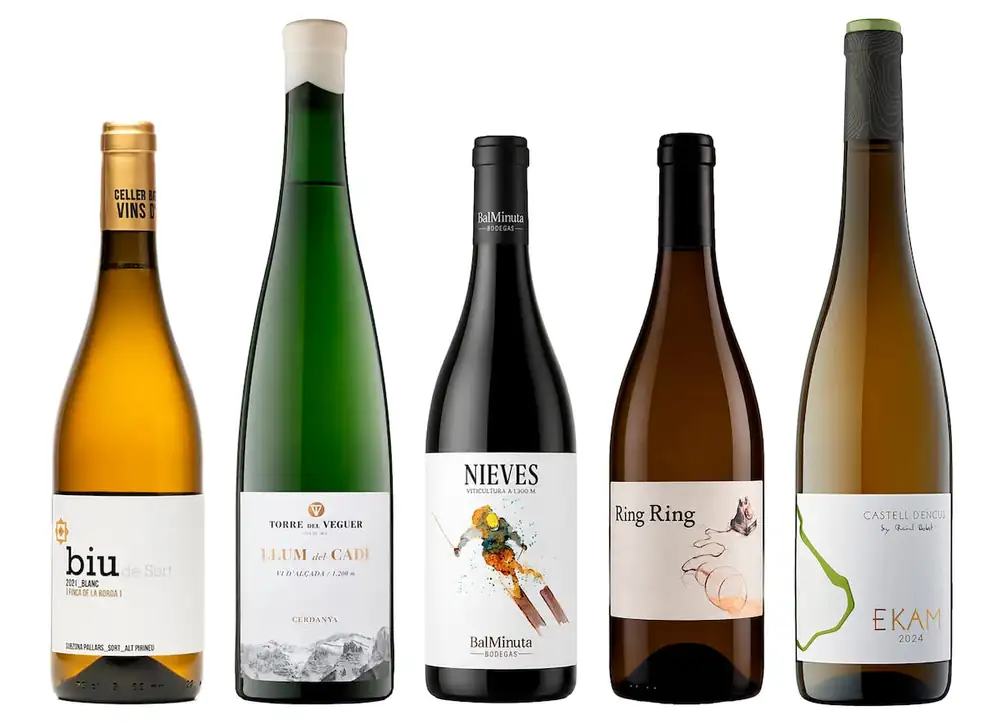
Five high-altitude Spanish white wines made with the Riesling variety
Riesling is one of the world's most prestigious white grape varieties, thanks to the exceptional quality of the wines produced in Alsace and the German Moselle and Rhine regions.
The problem is that our climate, especially in much of Mediterranean Spain, doesn't always allow these varieties to express their full potential. Riesling, in particular—a relatively late-ripening grape—needs cool climates that allow it to slow down its cycle and preserve acidity and balance. And here another factor further complicates matters: climate change, with its rising temperatures, heat waves, and extreme weather events. One way to overcome these challenges is to grow at higher altitudes, something Spain allows thanks to its mountainous terrain. Keep in mind that for every 100 meters of altitude gain, the average annual temperature drops by about 0.5 degrees Celsius, which translates to an extension of the ripening period by 4 to 7 days. This explains why some of the most interesting Spanish Rieslings come from vineyards cultivated in the high mountains, at altitudes of 900 to 1,300 meters. A viticulture that is often heroic.
Let's delve into a bit of history. Although for centuries the romantic theory existed that Riesling descended from the Roman variety Argitis Minor (mentioned by Columella in the 1st century AD), modern genetic studies have demonstrated that its origin is medieval and Central European. DNA analysis confirms that it originated in the Rhine basin as a natural cross between a wild grapevine (Vitis vinifera subsp. sylvestris) crossed with Traminer (Savagnin) and Heunisch Heiss (Gouais in the French region bordering Switzerland). The first known documentary references to Riesling date back to March 13, 1435. It appears recorded as Rießlingen in a wine cellar inventory of Count John IV of Katzenelnbogen in Rüsselsheim, very close to the renowned Rheingau region on the banks of the Rhine.
For centuries, the Riesling variety thrived in German-speaking regions, where it became one of the great symbols of winemaking quality. In Alsace, whose history was closely linked to the Germanic world, it also found a privileged territory, and its wines quickly achieved enormous prestige. From the 19th century onward, Riesling's fame crossed European borders, spreading to countries such as the United States, Australia, New Zealand, and South Africa. In each of these countries, it has demonstrated a remarkable capacity for adaptation, although it maintains a special affinity for cooler climates, where its slow ripening allows it to preserve acidity, aromas, and balance.
The arrival of Riesling in Spain is a story of bold Catalan winemakers who decided to invest in this German variety, drawn by its potential for producing quality white wines. However, unlike other European regions where Riesling adapted to cooler climates, in Spain's Mediterranean region it encountered a different situation, with hot summers and a winemaking tradition resistant to innovation. Only the family-run Miguel Torres winery, under the direction of Miguel Agustín Torres, made a decisive commitment to the German variety in the 1970s with its pioneering wine, Waltraud, named after his German wife, who inspired this bold decision. Later, Raúl Bobet, of Castell d'Encús, planted Riesling vines in the Catalan Pyrenees, and Viñas del Vero in the Aragonese Pyrenees.
Today, Riesling is cultivated not only in Catalonia but also in various wine-growing regions—Aragon, the Balearic Islands, Cantabria, Valencia, Rioja, the Basque Country, Castilla-La Mancha, Castilla y León, and Navarre—covering a total of 356 hectares according to data from the Ministry of Agriculture, Fisheries and Food (2025). This is enough to produce around 2 million liters of wine annually, although with highly variable results. These five high-altitude white wines, fresh and vibrant, make all the difference.
EKAM 2024
·Grape varieties: Riesling and some Albariño