Char Siu Pork: Chinese Barbecue Pork
This article contains affiliate links.
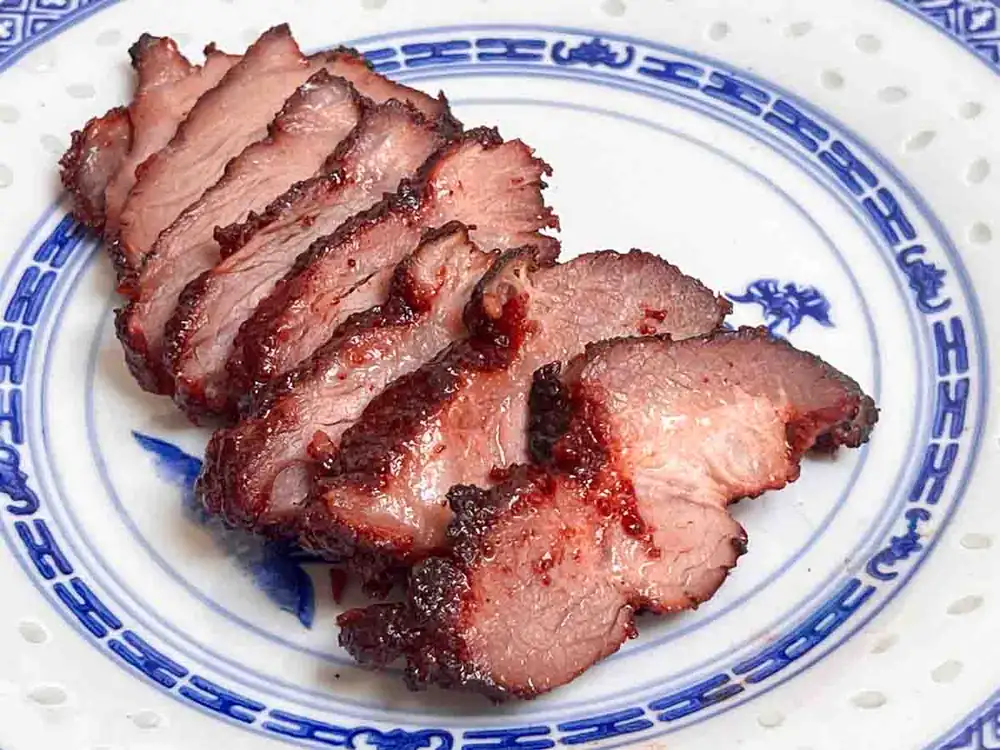
- 3 pounds boneless pork shoulder (sliced into 1 1/2 to 2 inch steaks)
- 1 tablespoon dark soy sauce
- 2 teaspoons five spice powder
- 4 cloves garlic (minced)
- 1/2 cup hoisin sauce
- 3 tablespoons light soy sauce
- 1 cube red miso (with added juice)
- 3 tablespoons red yeast rice (ground in a mortar and pestle or in a spice grinder)
- 1/4 teaspoon salt
- 1 tablespoon sesame oil
- 1/4 teaspoon white pepper
- 1/4 cup hoisin sauce
- 1/4 cup maltose (about 2 handfuls)
- 1/4 cup water (adjust to achieve desired thickness)
- 2 tablespoons char siu marination liquid (strained - optional)
- Mix the char siu sauce ingredients in a large bowl.
- Pour the sauce into a large ziptop bag. Place the pork steaks in the bag and seal it. Roll the bag around making sure the sauce covers all the pork.
- Place the bag in the refrigerator and let the pork marinate for 24 to 48 hours.
- Once you're ready to remove the pork from the refrigerator, preheat your oven to 300°f / 150°c (convection) or 325°F/165°C (conventional) for 30 minutes.
- Move the marinated pork steaks from the bag to a rectangular baking dish along with the marination liquid. Cover the dish tightly with foil and place it in the center of the pre-heated oven. Bake for 90 minutes.
- During the last 30 minutes that the pork is roasting, make the marinade by mixing the maltose and hoisin sauce in a small mixing bowl. (Use a wet hand to add the maltose to minimize the stickiness.) Add a couple tablespoons of the water to loosen the mixture and let sit for about 10 minutes. After 10 minutes the mixture should combine easily.
- Remove the pork from the oven and place it on a baking rack over a sheet pan. Set the oven to broil on its highest setting.
- Optionally strain a couple tablespoons of the pork marinade and add to the glaze. Add more water if the mixture is too thick. Pour 2/3 of the mixture over the pork and brush the glaze to cover the pork uniformly.
- Place the pork under the broiler and cook the first side for 8 to 10 minutes. Flip the pork and brush the remaining char siu glaze on the other side and cook for another 8 to 10 minutes. You want to see the glaze bubble and the pork to cook with the slightest char. Keep an eye on the pork as it can burn quickly. Remove from the broiler immediately when you see the glaze bubble.
- Slice and serve immediately. Wrap any remaining pieces with foil and store in the refrigerator for up to 5 days or in the freezer for up to 3 months.
We may receive compensation if you make a purchase using one of these links at no additional cost to you. Char siu is a food favorite both in China and around the world.
Learn how to make Cantonese-style BBQ pork at home that’s as good, or even better, than the char sui pork served at your favorite Chinese restaurant. Char siu pork is a common ingredient in fried rice, wonton soup, lo mein and char siu bao (i.e, pork buns). But purists love to eat the tasty BBQ pork on its own with just rice and greens.
We like it all of these ways. You can find char siu pork at Chinese barbecue (siu mei) shops where it’s often hanging enticingly in the window alongside roast ducks, soy-sauce-marinated chickens and roast pigs.
The best versions are made in Cantonese Chinese cities like Guangzhou, Hong Kong and Shenzhen. But the sweet fatty pork is ubiquitous in other Asian cities as well as in other parts of the world including Australia, Europe and the USA.
Char siu is relatively easy to find at Chinese restaurants in the US. Many versions are sold at local strip mall bodegas and Cantonese grill houses like Sang Kee in Philadelphia and Great New York Noodletown in NYC. At its best, char siu is a flavorful, fatty, sweet, umami-filled wonder.
At its worst, it’s an artificially colored, gray pork product often found floating in wonton soup. In Hong Kong, char siu derives its red color from actual smoke.
That bright shade is what most people identify with char siu today. The process is different in America since cooking pork with wood isn’t the norm.
Over many years, cooks have developed other methods of coloring and flavoring pork that simulate char siu’s desirable smoky look. Why Make Char Siu Pork at Home? Our first response to this question would be – why not?
But, seriously, in many cities it’s far easier to buy a takeout container filled with char siu pork at a local Cantonese restaurant. That’s what we did when we lived in Philadelphia.
Instead of spending days making char siu pork at home, we left the cooking to the pros. We’d either eat it all or save some juicy meat to cook with later.
But things are different now that we live in Lisbon. Portugal, despite having a former colony (Macao) in Asia, has a surprising dearth of Cantonese cuisine.
Once we found the right quality and cut of pork at a local market, we gladly jumped into making char siu at home. As we’ve learned, making char siu is a process that requires the following:
- A need to make char siu pork – Making char siu pork in Lisbon is a necessity since the Chinese food staple isn’t readily available for purchase.
- A recipe that works – We tried a number of recipes until we eventually discovered a wonderful method that gives us great results in our home kitchen.
- The proper ingredients – Finding a well-marbled piece of pork was a key part of our char siu journey. We also needed to find the right combination of ingredients that would generate maximum flavor and char siu’s distinctive red color.
Ingredients
Our quest to make great char siu pork began with the ingredients. We found a multitude of videos and posts showing how to make great char siu, many of which shared similar recipes and ingredients.
But only a couple stood out. That’s where we drew our inspiration.
For our Chinese barbecued pork recipe, we choses not to use any artificial colors. Many American recipes and Chinese restaurants use red food coloring.
Instead we use a combination of Chinese red miso and, with a tip from the cooking channel Chef Steps, red yeast rice. However, unlike Chef Steps, we skip pink salt and instead achieve excellent pink color with ground red yeast rice and a long marination process.
For flavor, we use a combination of hoisin sauce, classic Chinese condiments like soy sauce, sesame oil and oyster sauce along with the most crucial ingredient – five spice powder. All the other ingredients are Asian food stalwarts that contribute to the pork’s flavor.
How to Make Char Siu Pork
Our char siu pork recipe is a three-step process. First, you marinate the pork.
Next, you roast the marinated meat at a moderate temperature. Finally, you briefly broil the meat and caramelize it with an application of sweet Asian barbecue glaze.
The marination step takes the longest. To achieve maximum red color, you need to marinate the pork for at least 24 hours and as long as 48 hours. At 48 hours, your pork will be definitively red on the outside and slightly red on the inside.
Many recipes call for the pork to be roasted and marinated at higher temperatures and glazed at the same time. We, once again, followed a similar procedure as outlined on Chef Steps.
However, Chef Steps‘ recipe calls for lower heat, a closed cooking vessel (covered with foil) and a four hour cook time. We suspected that we could accomplish the same results in 90 minutes with moderate heat and the same closed cooking vessel.
Sure enough, with the aid of steam (which regulates temperature) from the marination liquid (which we poured in the roasting pan), we did exactly that. The char siu we produced was fatty and moist.
It tasted even better after we reheated it with steam. The first step is to mix the marinade ingredients in a mixing bowl Once the marinade is complete, pour it into a large ziptop bag and add the pork steaks.
Place the bag in the refrigerator and let the pork marinate for at least 24 hours and up to 2 days. A day or two later, once the pork is marinated, preheat your oven to 325°F/160°C (or 300°f / 150°c if you’re using a convection oven) and place the pork along with the marination liquid in an oven-safe roasting dish big enough to comfortably fit all of the pork. Cover tightly with foil and place the pan on the middle rack of the oven.
Roast the pork in the marination liquid for 90 minutes. Next, during the last 30 minutes while the pork is roasting, it’s time to make the char siu glaze.
Making the Glaze for Char Siu Pork
Our glaze or ‘Chinese BBQ sauce’ is easy to make with hoisin sauce, maltose, water and (optionally) a small amount (one to two tablespoons) of strained marinade.
We use about 1/4 cup of maltose, 1/4 cup of hoisin sauce and 1/4 cup (or less) of water. If you use maltose, wet a hand and scoop two generous scoopfuls of the sugar substance into a mixing bowl. The maltose will stick a lot, so have a spoon and paper towel on hand.
Next, spoon in the hoisin sauce plus a little bit of water and stir. The maltose, which is relatively thick, will begin to combine if you let it rest for a few minutes. Keep stirring, adding more water until the glaze reaches the desired consistency.
You can speed this step by carefully heating the mixture on a stove. However, if you start preparing your glaze on time, the maltose will incorporate in the mixing bowl and you’ll minimize the clean-up. Optionally, once the char siu is roasted, you can add a couple of tablespoons of the cooking liquid to the glaze.
Make sure you strain it before you do this. After 90 minutes, remove the pork from the oven and place it on a rack over a sheet pan.
Change the mode on your oven from bake to broil. If you’re using an electric oven, set the broiler on its highest setting. Remove the pork from the baking dish and place it on a wire rack fitted in a sheet pan.
Generously cover the pork with the glaze, using a brush so that it’s evenly covered. Leave enough glaze for brushing the bottom side of the meat (you’ll do this while broiling after you flip the meat).
Place the meat in the broiler and cook the first side for about 8 to 10 minutes. Flip the meat and brush it with the rest of the glaze and cook it for another 8 to 10 minutes.
Voila! You’ve created real-deal char siu pork.
You should have about five or six pieces which you can serve now or later. We like to eat one piece right away and individually wrap the rest in aluminum foil. We place one piece in the refrigerator to eat in the next few days and store the rest in the freezer where it will keep up to three months.
Slice the char siu pork against the grain into half inch strips before you eat the barbecued meat. If you reheat the meat, we find that it’s best to steam it.
Ways to Eat Char Siu Pork
There are so many ways to eat home-made char siu pork.
You can cube it and use it in fried rice. You can slice and steam it before adding it to a rice bowl along with green vegetables.
You can also lay slices on top of instant ramen or in wonton soup. You’ll likely have your own preparations for the tasty meat.
However, we won’t tell anybody if you can eat a slice or two as a late night snack. We sometimes do that too.
Ingredients
- 3 pounds boneless pork shoulder (sliced into 1 1/2 to 2 inch steaks)
Char Siu Marinade
- 1 tablespoon dark soy sauce
- 2 teaspoons five spice powder
- 4 cloves garlic (minced)
- 1/2 cup hoisin sauce
- 3 tablespoons light soy sauce
- 1 cube red miso (with added juice)
- 3 tablespoons red yeast rice (ground in a mortar and pestle or in a spice grinder)
- 1/4 teaspoon salt
- 1 tablespoon sesame oil
- 1/4 teaspoon white pepper
Glaze
- 1/4 cup hoisin sauce
- 1/4 cup maltose (about 2 handfuls)
- 1/4 cup water (adjust to achieve desired thickness)
- 2 tablespoons char siu marination liquid (strained – optional)
Equipment
- Zip Lock Bag
Instructions
- Mix the char siu sauce ingredients in a large bowl.
- Pour the sauce into a large ziptop bag. Place the pork steaks in the bag and seal it. Roll the bag around making sure the sauce covers all the pork.
- Place the bag in the refrigerator and let the pork marinate for 24 to 48 hours.
- Once you're ready to remove the pork from the refrigerator, preheat your oven to 300°f / 150°c (convection) or 325°F/165°C (conventional) for 30 minutes.
- Move the marinated pork steaks from the bag to a rectangular baking dish along with the marination liquid. Cover the dish tightly with foil and place it in the center of the pre-heated oven. Bake for 90 minutes.
- During the last 30 minutes that the pork is roasting, make the marinade by mixing the maltose and hoisin sauce in a small mixing bowl. (Use a wet hand to add the maltose to minimize the stickiness.) Add a couple tablespoons of the water to loosen the mixture and let sit for about 10 minutes. After 10 minutes the mixture should combine easily.
- Remove the pork from the oven and place it on a baking rack over a sheet pan. Set the oven to broil on its highest setting.
- Optionally strain a couple tablespoons of the pork marinade and add to the glaze. Add more water if the mixture is too thick. Pour 2/3 of the mixture over the pork and brush the glaze to cover the pork uniformly.
- Place the pork under the broiler and cook the first side for 8 to 10 minutes. Flip the pork and brush the remaining char siu glaze on the other side and cook for another 8 to 10 minutes. You want to see the glaze bubble and the pork to cook with the slightest char. Keep an eye on the pork as it can burn quickly. Remove from the broiler immediately when you see the glaze bubble.
- Slice and serve immediately. Wrap any remaining pieces with foil and store in the refrigerator for up to 5 days or in the freezer for up to 3 months.
Notes
- You can substitute honey for the maltose.
- Double up on the Chinese miso if you can’t find red yeast rice. If you can’t find either ingredient, you can add a couple drops of red food coloring or just be happy without any red color. Your char siu will taste great with or without the red color.
- You can use char siu pork in a number of ways including cubed in fried rice, over white rice with greens and in wonton soup.
Nutrition
💡 Frequently Asked Questions
What is char siu pork? Char siu pork is a Cantonese-style roasted pork that’s marinated in spices and Chinese sauces.
It’s finished with a sugary glaze at high heat. Are char siu ingredients hard to find?
Most of the ingredients, like soy sauce, oyster sauce, hoisin sauce, five spice powder and sesame oil, are common Asian ingredients. Others like red Chinese miso, maltose and red yeast rice are sold at most large Asian markets. Does char siu pork need to be red and do I really need to add red miso and red yeast rice?
You can choose not to use red ingredients in your marinade and your char siu will taste good. However, it won’t have that traditional char siu appearance. You can use a few drops of red food coloring instead of red miso and red yeast rice.
Another option is to substitute a tablespoon or two of Japanese miso (a more common ingredient in most markets but not as red as the Chinese product) for added umami flavor. What can I substitute for maltose? You can use honey instead of maltose.
Do I have to marinate my pork for 24 hours? You can marinate it for as little as two hours.
But your pork won’t have the same flavor and color as when you marinate it for a day or two. How do I store char siu pork?
You can wrap cooked char siu pork in aluminum foil and store it in the fridge for up to 5 days or in the freezer for up to 3 months. How do I reheat char siu pork?
We recommend steaming it for 10 to 15 minutes to reheat it. You can also reheat it in the steamer insert of a rice cooker if you’re serving it over rice.