Taiwanese Beef Noodle Soup
Beef noodle soup also known as niu rou mian is a traditional Taiwanese soup. The same soup is also found in the Sichuan province, which is well-known for its very spicy cuisine.
- 3 lb beef shank ((or beef cheek, cut into 1½ inch (4 cm) dice))
- 3 tablespoons soybean oil ((or peanut oil))
- 1 2-inch / 5 cm piece fresh ginger, grated
- 7 cloves garlic (, crushed)
- 6 scallions (, cut into 2-inch (5 cm) segments)
- 1 onion (, cut into strips)
- 2 tomatoes (, peeled, seeded and cut into 8 wedges)
- 5 dried red hot peppers (, halved lengthwise)
- 2 teaspoons tomato paste
- 2 tablespoons doubanjiang ((spicy paste of fermented soybeans))
- 2 teaspoons sugar
- ½ cup soy sauce
- ½ cup Shaoxing wine
- 2 quarts 2 l of water (for the broth)
- 1 packet Lu Liào Bāo ((lu bao - mixture of spices and Chinese herbs))
- 16 oz. white fresh wheat noodles
- 4 baby bok choy (, ½ per serving)
- Cilantro (, finely chopped)
- Scallion stalks (, cut into rings)
- Marinated kai choy leaves ((Chinese mustard leaves))
- 2 fresh red hot peppers (, cut into thin rings (optional))
- Dutch oven
- Strainer
- Electric cooker ((or classic pressure cooker))
- Place the beef in a Dutch oven, cover it with water and place it on a high heat.
- Boil for 1 minute.
- Drain it in a colander and rinse it thoroughly with lukewarm fresh water to remove impurities and blood.
- Then, in an electric cooker or a classic pressure cooker, heat the oil over medium heat.
- Add the ginger, garlic, scallions and onion in that order, stirring for a few seconds between adding each ingredient.
- Stir to lightly caramelize everything.
- Add the tomatoes and dried peppers.
- Add the meat, tomato paste, spicy bean paste, sugar, soy sauce and Shaoxing wine, and mix everything well.
- Pour in the 2 quarts (2 liters) of water. Add the packet of Chinese spices and herbs (lu bao) and mix.
- Close the cooker and cook under pressure for 30 minutes over medium heat then 2 hours over very low heat.
- When the cooking time is over, carefully release the pressure valve.
- Boil noodles in plenty of water according to package directions. Drain them.
- In the noodle cooking water, blanch the halved baby bok choys lengthwise for 2 minutes or until just tender.
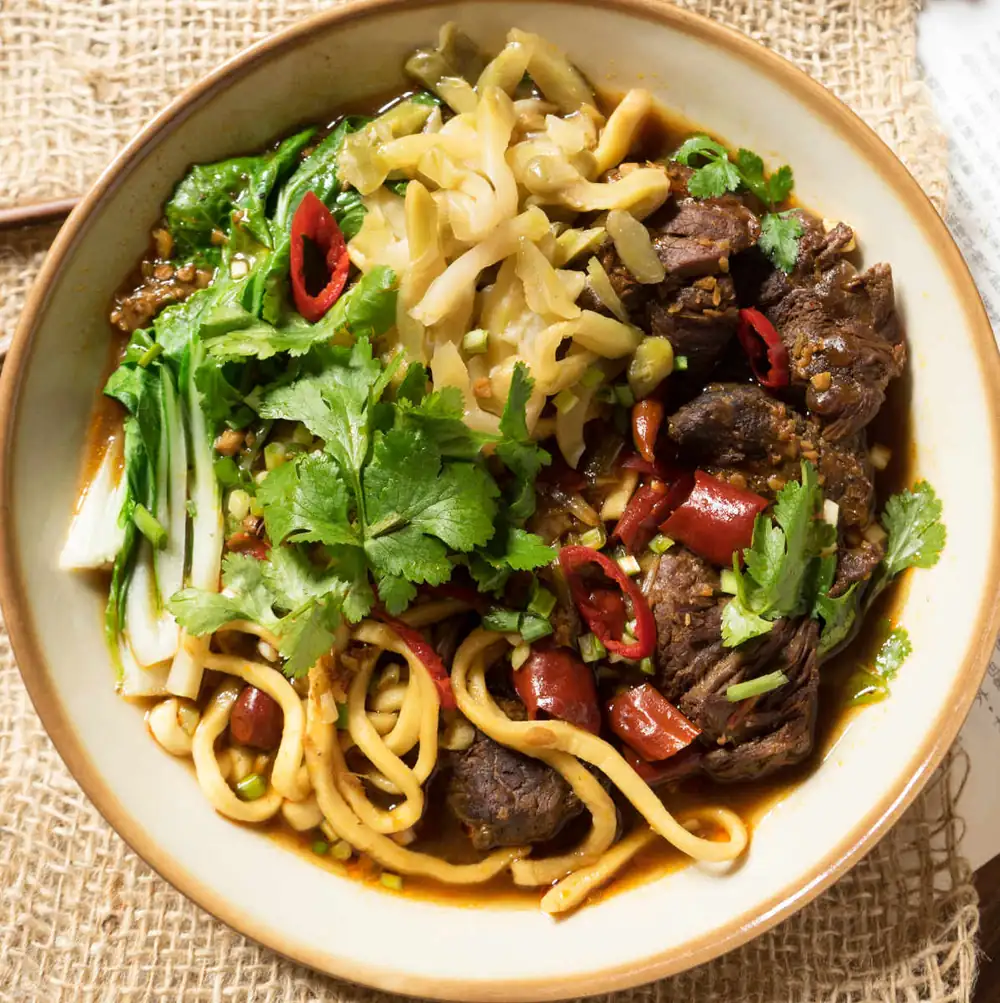
- Serve each bowl of beef noodle soup with a serving of noodles, ½ baby bok choy and generous pinches of cilantro, slices of scallion, marinated Chinese mustard leaves, and, optionally, slices of fresh red pepper (optional) .
It consists of beef, fresh noodles, a very aromatic broth, bok choi cabbage, coriander and fermented mustard leaves. Its taste is rich, spicy and spicy. What is the origin of Taiwanese beef noodle soup?
The origin of beef soup dates back to the Tang Dynasty (581-618). It was once the specialty of Lanzhou. It would have been introduced in Taiwan by Sichuanese veterans of the Kuomintang (the Chinese nationalist party of the beginning of the XXth century).
During the Chinese civil war (1927-1950), the soldiers would have taken refuge on the island of Taiwan taking with them the recipe of this soup. Taiwanese beef noodle soup is very popular in Taipei and Chengdu (Sichuan). It is usually sold on the street at night.
It has also become widely popular outside the borders of Taiwan and China, as it can be found in the United States in many Chinese and Taiwanese restaurants. In Taipei, this soup is considered the national dish. Every year, a big festival allows choosing the best chef and electing the best soup of the island.
How to prepare Taiwanese soup
To make a delicious Taiwanese beef noodle soup, it is imperative to get a piece of beef rich in collagen such as the shank or cheek.
By cooking for a long time, the collagen structure breaks down, making the meat tender and the soup creamy. The meat must be well trimmed and cut into 1 1/2 inch cubes.
It is then blanched, i.e. cooked for one minute in boiling water. This step has the effect of removing the albumin contained in the blood.
This will coagulate and rise to the surface in the form of a whitish foam. This step is essential to obtain a soup without impurities and a clear broth.
Once blanched, the meat is rinsed with cold water and can be used to make the soup. The soup can be made in a pressure cooker or in a standard Dutch oven.
Simply adjust the cooking time so that the soup is tasty and the meat tender. Minced garlic, ginger and green onions are fried in oil, followed by tomatoes and chilies. We then add fermented soybean paste very popular in Sichuan, doubanjiang, and sugar whose function is to balance the different flavors.
Then comes the meat, followed by soy sauce and Shaoxing wine. The soup is completed with water and a mixture of spices, lu bao (or lu liao bao) composed of star anise, Chinese cinnamon, dried bay leaves, fennel, cumin and coriander seeds, Sichuan berries, white pepper and a five-spice mixture.
The soup is then cooked for a few hours until the meat is very tender. Separately, fresh wheat noodles and bok choy cabbage are cooked and assembled in the bowls.
The noodles, cabbage, soup and beef pieces are incorporated, along with coriander leaves, fresh spring onions, fermented mustard leaves and extra fresh red pepper. What are the variations of the Taiwanese soup?
In the United States as well as in China, the soup knows some variations. It sometimes includes braised dried tofu, pork intestines or various vegetables.
A variation of beef noodle soup differs in the choice of the piece of beef used. Thus, the soup can be prepared from shank or breast.
It can also contain wontons (ravioli). Tendons can also be incorporated into the recipe.
The soup is also served without meat in a Hong Kong version. The broth is then well flavored with meat, but the soup has no pieces, and it is sold for less.
The soup can also be prepared without soybean paste, giving it a lighter appearance. In this case, it is more usually eaten in summer and a large amount of fresh herbs is added.
In the south of the country, the soup is garnished with radishes and chili oil. In Chengdu in Sichuan, water is replaced by beef marrow bone broth and oil by beef fat, which greatly enhances the taste of the soup.
4 anise stars
- 1 stick Chinese cinnamon
2 tablespoons Sichuan pepper
- ¼ teaspoon Chinese five spice powder
- ¼ teaspoon white pepper