Fired Up: Saverne, the Gabriel Kreuther Restaurant at Hudson Yards, Reopens
The first time I visited Gabriel Kreuther’s new restaurant, Saverne at Hudson Yards, back in March, the allure of open fire cooking and a return to the chef’s roots had me on the edge of my seat. Unfortunately, I never made it to my entrée.
“And hospitality is not something you create overnight. It’s something you live.”
After settling into my place at the chef’s counter, sipping a glass of wine, and enjoying some country paté—all with a perfect view of the open flames defining Kreuther’s new concept—a smoke detector went off, and yet there was no smoke in sight. Servers quietly began asking us to gather our things and step outside.
Within just minutes—I have the time-stamped pictures to prove it—FDNY filed into Saverne and responded to what would later be described as a mechanical issue hidden floors above the ceiling. Saverne had only been open for eight days.
There was no visible smoke, no dramatic blaze—only a twinge of disappointment as the evening ended before it had truly begun. Diners lingered outside, hoping to be magically ushered back inside.
But it never happened. Saverne remained closed for four months. This time, when I returned to finish the meal at the restaurant’s soft opening two weeks ago, the fire was just where it was supposed to be—contained within its enormous hearth.
Before opening the doors of the new Hudson Yards restaurant, you could smell the aroma of wood fire from a block away. Instead of being alarmed, I thought, They are Back! For Chef Kreuther, the connection to open fire goes back to the farm he grew up on in Alsace, France, where it wasn’t a trendy concept—it was everyday life.
Burning logs, food prepared over open flames, and family gathered around in the kitchen constitute some of his earliest memories and the spark that ignited his dream of being a chef. As early as four, he says, he would dress up as a chef: “I never wanted to be anything else.” So for him, Saverne represents a return to those early memories, before his successes, before the accolades, before his namesake restaurant and the notoriety; back to a time when things were simpler. “It’s going back to the old ways,” he says, “going back to principles, to the basics.”
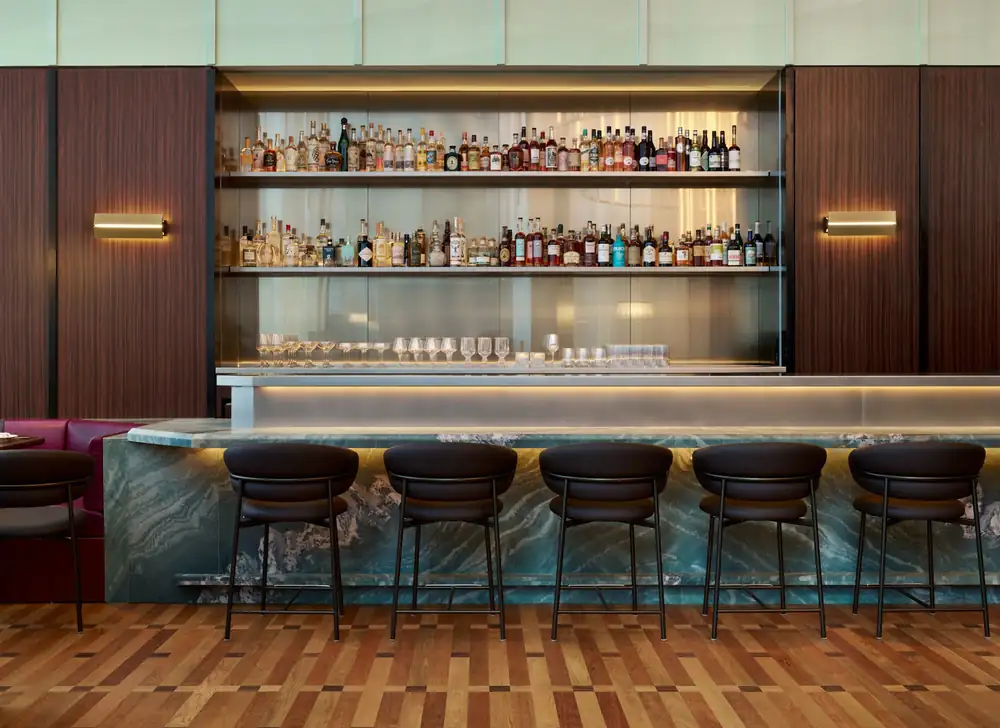
The open fire anchors the restaurant both physically and philosophically. Beyond the massive modern dining area—with lofty ceilings, and beautiful warm wood finishes—diners move to the center room with the open fire where they watch cooks tend the fire throughout the evening.
“It’s beautiful to invite people into your kitchen,” Kreuther says. “You see the exchange.” It’s something he has had on his mind—the need for the type of human contact and interaction that technology and the pandemic has fractured. “We’re in the hospitality business,” he adds. “And hospitality is not something you create overnight. It’s something you live.” It is a philosophy that extends to his cooks behind the line.
During our conversations since the abrupt closing in March and most recently when Saverne reopened, I’ve learned that Kreuther believes deeply in creating a culture where his team communicates and feels a sense of pride and togetherness. Each day, often twice a day, the team discusses everything from ingredients and techniques to producers or new ideas. Cooks are encouraged to ask questions and understand the how and the why of what they are doing. “People want to be heard and be a part of something,” he says. “It’s not just a job.”
He actually speaks very much like a seasoned teacher encouraging new chefs to be curious about the things they are passionate about and to not rush or force a level of mastery that actually has to be experienced. “You have to do it until it becomes muscle memory,” he says. His style of leadership and teaching was put to the test after the fire that closed the restaurant in March.
Although the event itself was brief, mechanical, and fixable, the restaurant ended up being closed for several months, which can often mean a gap in stability and also a setback in a culture that had been created. Nevertheless, 80% of Saverne’s original team returned.
“Walking back into the kitchen with so many of the same faces—that mattered more than people might realize,” says Executive Chef Andy Choi. “We didn’t lose the chemistry that makes a kitchen work—we got to build on it.” It was like resuming a conversation that had simply been interrupted.
Everyone got the chance to give menus and methods a second look. “We didn’t want to just reopen—we wanted to open stronger, “Director of Operations, Paul Murphy says. “Retaining staff was the foundation of that. It let us focus our energy on elevating the menu and improving operations rather than rebuilding a team from scratch.” When returning to Saverne just before its grand reopening on July 27, I found myself at the chef’s counter yet again.
Drawn in by the smell of open fire and a front row seat to the flames, I was excited to continue what I started in March. One glass of Riesling and a house-made smoked fish rillette with toast, whole grain mustard, and cornichons, and my return visit to Saverne was in full swing. While staring at the fish hanging over the fire, which would later get used for stock, I moved onto the Charred Broccoli Caesar, Aged Blue Fin Tuna with Black Garlic, then enjoyed a Roasted Chicken, that somehow became the most tender bite of poultry I think I’ve ever had.
The menu features variety without feeling overwhelming with nods to Alsatian traditional fare like thin flatbreads called Tarte Flambée, wood-fired meats, seafood, and sausages. There are also housemade pastas–a signature favorite is the saffron cavatelli with Riesling-braised rabbit and mushrooms–and small shareable bites like veal liverwurst, croquettes, and Alsatian pretzels and dip.
And, unlike the massive wine list at Chef Kreuther’s namesake restaurant, the one at Saverne is small, with approximately 20 bottles of wine highlighting bottles from Alsace, the Loire Valley, Burgundy, the Rhône, Bordeaux, California, and South America. I sat next to two young men, one of whom I overheard saying, “I think I might cry,” as they thanked the chefs and servers for the experience.
If anyone new had just catapulted themselves into New York and didn’t know about the closure, they would have never believed there had been an interruption; the movement between chefs and servers, and everyone in between felt smooth and steady, underscored by a real pride of place and purpose. Throughout our conversation, Chef Kreuther repeatedly returned to one idea:
that restaurants remain among the few places where genuine human connection still unfolds naturally. “People are responding to human contact again,” he says. “That’s what genuine hospitality is.” And given his legacy so far—his award-winning namesake restaurant near Bryant Park and his chocolate boutique next door—Saverne is primed for success for the community inside and outside its doors. Despite the mechanical fire that forced the restaurant to close just eight days after initially opening, Chef Kreuther and his team have returned to the restaurant, stronger, eager and ready for guests to enjoy the real, open fire that brought them all together in the first place. “There’s a version of this that could have felt like a setback,” he says. “Instead, it became an opportunity.”
- Who: Saverne · Kreuther · Chef Kreuther · Hudson Yard
- Percentages: 80%
- Figures: 80%