The Technological Answer to Ireland’s Growing Dairy Industry
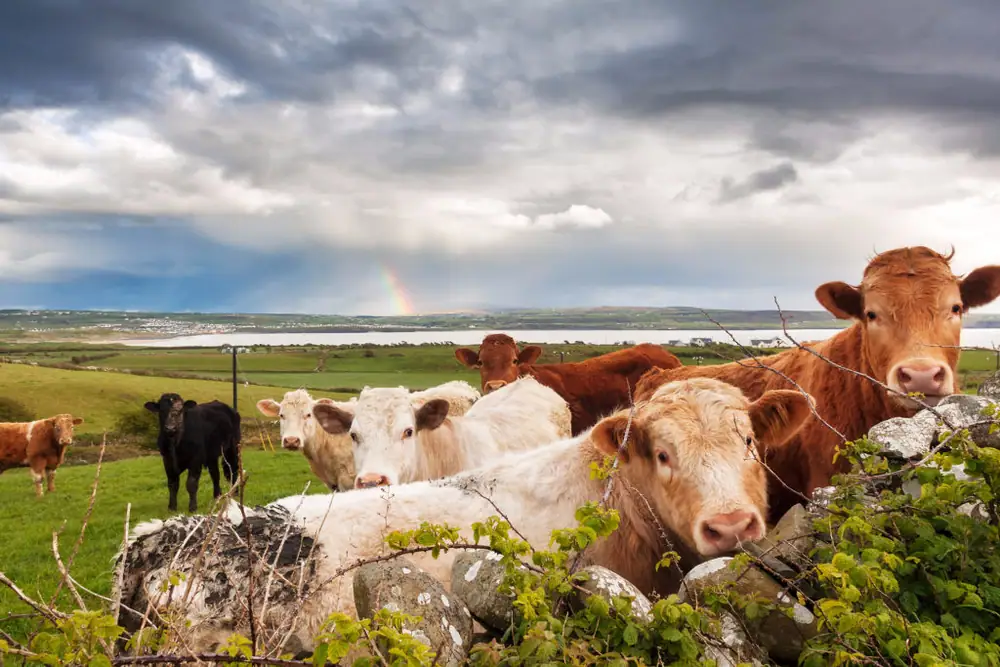
Driving around rural Ireland, it’s easy to guess Ireland’s biggest agricultural industry: dairy, dairy, and dairy.
“With this technology, we can reduce the methane content in the manure by two-thirds … So even if we just burnt it and let it go off into free air, our emissions factor is going from 24 down to one,”
Though Irish farmers in addition grow cereals, potatoes, beans and peas, oilseed rape, and maize, 90% of Irish farmland is grassland and that means dairy — and to a lesser extent beef. A 2017 report from the Irish Food Board valued the country’s dairy sector at €3.38 billion ($4 billion).
Ireland’s grass-based dairy sector has likely kept the country’s dairy yields from matching the heights of the top three global growers: the US, the Netherlands, and the UK — milk production drops when cows eat more forage as opposed to grain. Between 1984 and 2015, the European Union’s dairy trade operated under a quota system, capping milk production in each country to avoid oversupply.
The much-resented quota system was abolished in 2015, which led to producers growing their herds and the Irish the authorities putting in place ambitious goals. From February 2015 to 2016, Ireland upped its milk production by 37% to 295 million liters, miles ahead of the EU’s 5% bump in overall production in roughly the same time period.
The advance of the robotic milkers Robotic milkers, which allow cows to be milked at a faster rate with less labor, have been around since the 1990s, though Irish producers have been slower to use the technology than the rest of Europe. Teagasc estimates that there are 500 automatic milking setups in Ireland (North and South) and 17,000 dairy growers with an average herd size of 60 cows.
A 2015 Teagasc study of the issue concluded that automated milking would have a positive impact even on grass-based dairy estates, but Teagasc offers many reasons that growers are not taking the plunge into full automation including little work about converting a grass-based operation to automated milking, the costs of converting, and the low price of milk. With so much labor needed in the dairy trade, due in part to a lack of automation, Teagasc is studying bring agricultural students from outside the country into Ireland for the first time, going to Agriland . But there is also a challenge when it comes to what to do with all the new milk that’s being produced and the waste associated with extra milk production.
The need to add value “The real manifestation of the abolition of quotas for me was the pressure that brought to bear on our dairy industry to develop new products to use the milk,” states Alan Hobbs, manager of high potential startups for Enterprise Ireland , a the authorities organization with the mission of promoting Irish businesses all over the world. Since fresh milk has a short shelf life and is produced in much of Europe, it has limited export potential, so Ireland has accepted that it needs to beef up its value-added product processing and get into more premium marketplaces, Hobbs argues.
The administration and Enterprise Ireland have put a few plans in place to agreement with the extra supply, including the Food Health Ireland (FHI) initiative, founded in 2006 and funded by Enterprise Ireland. But many sector players say that Ireland must shift from relying so heavily on trade with the UK as, due to Brexit, this trade could soon become more difficult, more dear, or be cut off completely in favor of domestic production. “You want to get away from large commodity blocks of cheddar cheese as you can’t now, in hindsight with the Brexit scenario, overly rely on a low-value product,” said Hobbs.
The country is now focused on cheeses that are more popular in mainland Europe (a Jarlsberg factory is in the works). Infant formula ( Danone has a drying facility for formula production in Cork, Ireland), a product that prizes the high nutritional content of grass-fed milk. Even if all the milk is sold and put to use, Ireland will be left with a big waste problem as the herd grows. Agriculture comprises an eighth of gross domestic product (GDP) in Ireland, and its emissions comprise a third of total emissions, going to a 2015 article in The Irish Times .
But Thomas Wilmington of DIT Hothouse , a technology incubator at the Dublin Institute of Technology, has a plan to agreement with the waste by capturing the methane produced and converting it into biogas. He explains that as a result of not treating the waste, “our methane emissions are some of the highest per capita [of heads of cattle] in the world; it’s crazy.” Wilmington, an engineer and university lecturer, has invented a solution in cooperation with DIT Hothouse.
What used to be a simple tank can effectively be retrofitted into an anaerobic digester, allowing the producer to capture the methane biogas for use. “With this technology, we can reduce the methane content in the manure by two-thirds … So even if we just burnt it and let it go off into free air, our emissions factor is going from 24 down to one,” explains Wilmington.
- Who: Ireland · Ireland’s · Enterprise Ireland
- Money: €3.38 billion · $4 billion · €200,000 · $240,000
- Percentages: 90% · 50% · 37% · 5%
- Figures: 90% · 3.38 billion · 4 billion · 50%