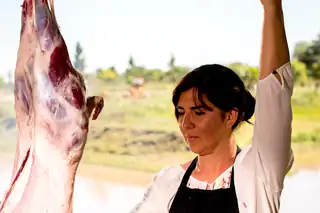
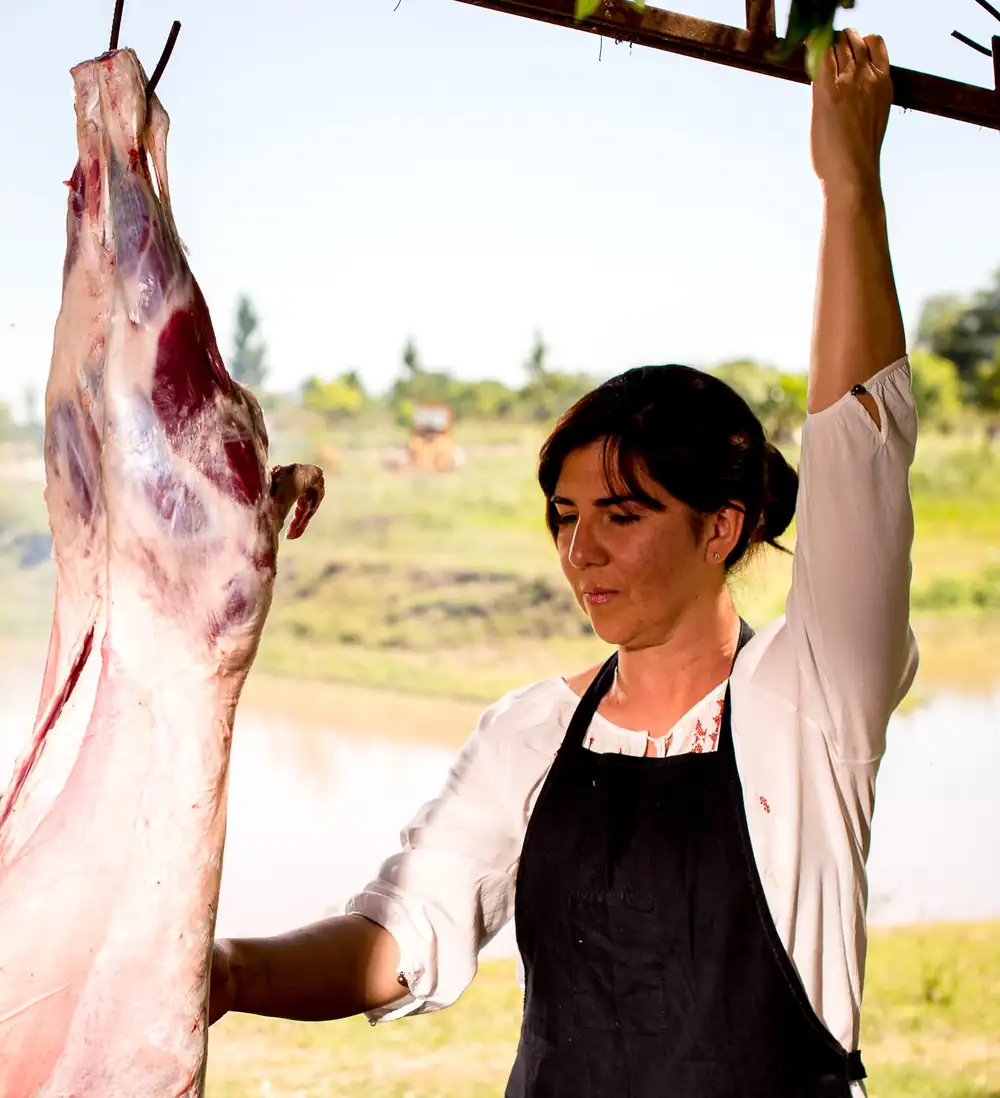
Alina Ruiz, the cook of El Impenetrable 7 Cannibals
El Impenetrable National Park, 128,000 hectares in the Gran Chaco region, is Argentina's best-kept secret. It protects one of the very few remaining subtropical dry forests on the planet and is one of the least explored territories by humankind.
El Impenetrable National Park, 128,000 hectares in the Gran Chaco region, is Argentina's best-kept secret. It protects one of the very few remaining subtropical dry forests on the planet and is one of the least explored territories by humankind. The indigenous peoples who inhabited it (the Qom and Wichi ethnic groups; their descendants still do) were the last to submit to the Spanish colonizers and maintained conflicts with the national army until 1917. The dense forest acquired its own sovereignty, with a way of life that remains unchanged. Its cuisine is a journey into the past and an encounter with ancestral recipes and authentic products. Alina Ruiz (43 years old) owns her restaurant, Anna, Restaurante de Campo, at the entrance to El Impenetrable, where she offers all the culinary knowledge of this weathered and pristine land.
“You eat what you can find” says Alina Ruiz, heir to a rich and unique family culinary tradition. Nature has provided those who dare to live in El Impenetrable with a limited number of animals and plants that can survive an extreme climate. Rainfall doesn't exceed 600 mm per year, and in winter the temperature can climb above thirty degrees Celsius. Water is a scarce resource. “What was natural to me, I suddenly realized was a trend in gastronomy” she affirms. Locally sourced ingredients were always readily available to her. All the products she uses in her dishes are produced on the family farm where she grew up.
She started cooking at nine years old to pay for her school trip, and her grandmother gave her the ricotta to make the cannelloni she sold in Castelli, the town where she was born and lives, and where she has her restaurant. Castelli is considered the gateway to El Impenetrable, two hours from the mountains. “I would tell customers they were filled with my grandmother Anna’s ricotta” she recalls. That experience set her on a path: her restaurant bears her grandmother’s name. “I always loved what I had, but I had to leave my town to realize it” Ruiz confesses. First Buenos Aires, the capital of Argentina, but also Lima and Bogotá, destinations that shaped her and broadened her horizons, showing her that the only path she should follow was in her own backyard.
Her determination to become a chef led her to work in Buenos Aires as a domestic servant. In her free time, she took culinary courses. In 2009, an idea was born that changed her life: to open a restaurant on the family farm, Don Miguel. Her plan was perfect: to follow her grandmother's teachings, her recipes, and the farm's produce. She had few material resources, but an abundance of raw materials. "I set up a restaurant with just one table, behind closed doors," she recalls. It's innovative now, but it was much more so back in Castelli, in that remote, remote area.
“I never thought about clients outside my own town” Alina says. Local has always been central to her life. From Buenos Aires, she produced her first dinner. She bought tableware, glasses, wines, and everything else that could only be found in the capital. She crossed half the country, a 23-hour bus ride carrying her dream, and after traveling 1,200 kilometers, she arrived in Castelli and prepared the dishes she would offer on her farm. She set that single table and took photos. She made an album and went door-to-door in town to share her idea. The first dinner was a success and changed her life, although, calmly, she returned to Buenos Aires to continue working and gaining experience. Once a month, she opened her one-table restaurant.
Everything changed again in 2016, this time in a crucial way. Her father, the village greengrocer who supplied her with produce (and still does), also grows watermelons and melons, and in good harvests, he showered his children with generosity. “I’m going to give you the restaurant” he told her. That single table grew to accommodate twenty people and a full-fledged establishment, all on his own property. Anna Restaurante de Campo was born, the only culinary experience that encapsulates all the flavors of the Chaco Impenetrable region.
“It wasn’t really my idea, but rather a way of bringing to life what I experienced growing up in the countryside” Ruiz explains. Her values quickly made her a role model: rescuing simple, traditional cuisine, rooted in the purity of the land and its aromas. She left the big city and returned to her origins, to live in her village.
An inaccessible territory
Reaching Anna and its aromas isn't easy, just as El Impenetrable isn't, but this very inaccessibility is what makes this land so mythical. The restaurant is located on the family farm, Don Miguel, in the General Güemes department, in the town of Juan José Castelli, on Route 95. Her grandfather, Miguel Hrunik, a Czechoslovakian immigrant, established a family dynasty of farmers there, who have always worked the land.
“I don’t have elaborate techniques; what saves me is the quality of the ingredients. If I didn’t have the vegetables my father grows, I couldn’t make my dishes” says Ruiz. The heart of his family is the soul of his menu. Not only vegetables, but also fruits and meats from their own livestock. From the restaurant itself, in the courtyard of his grandparents’ house, you can see the grapefruit trees, the orange trees, and the vegetable garden they planted themselves. The nature of this arid and dry region reveals its fertility before the tables. He offers a four-course menu at lunchtime and a seven-course menu at dinner. “We never take reservations; we prioritize personalized service” he states as a declaration of principles.
Rainwater is the only water used for drinking and cooking. In times of scarcity, they obtain water from the yacón plant.
The products of El Impenetrable are those of the dense forest: carob, quebracho, palo santo, palo cruz, vinal, and cardon cacti make it virtually impenetrable. The parchment-like soil is traversed by anteaters, peccaries, tapirs, and jaguars. Thorns are everywhere. They were the natural shield of the original inhabitants, protecting their identity. The houses are made of adobe with mud and thatch roofs. Clay ovens are used for cooking. Water is barely visible, appearing only in isolated puddles and in the two large rivers that cross it, the Bermejo and the Bermejito.
In times of scarcity, men and animals sustain themselves by eating the heart of the pindó palm or drinking the liquid found in the yacón tuber. In this extreme environment, a handful of landscapes surround El Impenetrable National Park. Life here possesses both basic characteristics and a complex diversity that creates a unique blend of flavors and textures found only in this territory.
Traditional products include passion fruit, grapefruit, lime, sour orange (used to make marmalade), ucle (a thistle used to make juice), doca (a plant-based salt), and carob pods, the fruit of which is ground into flour. Also included are watermelon and various types of squash cooked over embers, fox-thighed vine (a climbing plant with a taste similar to chestnuts), wild beans, sweet potato, corn, honey, and cassava, the "generous mother." Animals such as rheas and deer, cattle, goats, fish (like catfish, moncholo, and surubí catfish), iguanas, and vizcachas are part of the diet.
The taste of the earth
“The stews are what define this land” says Alina. The iron pot is the inseparable companion in the kitchens, where the fire is never allowed to die down; there’s always a flame burning in the houses of the mountains. Rice and noodle stews with squash, sweet potatoes, cassava with pieces of kid goat, iguana, or vizcacha seasoned with wild chili peppers, or braised dishes, are typical of El Impenetrable cuisine. Alina’s menu reflects the region she has known since childhood. For example: stuffed egg with beet mayonnaise and chickpeas with a peanut crust, pickled charata (a wild bird), pacu empanadas, pasta stuffed with goat, and lemon verbena ice cream.
“Cooking can change realities” she asserts. Her work focuses not only on the restaurant but also on fieldwork in the various areas of El Impenetrable, rescuing traditional recipes and training women so they can make a living from their culinary knowledge. She doesn't do this alone, but with the support of the Rewilding Foundation, which is dedicated to reintroducing endangered species to restore the environment in the National Park, as well as strengthening the communities' connection to the land.
“Alina is a role model. Her products focus on the region, her cuisine highlights local culture, and she makes use of the resources of the forest” summarizes Fátima Hollmann, Community Coordinator of the Impenetrable Project of the Rewilding Foundation.
At the entrance to the National Park lies the hamlet of La Armonía, home to twelve families (around 50 inhabitants). There, the Foundation has set up a glamping site on the Bermejito River and another (free) campsite, La Fidelidad, on the Bermejo River. Alina Ruiz, from the Rewilding team, trains the women of this small community. The group is called “Las Cocineras de La Armonía” (The Cooks of La Armonía) and they are part of the Emprendedoras por Naturaleza (Entrepreneurs by Nature) project. Each of them opens their homes to offer traditional dishes to tourists. There's no better way to experience the true flavor of El Impenetrable.
“I can’t expect to recover a recipe without being with the cooks in their homes” Ruiz explains. Every week she travels to different communities. Her work is a grand undertaking to protect traditional flavors. The charque empanada (made with salted dried meat), the doca sweet, the arrope (a type of syrup), and the aloja (a fermented carob drink). “Many recipes are dormant in the forest, and my job is to awaken them” concludes the cook from El Impenetrable.