Jean Ginglinger, sixteen generations of wine in Alsace: “Enough with labels”
It is one of the best-known producers of “natural” wine in Alsace, active since 1610. Land of great whites, above all Riesling and Gewurtztraminer, and great bubbles, above all Crémant d'Alsace.
It is one of the best-known producers of “natural” wine in Alsace, active since 1610. Land of great whites, above all Riesling and Gewurtztraminer, and great bubbles, above all Crémant d'Alsace.
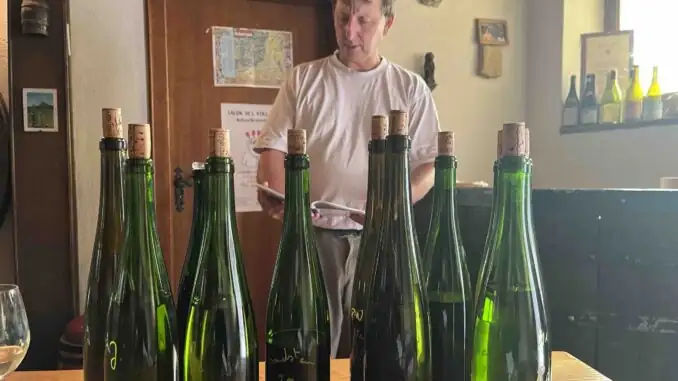
Jean Ginglinger, 55, is a sixteenth-generation winemaker. He welcomes us into a rustic, welcoming room at his headquarters in Pfaffenheim, a tiny town surrounded by vineyards. He's 55, blond, with a long face, a thin mouth, and a French profile.
He's wearing a white T-shirt and trousers with military patches. He pulls some stones from a shelf, showing the limestone and quartz that characterize his territory. There's a plaque with a "Profession de foi," a profession of faith: "GMOs will never be seen in my land, much less in my glasses."
He's been running the company since the 1990s and converted all his production, first to organic, then to biodynamic and natural, after a doctor attributed his wife's deteriorating health to the chemicals used in their vineyards. He obtained all the certifications, Ecocert in 1999 and Demeter in 2001, but then he quit: "I don't like labels. I've quit everything; people don't drink my wines randomly. If they want to know how they're made, they ask. I don't like people who buy wine just because there's a label. It's just marketing."
Jean Ginglinger, behind a smiling kindness, hides an iron character, unwilling to compromise. "Nowadays, there are large wineries that have converted for their own gain, buying up vast amounts of land and enormous tractors, which devastate the land and prevent any porosity in the soil." The harvests on his farm are strictly done by hand, with the only help of Boris, his horse.
His uncle, Gerard Schueller, is a famous local producer, from whom he learned a lot. Thanks to him, and with the help of other greats, like his neighbor Pierre Frick, Ginglinger has converted everything to natural, completely eliminating the use of sulfites. Some appellations have remained, but it's time to break free from them too. He lets us taste a 2021 Riesling, vibrant and wild like Boris: “I can't label this Riesling like that. Better yet. The tasting committee rejected it because they said it tastes of écurie and souris.” Of stables and mice. “Do you realize? My stables and mice wines? Do you know how much they gave me? Zero. Incredible. Now I've appealed because I've already sold them as Rieslings in Japan and the United States, so I need that written on the label. But starting next year, I'm also leaving the appellation, and there's no more talk of it.”
His best-selling wine is Pinot Noir: “Why? Obviously because it's so popular” he smiles. Pinot Noir is the only red grape variety in Alsace, but even this uniqueness needs to be put into perspective: “Do you know how many variations of Pinot Noir exist? Two hundred.” His reds are rustic, with few tannins, vin de soif, as they say, that is, wines that go down easily, not for tasting, not for swirling the glass searching for who knows what olfactory sensation, but simply for drinking. Now, in reality, it's not the only red: “I planted some Sangiovese vines” he says. “My friends from Lazio at Le Coste gave them to me. In exchange, I gave them some Pinot Noir vines.”
A third of the vineyards would be Grand Cru, but since they don't add sulfur, they don't get the certification. Jean is fine with that. Or rather, Jean-François. "Everyone in the family is called Jean." What do you mean? "You add another name, like Jean-Baptiste, and you move on. My son's name is Arthur-Jean. He works with me and at 22 he already has his own production, Le Paradis d'Arthur."
He lets us taste all his wines, made with Alsatian grape varieties: Sylvaner, Pinot Blanc, Riesling, Pinot Gris, Muscat d'Alsace, Gewurztraminer, Auxerrois Blanc, and Pinot Noir. His macerated Gewurztraminer is particularly impressive. We often dismiss Gewurztraminer because we consider them too sweet, and they usually are. But maceration transforms it completely: his Gewurztraminer is rich, enveloping, smooth, and opulent. It should definitely not be drunk chilled. Not exactly "hot," as biodynamic guru Nicolas Joly advises, but certainly at a temperature well above 40-43 degrees Fahrenheit. It won't have any labels, neither the European organic one nor the Demeter biodynamic one, it won't be in any AOC or denomination, it won't appeal to any tasting committee, but it's a blast. This is a wine that presents itself, like Jean Ginglinger, it doesn't need business cards or stamps or official paper.