Rugelach, an Eastern European pastry that became famous in New York
Rugelach is a small rolled cake, linked to the Jewish gastronomy of Central and Eastern Europe and to 20th-century immigration.
This small, rolled pastry pairs perfectly with a cup of coffee, but its history is surprisingly diverse. It's part of Ashkenazi Jewish cuisine and is primarily associated with Poland, Hungary, and Austria. Its name is of Yiddish origin, and most linguists believe it comes from the word "rugel," meaning a small fold or twist, referring to the pastry's shape.
The earliest versions weren't necessarily made with the shortcrust pastry we know today. According to several sources, those from the 19th century and earlier were made with a leavened dough, similar to that of a sponge cake, and had a shape similar to a croissant. Nuts, cinnamon, honey, and jam were already common fillings at that time.
The rugelach is often compared to other Central European pastries. However, its relationship to the croissant is more formal than technical: historical parallels point more to kalács and filled rolled pastries, which are found in many cuisines of the region.
The most well-known version developed in the United States in the 20th century. Jewish immigrants from Eastern Europe brought the recipe to New York and other major cities, where it continued to evolve with new ingredients and local flavors. The most significant change is in the dough: the American version has become popular with cream cheese, giving it a softer, more crumbly texture. By the mid-20th century, rugelach had become a staple in New York bakeries, and from there it achieved international fame.
In the classic method, the dough is rolled out into a circle, cut into triangles, and then rolled into a croissant shape. There are also versions shaped like a stick, a spiral, or small, bite-sized pastries. In all cases, the ratio of filling to dough and the contrast between the layers remain constant. Walnuts and cinnamon are still among the most common fillings and were present in the earliest versions.
Modern bakeries have also incorporated chocolate, pistachio, or caramel, which complement the classic flavors rather than replacing them. In American versions, the filling is integrated into the rolled structure, forming a thin layer that melts into the pastry during baking.
Originally, rugelach was associated with festive occasions, especially Jewish holidays, where these small cakes, ideal for sharing, served both a practical and symbolic purpose. Over time, it has transcended that context and become part of everyday life.
At the SALT bakery, rugelach came onto the menu as a result of a personal story, linked to an interest in Jewish cuisine and family memories. "When developing our offerings, the goal is always to include classic Hungarian pastries alongside products that are less common at home but closely tied to Central European traditions. Besides, I have many childhood memories associated with them: my grandmother used to bake us lots of pastries when we were children."
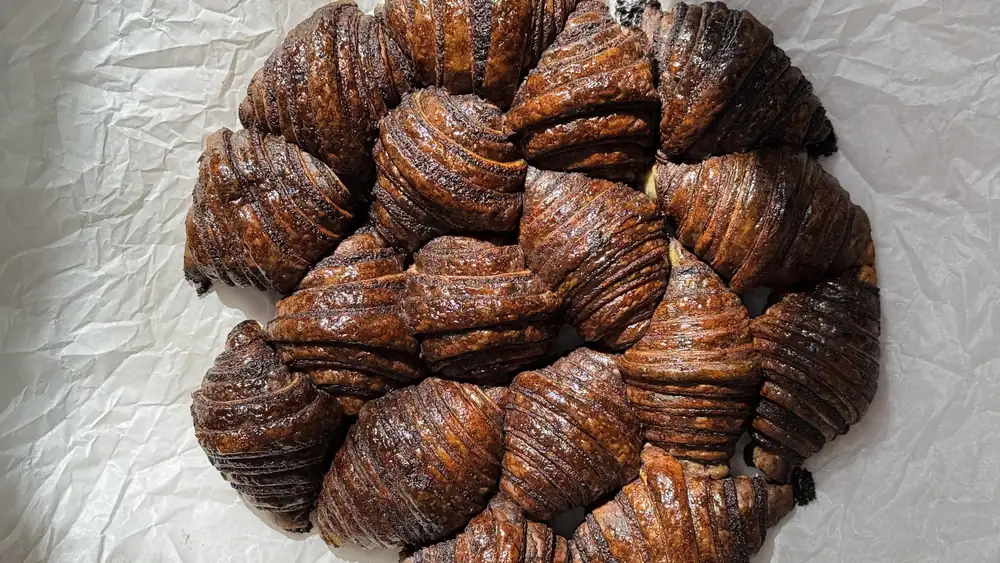
“Our version differs from classic recipes in several ways: the dough is entirely plant-based, contains no eggs or dairy products, and is made with oil instead of butter, resulting in a lighter yet functional structure,” explained Lea Lefkovits, co-owner of SALT Bakery. In the bakery’s rugelach, which already has three locations, the chocolate is incorporated into the dough: the rolled-out dough is covered with a lighter chocolate sauce, folded, and rolled out again several times. This creates a layered structure with an intense chocolate flavor, still very visible even after baking.