
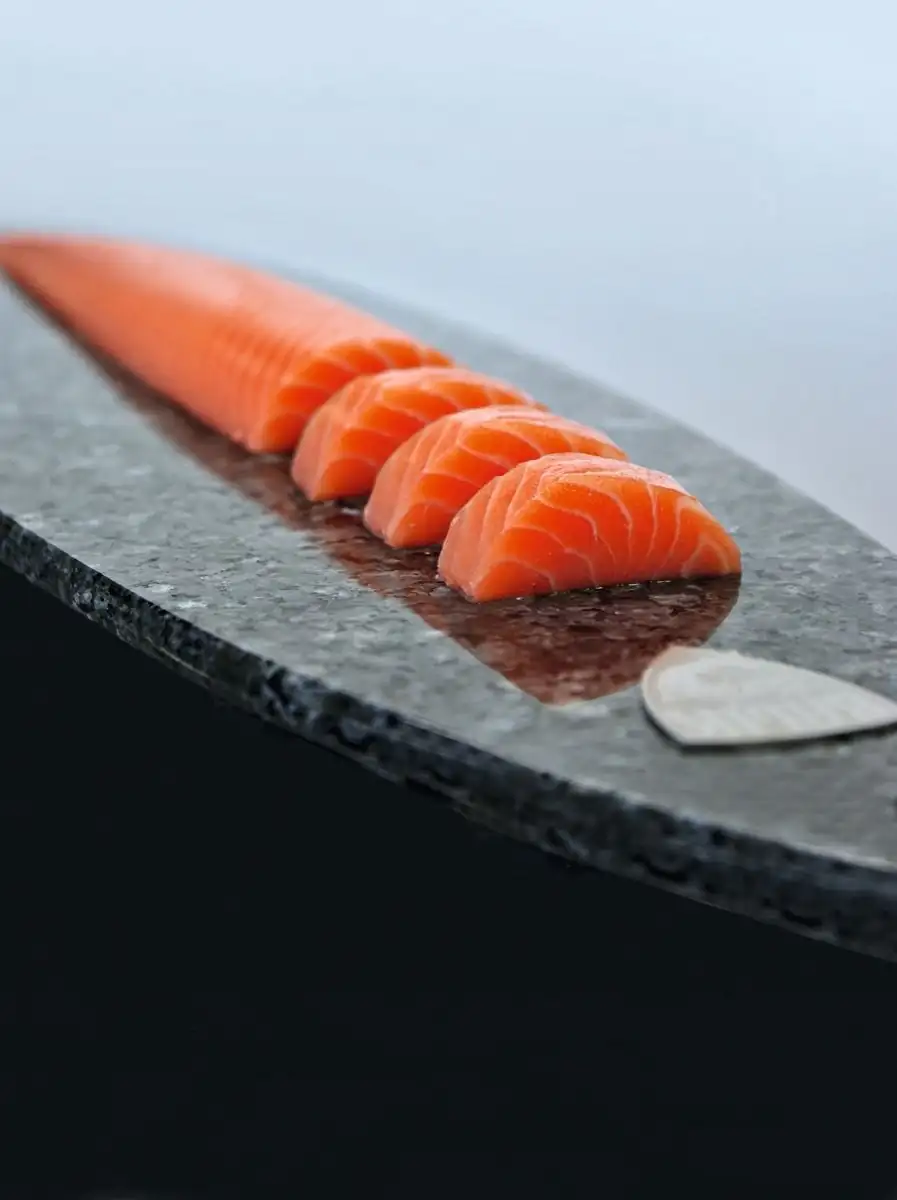
Balik salmon: a smoked delicacy
Balik salmon: The world's finest delicacy of its kind
Balik salmon: The world's finest delicacy of its kind
"Balik salmon is the benchmark for smoked salmon," says top Berlin chef Tim Raue. Indeed, this specialty is considered the finest of its kind in the world. It is the result of Norwegian fish farming, Swiss craftsmanship, and the revival of an old Russian recipe.
The Russians use the term "Balyk" to refer to the best cut of fish. In this case, it means the back fillet, the most prized part of a salmon. Only magnificent specimens of the species Salmo salar, which have spent three years in the icy waters of Norwegian fjords and reached a weight of five to six kilograms, are used for Balik salmon.
The fish arrive flash-frozen in Ebersol, a village of 2,200 inhabitants in the heart of the Toggenburg region in the canton of St. Gallen. There, at an altitude of 920 meters, the processing begins.
Balik salmon production – a true craft
After delivery, the frozen fish are gently thawed overnight under flowing soft water. This water comes from a private spring that bubbles up on the 15-hectare grounds of the Balik farm.
On the second day, the salmon are cut in half and salted by hand with coarse Himalayan salt. This takes effect for 24 hours, drawing moisture from the fish and preserving it.
The halves spend ten to twelve hours the next day in the smokehouse, where lukewarm smoke gently caresses the salmon.
On the last day, employees use tweezers to remove the bones from the fillet.
Finally, the back fillets are artfully cut into shape – it is not without reason that the room in which these masterpieces are created is called the “Room of Artists” within the company.
The secret to perfect salmon preparation: How it came to Switzerland
In 1978, Hans Gerd Kübel, then a director and actor at the Zurich Playhouse, renovated an old farmhouse to use as a weekend retreat. At the same time, he met Israel Kaplan in Berlin, grandson of the purveyor of smoked salmon to Nicholas II, the last Russian Tsar. For six decades, Kaplan had guarded the family secret of perfect salmon preparation – now he entrusted it to Kübel.
From then on, he sold not only eggs from his own farm, but also smoked salmon himself. Initially to acquaintances, later also to restaurants, which were enthusiastic about it.
In 1993, Kübel then handed over his smokehouse to the delicatessen specialist Caviar House (today Caviar House & Prunier).
Interesting facts about Balik smoked salmon
- Farmed salmon from Norway is not subject to seasonal fluctuations and is available year-round in consistent quality. Thanks to ocean currents, the fish constantly receive fresh water, and they have plenty of space: the net pens contain 2.5 percent fish to 97.5 percent water.
- The type of wood used for smoking is a trade secret. All that's revealed is that it comes from surrounding forests and is dried for four to six years before use. The logs for the top-of-the-line product "Balik Fillet Tsar Nikolaj No 1" have even been stored for ten years.
- The smoking time for Balik salmon depends on the weather. High humidity, for example, prolongs the process. The smoke master, Manuel Vilas, who has been with the company for 34 years, decides when the flavor enhancement is complete and the salmon can be removed from the oven.
- Trimming salmon requires utmost care and extensive experience. As a result, new employees are sometimes only allowed to independently shape the back fillets after two to three years.
- The trimmings left over from the preparation are, of course, also made from the finest quality salmon. They are processed into tartare in our own production facility.
- The creamed horseradish can stay in the refrigerator when serving Balik salmon: the harmonious balance of fish, salt, and smoke is best appreciated on its own. To enjoy the buttery-soft texture, slice the back fillets into medallions about one centimeter thick. Then you can serve the prized Balik salmon.