Hetty McKinnon and the Quiet Power of Tomato and Egg
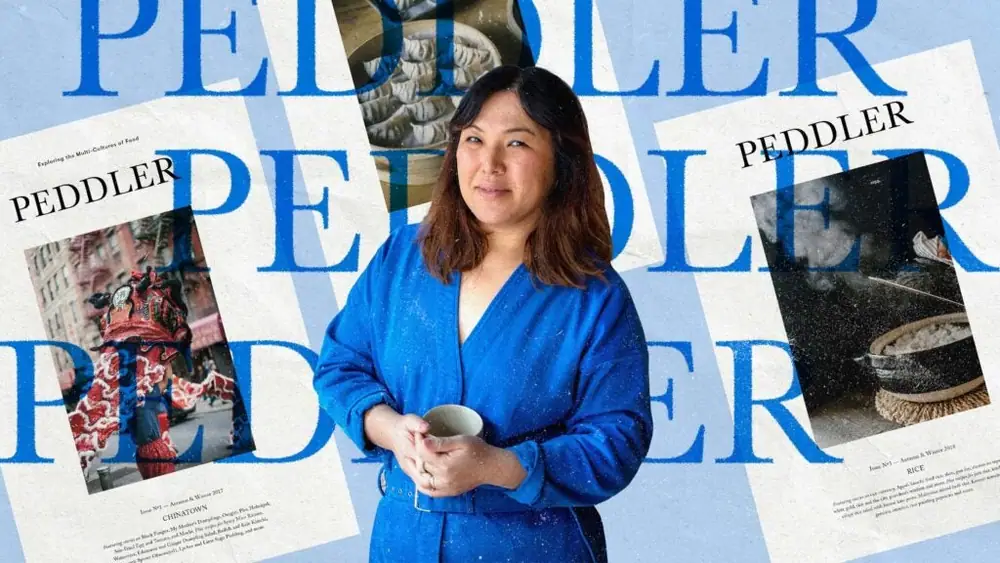
The Australian author and publisher is carving out a space for herself in the fame-seeking, overly styled world of American food media. “ Peddler is a chance to breathe and have a moment of quiet, which I don’t think there’s a lot of in food media,” states Hetty McKinnon.
“Absolutely, just use the ingredient that is the most authentic to that recipe, or that is the most authentic to your family.”
Since McKinnon introduced Peddler in 2017, the twice-yearly food journal seeks to highlight the small, “in-between” moments of food with its limited runs of 1,000 copies per issue. But in doing so, she felt there was more room to contemplate the kinds of stories that get published and who gets to tell them.
The Peddler “universe,” as she calls it, is a reflection on the way we think and talk about food, free from barriers like “unfamiliar” ingredients, “30-minute meals,” prestigious bylines, and fame-driven chef personalities, told through the lens of plain text and film photography, against the backdrop of blank white space. Sometimes I ask myself, “How do I exist in the American food space that wants people to really discuss their success?” That’s one of the things I’ve really struggled with, and, you know, being Chinese, being Australian—those are both cultures where you don’t talk about success very much.
Peddler is a chance to breathe and just have a moment of quiet, which I don’t think there’s a lot of in food media right now. One of the things I found really shocking was the way food was styled—it was so in-your-face and colorful and intentionally styled.
And so, one of the things that you’ll notice about Peddler is that there’s a lot of white space. A lot of the work for major publications has to be: not very many elements, easy-to-access components, you have to be able to cook it in 30 to 45 minutes, and all those things. Whatever the method is works for us.” The recipes, to me, are part of the story.
That’s really freeing to me, as an editor, to be able to do that, to say, “Absolutely, just use the ingredient that is the most authentic to that recipe, or that is the most authentic to your family.” And without any of the worries about things being able to be cooked in half an hour and really easy to access. When I kicked off Peddler in 2017, people asked me, “Why don’t you just go to someone, and they could bankroll it?” You know, they could finance it, and it could have been bigger.
I want it to always stay that way, without any of the pressures of all the outside world and all of that. I doubled the print run last time with the Immigrant issue, and it was not without consideration of whether I really wanted to do that, but I recognize that with every business, with every brand, it grows. But a lot of it is because I want to keep my hands in every single aspect of it.
I don’t ever want it to get to the point where someone else needs to do certain things for stakeholders and all of that. You know, what I wanted to create with Peddler is the immersive world where people feel like they can belong to that world. It really resonated with me.” And I say, “Well, do you want to write for us?” And it’s so shocking to them, but I’ve established some great relationships with writers who have written for me for the very first time and then have gone on to write in subsequent issues and elsewhere.
One of the things that we’ve tried to do with Peddler is to really foster new talent, new voices, and a different style of storytelling. When I first pitched it to my publisher, it was going to be a Chinese cookbook—and there are some very traditional recipes in there—but as I was writing it, I realized, that’s not who I am.
But when we first did it in 2017, the only article we could find on it was one that Francis Lam had written when he left the New York Times . For me, it is one of the quietest books in the commercial cookbook space.
- Percentages: 90 percent
- Figures: 90 percent