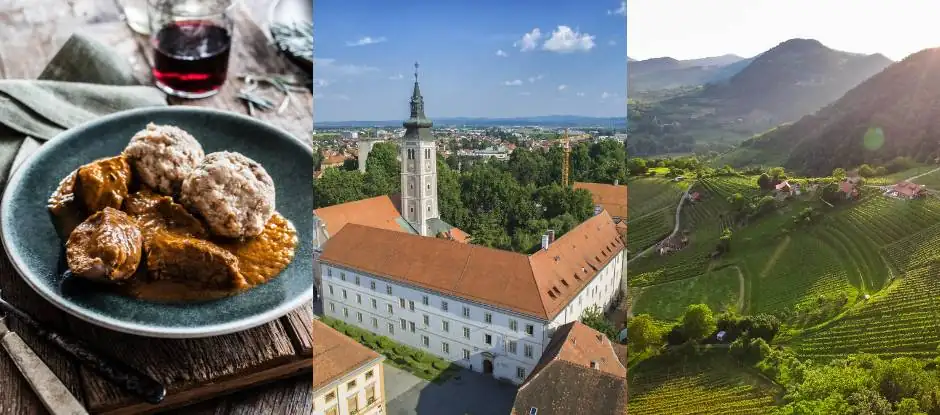
On the hunt for flavour: a food-first adventure through Central Croatia
Presented in partnership with Croatian National Tourist Board.
Welcome to Central Croatia, a cradle of culture with a storied past, where idyllic nature and an abundant natural larder collide to sublime effect. While anchored by the country’s buzzy capital, Zagreb, continental Croatia remains somewhat unsung: but for those curious enough to step off the beaten urban track, stunning scenery, medieval towns and a tempting world of flavour await discovery. Join 50 Best as we guide you through the rural region’s culinary wonders, and stay tuned for our guide to eating and drinking in Zagreb in early 2024.
Sprawling in a ring from Croatia’s capital, Zagreb’s undulating hinterlands are awash with green. This is a land where time slows; a place in which ancient fort towns and baroque masterpieces daub the hillsides – and where some of the country’s most beloved culinary specialities reside. Sandwiched neatly between Hungary to the north, Slavonia to the east and the natural spectacle of Lika-Karlovac to the southwest, Central Croatia bears influence from its neighbours. Sitting at a culinary crossroads, all who have passed through – from the Czechs, Austro-Hungarians and Slovenians to the Venetians, Ottomans and Romans – have left their signature. But, while influenced by Central Europe, continental Croatia holds firm its idiosyncrasies, many of which are realised from the land itself.
It was here that the upper echelons of Croatian society once flocked to soak up natural beauty, flecking the terrain with palatial summer houses and castles as they went. Today, active travellers are drawn in by tranquil landscapes – dense forests, glistening lakes, thermal springs, towering mountains and pretty meadows – which offer ample opportunity for the likes of cycling, hiking, fishing and horse riding. They’ve probably been keeping the marvels of the region to themselves. Little wonder: part of the region’s charm comes from a sense of unblemished authenticity that’s imbued into every element of life here – something most evident in the quality of its cuisine. To journey deeper is to be rewarded with a food scene full of surprises that lives and breathes a farm-to-fork ethos, just as it has for centuries.
Refined rusticism
In an enticing land where baroque mansions are fringed by pastures speckled with old shepherds’ huts, expect a harmonious marriage of flavoursome country fare and old-school bourgeois refinement. Whatever you choose to devour, rest easy in the knowledge you’re getting an authentic taste of a region venerated by its chefs and cooks.
Krapina town’s winery hotel Vuglec Breg is a good place to try it for yourself. The timber-clad restaurant comes with sweeping views and reveals other local morsels like Zagorski štrukli. Served as a starter, snack or alongside soup, think of it as a savoury, doughy pastry filled with a mix of cottage cheese, sour cream and eggs, then sprinkled in breadcrumbs and cooked. Or head to Grešna Gorica, a rustic spot that acts as a regional museum while dishing up all the area’s favourite plates.
Nurtured by nature
Elsewhere, corn is so intrinsic to the life of locals that Posavina even has its own maize. It is used in zlevanka, a dish integral to Central Croatian tables – a dense cornbread-style pudding served both savoury and sweet, either with the addition of cheese or apple, walnuts and jam. It’s slow food from a land that truly provides.
A spoonful of sugar
Word on the vine
Gvirc (mead) is a delicious buzzword around here. It’s one of the world’s oldest drinks: historically it was made by local beekeepers using grape must, and sold at county fairs and festivals. The dark, amber chestnut honey typical of production today sings of the region. It’s perhaps most popular in Samobor, where it’s often served in place of a sweet wine with dessert.
The town also acts as vanguard to the aromatic bermet – a sort of hybrid dessert wine/herbal liqueur. It’s made from blue frankisch grape must muddled with a litany of spices and botanicals (clove, nutmeg, liquorice and mugwort), citrus zest, carob and dried fruit. At one time, every household would craft their own. A bittersweet edge makes for an ideal digestif.
Native poet Antun Gustav Matoš declared Samobor ‘the most Croatian of Croatian towns’. Dating back to 1242 and just 20km from Zagreb, on the eastern slopes of the Samoborsko Gorje range, it offers incredible baroque architecture and welcoming hosts. Immerse yourself at Salvator in the traditional confines of Hotel Livadić. The tavern-like dining room is tucked away in the old cellar, offering an atmospheric framework for the likes of štrukli Livadić, platters of boiled ham, Samobor salami and cheese, slow-roasted veal and buncek (ham hock). Braised buncek (ham hock) Or you could try Gabreku 1929, a name indicative of its time at the helm of Samobor’s dining scene. Facing the church of St Michael at the edge of the Old Town walls, an outdoor terrace is perfect for clement days. The menu follows original home recipes dating back to its inception, all prepared with local ingredients. Don’t miss the tempting bučnica. From here, immersing yourself in nature is a breeze: the stunning Žumberak Nature Park and Samobor Highlands are within striking distance.
Bastions of tradition
On the outer edge of Žumberak Nature Park are the loping vines of Plešivica wineland. Vina Braje is a choice table to book. The charming restaurant feels like stepping into a family home, with an offering that channels the same cosseting sentiment. Homespun and hearty, it conveys real sense of place.
Bolfan Vinski Vrh, in Hrašćina, is another fail-safe. Chef Marija Turek works with a low-food-mile mantra to form a creative menu grounded in heritage dishes with a contemporary edge. Balanced on a hilltop surrounded by vines, it’s a spectacular setting that could easily be mistaken for Tuscany. And make time for a meal at Restaurant Bedem: chefs Anđelko Levanić and Zlatko Novak are leading lights of new Varaždin cuisine.
Gablec: a culinary institution
The man blazing a gastronomic trail.
While Central Croatia’s gourmet wonders may yet sit in the ‘insider knowledge’ camp, that’s set to change. Putting Zagreb County on the epicurean map, and piquing global interest, is chef Bernard Korak. His eponymous restaurant sits resplendent in the bucolic wine region of Plešivica and is considered the first bona fide fine-dining restaurant in the Croatian Upland area. As it’s part of the family’s lauded winery in Jastrebarsko, excellent graševinas, chardonnays and pinot noirs are paired with Korak’s exquisite five- or eight-course degustation menus.
But there’s more to the story. Korak is as emphatic in his commitment to honouring local culinary traditions as he is in his love of the region’s distinct terroir. Two kitchen gardens fuel the sustainable menu, backed by top-class produce from a network of local growers, foragers and hunters. The rule is: if it’s not in season, it’s not on the table. It makes sense when you discover that he cut his teeth in the kitchens of Hiša Franko – under The World’s Best Female Chef 2017, Ana Roš – and with Massimo Bottura at Osteria Francescana, a previous No.1 on The World’s 50 Best Restaurants list.
The result is pure gastronomic alchemy and a real snapshot of the region. Served in a contemporary dining room – all floor-to-ceiling windows with views over the vines and Sava plain beyond – the menu is grounded in Korak’s grandmother’s recipes, which he brings up to date for the modern palate, while remaining true to their heritage. A wise move, as she occasionally lends a hand in the kitchen making the curd to fill the delicate pockets of his signature tortellini. Nuanced flavours and pretty, accessible presentation are showcased across the pitch-perfect menu. Notable plates might include zander laced in brown butter with wild garlic; homemade cured meats and sourdough with hand-churned sour cream cultured butter and venison carpaccio, served with walnut liqueur and blueberry balsamic.
A play on elevated country classics, if you will, this is one to watch. Because that’s the thing about continental Croatia. As it advances, it turns ever-more to its roots. The result is as enticing as it is delectable. Get there now – before everyone else does.
Continue your journey around Croatia’s delicious food and drink on croatia.hr.
Browse even more restaurant and bar recommendations across the world on the 50 Best Discovery website, and follow 50 Best on Instagram, Facebook, X and YouTube for the latest news, features and videos.