Parramon's triumphant return with La Palma de Bellafila
“I didn’t disappear, I simply decided to follow a path that at the time didn’t interest the press.” Perhaps tired of hearing about the “prodigal son of Catalan gastronomy,” Jordi Parramon downplays some of the hype surrounding everything that has been written about him lately with the opening of La Palma de Bellafila and the return of a chef who, indeed, had been lost from the public eye in recent
Often labeled a rebel, he also rebels against that. “I simply had to step aside to achieve what I was looking for,” he says as we chat about his career, his day-to-day life at the helm of this new and celebrated restaurant in Barcelona’s Gothic Quarter, and his future plans.
He speaks slowly, conveying a tranquility so often lacking in the world of gastronomy. And each insight he offers could spark another topic, and surely a lengthy article, one more closely related to anthropology and food. “I’m more interested in food than in cooking,” he confesses.
Catalan cuisine
Having become, with little room for debate, the hottest new opening in Barcelona, La Palma de Bellafila has all the ingredients for the kind of buck-the-trend success so desperately needed in tourist-heavy cities where formulas, decor, and off-premises recipes are repeated, and where the focus is more on the visitor than the local business. La Palma de Bellafila, one of Barcelona's most celebrated openings.
“We’re honest about what we do; we strive for quality products, and we try to keep things simple,” Parramon explains when asked about the secret to the success of this project, where he serves as a consultant. And his consulting, of course, is in his own style: no designing the menu and dropping by occasionally, but rather being in the kitchen every day, without a set duration, staying until everything is running smoothly.
“I’ve been given complete freedom. This balance between capital and cuisine is sometimes difficult to manage,” she notes. The project belongs to Judit Giménez and Albert Rial, from the nearby La Palma winery, a local landmark, who have now opted for something more gastronomic in the welcoming space that for many years housed the Pla restaurant.
Although Parramon doesn't seem to be a big fan of labels, if he had to choose one for La Palma de Bellafila, he'd go with traditional Catalan cuisine. This translates into a straightforward menu where seasonal produce defines the essence of the dishes.
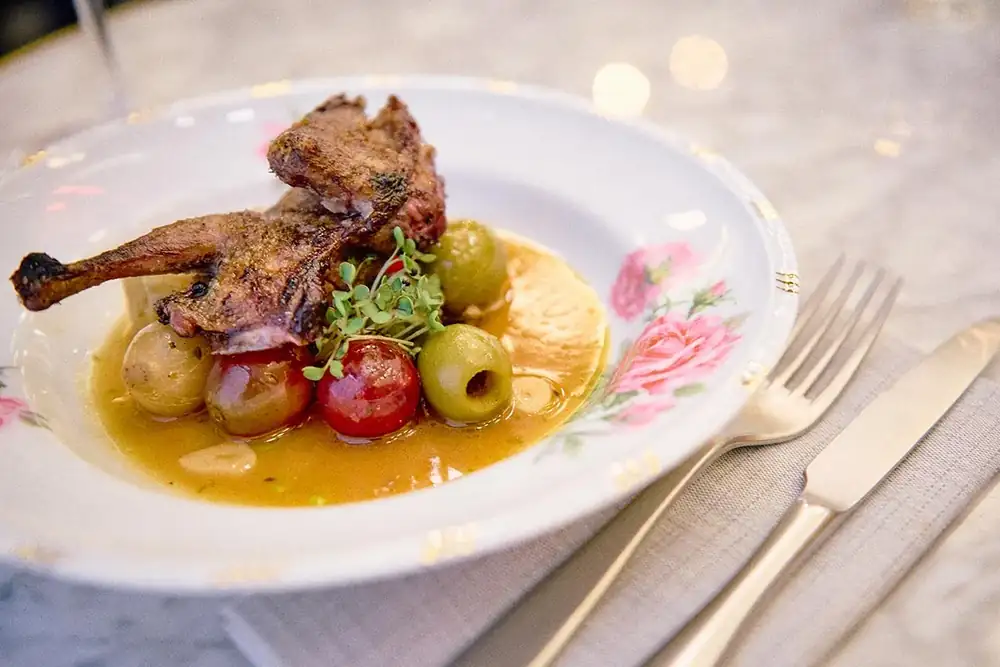
The pig's ear snack or the smoked eel with roasted apple and cabbage make their intentions clear from the start. The marinated sardines with grapes—a harvest dish—or the pigeon with olives, which lighten this rich meat, are just a few examples to give you an idea of what this restaurant offers. They also feature surf and turf dishes—with their own section on the menu—and for dessert, you can opt for the simplicity of a pear in syrup with cardamom, a classic "Music" cake, or go all out for the iconic 80s-style pajama, invented at the nearby 7 Portes restaurant and presented here as "El pijama de la Palma" (The La Palma Pajama).
Mysticism and the stars
But his respect for traditional Catalan cuisine comes across without fanfare or grandiloquent pronouncements about the region. All of that is already present in the dish, requiring no explanation. He also doesn't shy away from the fact that there's a resurgence of restaurants in Barcelona serving these kinds of recipes, and that's precisely the approach he envisioned for La Palma de Bellafila.
Also involved in the world of photography, Parramon prefers not to mix the two facets to avoid falling into the trap of being seen as an "artist chef." But it's impossible not to approach his dishes and wonder how it's possible that someone who, he tells us, has only eaten once a day for so many years, dedicates himself to feeding diners—and feeding them very well.
“Sommeliers don’t drink 10 bottles of wine a day either,” he jokes. As a result of his time traveling and researching, he concluded that “people who live long lives eat very little.” So he started eating less and, he recalls, feeling much better. He also began to savor food more: “The palate is more sensitive that way. If you eat little and the body relaxes, the palate is more attentive,” he asserts.
A mystical vision—as he defines it—of food where respect and ritual surrounding life and death are key. “Food has to be sacred, but we use it as an anxiolytic,” he argues.
Parramon is clear that his future lies in opening his own place. Far from making these ideas a kind of rallying cry, it's up to the diner to simply sit back and enjoy the dishes he prepares or delve deeper into the story of this chef who, he insists, didn't relinquish his Michelin star, he simply closed his restaurant. The former seems more appealing, certainly. But he prefers to acknowledge that without the star his career "would have been very different."
Medium-term plans? First, he insists, is to consolidate the opening of La Palma de Bellafila. But he's long known that his future lies in setting up his own business, as a kind of legacy, putting everything he's learned to use. “I'm 57 years old, I have 10 years of good energy left. I want a place where I can keep my entire library, have 3 or 4 bedrooms, and a shared table where we can talk,” he explains. For now, he doesn't know when it will happen, but he is certain it will, and it will be in the Osona region.