Culinary delights in Lech are gaining momentum
For Dominik Schmid, a new chapter begins at the brand-new Kristberg in Lech.
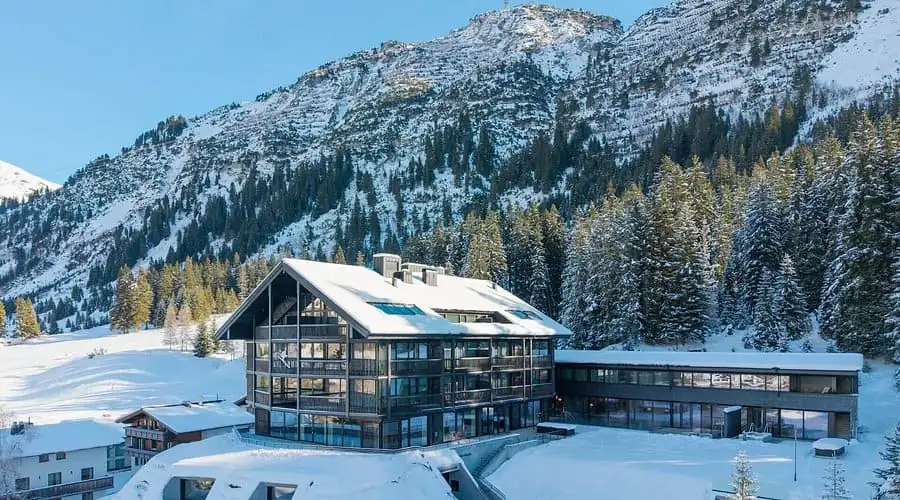
Schmid is now taking over the culinary direction at the newly renovated Kristberg. The hotel in Lech am Arlberg has been completely redesigned, combining 27 suites and a spa with a restaurant that plays a central role in the overall hotel experience. The new head chef's signature style will also be evident in the Salon Lech and the Scotch Club.
His cuisine focuses on high-quality products and precise craftsmanship. Austria and the Alps provide the inspiration; Schmid's international experience broadens the culinary spectrum. For him, this connection is also a natural one: he comes from a family of butchers and innkeepers and is familiar with classic hospitality culture from his childhood.
From London via Munich back to the Arlberg
Schmid has worked with the who's who of Europe's top restaurants throughout his career. His most formative experiences include Mosimann's and Gordon Ramsay in London, Vendôme in Bensberg, Oud Sluis, and Werneckhof in Munich. Later, he worked alongside Tohru Nakamura in the writing department.
Schmid also knows the world of traditional inns from his own experience: As head chef of the Staudenwirt, he was responsible for his own establishment; he also worked at the Rote Wand in the Arlberg region. He now brings this breadth of experience to the Kristberg – with extensive experience in top-class kitchens and a strong connection to product, craftsmanship, and regional cuisine.
A gastronomic story with a long tradition
Culinary arts have been part of the Kristberg family history for decades. Even Egon Zimmermann, ski world champion and Olympic gold medalist, and later founder of the establishment, completed a culinary apprenticeship before his illustrious sports career. His training took him as far as Paris, from where he brought many influences back to the business.
His brother, Karlheinz Zimmermann, shaped the Gasthof Alpenblick in Zug for decades and worked as a caterer in Formula 1. Together with Sabine Lukan, the long-time head chef of the Alpenblick, who is once again part of the culinary team, a distinctive gastronomic style developed over the years that remains evident in the new Kristberg location.
Some of these dishes are still on the menus. At the Scotch Club, for example, you'll find the foie gras "Alpenblick" and the roasted calf's liver à la Sabine. At Salon Lech, the homemade white sausage and the legendary Boeuf Stroganoff from the Alpenblick restaurant are featured.
“Not every good dish needs a new interpretation. Sometimes the art lies in knowing what is better left alone – and we are grateful that our new head chef Dominik has mastered exactly that.” Family Zimmermann
Schmid is thus taking over a kitchen with its own history. His task is to further develop it and contribute his personal experience. This is precisely one of the most exciting aspects of his move to Lech.
Two brothers are shaping the new kitchen
Dominik Schmid is also joining the family team at the Kristberg restaurant. His brother Stefan Schmid, as head pastry chef and in-house baker, is responsible for bread and desserts.
This gives these areas their own distinct place within the culinary concept. In Salon Lech, for example, the evening begins with homemade bread and ends with the dessert buffet. There, guests can choose from dishes such as Sachertorte à la Kristberg and apple strudel à la Alpenblick.
For Kristberg, this new arrangement also marks a generational shift. Michael Haslinger shaped the restaurant's cuisine for 13 years and oversaw the transition from the old Kristberg to the new building. Now he is returning to his native Lower Austria. Dominik Schmid, a chef who knows the existing foundation and brings a fresh perspective, is taking over.
Sharing im Salon Lech
The hotel's two restaurants follow different concepts. Salon Lech's motto is Meet · Share · Inspire.
During the day, the salon serves as a breakfast and lunch restaurant; later it transforms into a lounge and bar. In the evening, the focus is on communal dining. The open kitchen is part of the space; there are no set seating arrangements.
On the table you'll find items like homemade bread or Arlberg ham. Kaspressknödel (cheese dumplings) and cured pork carpaccio are also meant for sharing. For larger dishes, the selection ranges from Arctic char with pearl barley and Kristberg kimchi to roast beef cheek with quark spaetzle. Upon request, the Kristberg Wellington (venison) or two variations of broth fondue are also available.
The dining room is primarily intended to provide space for a long evening. Dishes are passed around the table, another bottle is added, and eventually everyone goes together to the dessert buffet. The restaurant thus also sees itself as a meeting place within the building.
When dinner becomes nightlife
The Scotch Club 1966 strikes a different tone. Under the motto "Drink · Dine · Dance," it combines Austrian-Alpine cuisine with a cocktail bar and later, a nightlife scene.
Culinary classics take center stage. The menu features Wiener Schnitzel and Tafelspitz, as well as venison ragout and calf's liver à la Sabine. A separate steak menu complements the offerings. For dessert, familiar Austrian flavors like Kaiserschmarren and Topfenknödel are also present.
Dinner is served in two seatings at 6 pm and 8 pm. Afterwards, the focus shifts to the bar. Music and cocktails increasingly dominate the space; a resident DJ provides the music for the evening. Around 10:30 pm, the Scotch Club transforms further into a nightlife venue.
The history of the Zimmermann family is also evident here. Formula 1 helmets and memorabilia reflect Karlheinz and Egon Zimmermann's decades-long connection to motorsport and give the room a personal character.
Gastronomy as part of the entire house
“With our suites and spa, we offer our hotel guests an exclusive retreat. We see our restaurants and bars as open meeting places where external guests and locals alike feel comfortable and welcome.” Christiane & Michael Zimmermann
Salon Lech and Scotch Club 1966 are explicitly aimed at guests outside the hotel as well. For the Kristberg, this openness is part of the concept behind the new establishment. Gastronomy accompanies guests from breakfast until late at night, creating spaces where they can meet.
With the new Kristberg, the team behind the scenes is also growing. They are looking for people to help shape the restaurant's future, whether for the kitchen, service, or other areas. The direction is clear: a strong connection to the Lech River, a rich history – and with Dominik Schmid, a new generation of chefs.