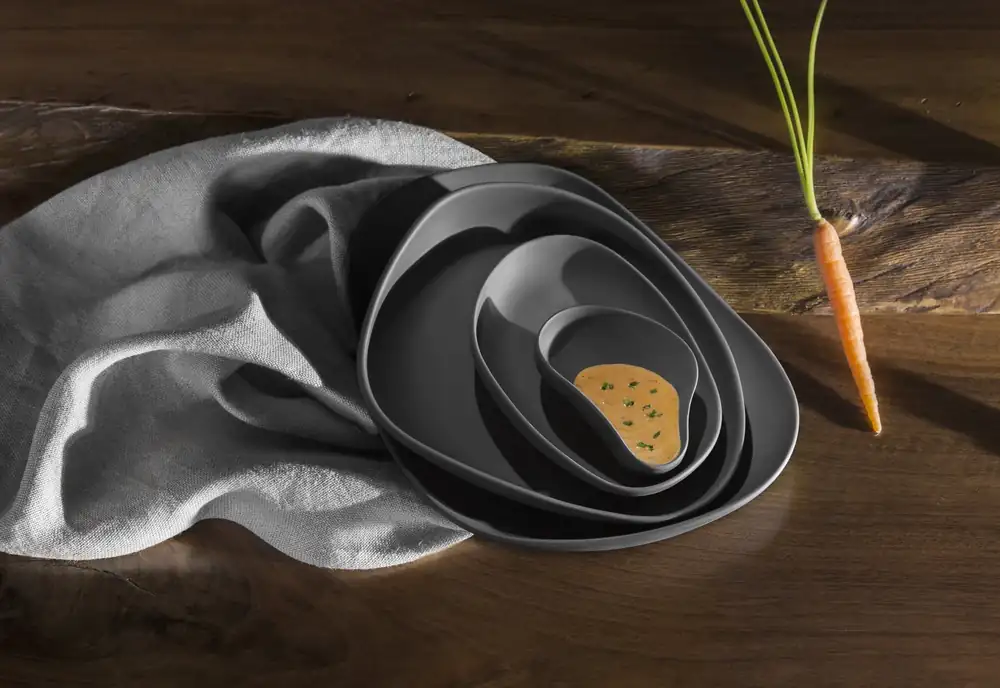
Cookplay, a decade of the company that changed tableware
We could tell you a series of curious anecdotes, strokes of luck or happy coincidences that led the Bilbao-born designer Ana Roquero to become the head of the most famous contemporary tableware brand on the market.
But the truth is that their success is the result of a thorough examination of the circumstances, a highly trained talent for design, and their perseverance in forging a brand that, while maintaining its identity intact, has revolutionized the concept of tableware.
Ten years after its founding, it's no longer the startup that garnered more awards than revenue, but has established itself as a favorite among chefs and has even spawned countless imitations. "I take it as a compliment," he says, finding solace in it.
Cookplay is actually the result of a transformation as bold as its pieces. After years dedicated to industrial design consulting—furniture, office supplies, appliances, and even gym equipment—Roquero was forced to explore a completely new field when the 2008 crisis wiped out much of her clientele. Together with her partner Thibault Paoulou, she sat down to analyze the possibilities and realized that the gastronomic revolution led by Ferran Adrià was changing the way people cooked, but it needed equally innovative tools.
"Entering the world of gastronomy was a very deliberate decision. I love design and wanted to continue in the sector, but I needed to do it on a more human scale than that of the big industry," says a professional who still draws her pieces in pencil on DIN A-3 sheets.
As daring as it may seem, what distinguishes a design object from a sculpture is its ability to respond to specific needs: "How do you eat at home? How do you eat at an event?" were the questions Roquero asked himself during the development of his first collection.
"The original idea was to make disposable containers for events, but at first they weren't successful, so we focused on porcelain." When the pandemic hit during their growth phase and the delivery market exploded, they were ready.
Unclassifiable pieces
Plates? Bowls? Bowls? It's difficult to label that first iconic line, named Jomon, which helped create a new language.
In any case, these are ergonomic pieces, with organic shapes, slightly inspired by the purity of ancestral objects such as the kaiku, but adapted to contemporary habits in which the daily act of eating rarely involves a table and tablecloth.
Their goal then was "to get into people's homes, for those who eat a single dish sitting in front of their computers or lounging on the sofa." However, it was the chefs who best understood their concept. Francis Paniego, Fernando Canales, Dani Lomana, and Dani García are the only ones who own pieces from that first run of 1,000 units, handcrafted in Barcelona. These are rare finds from a brand that now manufactures on a large scale in a family workshop in China, the birthplace of porcelain.
Then came the giants of international cuisine – the Roca brothers, Eneko Atxa, Martín Berasategui, Dabiz Muñoz, José Andrés, Quique Dacosta, Alain Ducasse… and up to 500 chefs from around the world – skyrocketing Cookplay's popularity. Design awards piled up, "but my financial partners told me to stop winning awards and start generating revenue," recalls Roquero, whose company brought in nearly 2 million euros last year.
This alliance with chefs has been evident in subsequent collections, increasingly tailored to the needs of haute cuisine, while always maintaining a very clear identity. "When designing, I let my most intuitive and wild side come out; I look for sensual, expressive objects. The common thread is the feelings that arise around a dish," he explains.
Recognizable by the predominance of white, the purity of lines or the absence of enamels – in their opinion unnecessary – and also by their photogenicity, a vital detail in the Instagram era.
In 2022, her first line of cutlery was launched, and next year will see the release of her first glassware collection. To celebrate this tenth anniversary, Roquero has revisited her first collection, adding decorative textures. A small self-tribute before continuing to imagine ways to change the rules in something—until she arrived—as conventional as tableware.