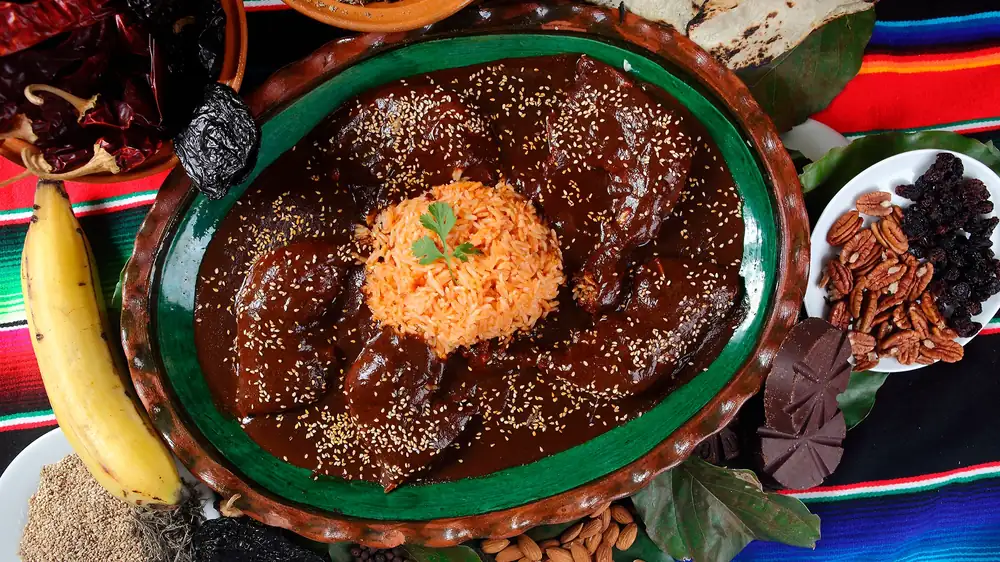
Cannibal guides. Mole: Saying it doesn't mean anything
I'm in a fine dining restaurant whose name I prefer not to mention, facing a mole that costs 850 pesos and tastes like betrayal.
The chef serves it with duck confit and seasonal vegetables, packaged in glassware that reflects the dining room lights. The waiter introduces it as a "contemporary reinterpretation of the Puebla tradition." Each word hurts more than the last.
I take a spoonful. Then another. I look for something to remind me why I came here. I can't find it. What I have in front of me is soulless technique, price without history, mole without Mexico.
And then I understand: by saying "mole" we are not saying anything.
The sauce that was never sauce
Because mole isn't what you think it is. It's not a recipe you learn on YouTube, nor a dish you order to impress tourists. Mole is a system. An edible architecture of time, territory, and tensions that we've turned into a souvenir.
We say "mole poblano" as if that were enough to explain centuries of ritual cooking. We say "black from Oaxaca" and think we're talking about identity, when in reality we're repeating a code already filtered through gastronomic marketing.
Because there is no single mole. There are moles. And each one tells a story that can't be found on any menu.
Oaxacan black mole can contain more than 30 ingredients, ground on a metate for hours. In San Pedro Atocpan, nine out of ten families begin producing it before dawn. In the Huasteca region, there are brothy moles that don't appear in tourist guides. In Guerrero, there's huaxmole, made only with beef bones and eaten with the hands.
Each variant responds to a specific landscape: the soil, the climate, the seeds that grow there and only there. Each monument is a way of interpreting the territory, of understanding what the land offers and how to transform it into something that nourishes not only the body, but also the collective memory.
The Lost Laboratory
Mole is not a recipe: it's a technique. An ancestral laboratory that requires toasting chilies, grinding them on a metate, and the slow integration of spices that can take days to reveal their full character.
Each chili is roasted at a different temperature. Each spice requires its own time. The grinding is not mechanical: it is artisanal, intuitive, passed down from grandmother to granddaughter in a chain that has been operating for centuries without manuals or certifications.
But that doesn't fit into the logic of the modern restaurant. There, mole is made with an industrial blender, thickened with flour, and sweetened with commercial chocolate. It's served lukewarm, glistening with lard, with proteins that never wanted that company.
And we pay, we applaud, and we upload the photo to Instagram. Because we confuse technique with tradition, price with authenticity.
The mole of the others
Who cooks the mole we eat in the restaurants of Roma Norte? Not the women who learned it from their mothers in Tlacolula. Not the cooks who still grind it by hand in Santa María Atzompa. They are young chefs, mostly men, who studied gastronomy and read about mole in books written by anthropologists who also don't know how to grind it.
Meanwhile, the true mole makers—because that's what they're called, mole makers, not "guardians of tradition"—continue working in markets where no one interviews them for food magazines. They sell their mole for 40 pesos a serving. No decoration, no origin story, no mention in the Michelin Guide.
They don't talk about "cultural rescue" or "intangible heritage." They talk about survival. About maintaining a craft that has fed families for generations. About resisting in a market that sees them as folklore, not as artists.
And while they resist, we applaud the chefs who "reinterpret" their work without mentioning them, without paying them royalties, without acknowledging that what they are serving is an impoverished translation of something they never fully understood.
The memory that hurts
Mole chichilo is only prepared for wakes. I know this because I was at one in the Mixteca region of Oaxaca when a friend's grandmother died. The women of the community organized themselves from dawn: they toasted chilhuacle chiles, ground masa with ash, and cooked for hours a stew that only appears when someone is gone forever.
It's not an everyday dish. It's cooked memory. Ritual transformed into food. A way of processing grief that isn't learned in cooking schools or explained in cookbooks.
That mole has an earthy, almost mineral flavor that accompanies the pain without denying it. It doesn't seek to console: it seeks to accompany. And when you taste it, you understand that there are flavors that only appear at certain moments in life. That not everything can be commodified, touristified, or turned into a gastronomic experience.
But that rich tapestry is also disappearing. Young people are leaving for the cities. Grandmothers are dying without passing on all their secrets. And when someone tries to document it, what remains on paper is only a shadow of what it once was.
The mole that doesn't exist
I return to the fine dining restaurant. I finish my plate because I hate wasting food, but each spoonful confirms the same thing: this isn't mole. It's an interpretation, an approximation, a stylistic exercise that uses the word "mole" to justify its price.
And it's not just this place. It's an entire food industry that has turned mole into a brand. A label slapped on any thick sauce with chili and chocolate. A narrative for menus that try to sell Mexican identity without understanding Mexico.
I pay the bill: 2,400 pesos for two people. With that amount, at the Tlacolula market, I could eat authentic mole for a month. Mole made by hands that have known it since childhood. Mole that tastes like it should: of time, of land, of inherited technique.
But this mole doesn't appear in international guides. It doesn't have Michelin stars or gastronomic accolades. It has something better: it has truth.
And yes, it exists. You can find it, try it, and defend it with your palate and your wallet.
Where can you find the mole that actually exists?
In the Tlacolula Market (Galeana 2, Third Section, 70400 Tlacolula de Matamoros, Oaxaca), an hour from the city of Oaxaca, Doña Carmen has been grinding chiles for 30 years on the same volcanic stone metate she inherited from her mother. Her stall doesn't have a name, but any taxi driver knows it: "the mole stand." She sells black, red, yellow, and coloradito moles for 80 pesos a serving, served on handmade tortillas. On Sundays, she sells out early.
In Cholula, the Cosme del Razo Market (Calle 3 Nte 3, Barrio de San Juan Calvario, 72760 Cholula de Rivadavia, Puebla) is home to the Flores sisters, who start preparing mole poblano at five in the morning. Their recipe includes 28 ingredients, including Tabasco chocolate and chiles that they select themselves. They don't deliver or take reservations. They simply cook until it's gone.
In Mexico City, the Mercado de Medellín (Mercado Medellín #20, Mexico City) hides one of the best-kept secrets: Moles Lupita, where Guadalupe Hernández grinds black mole daily and sells it by the kilo. Her clientele includes restaurants in the Roma neighborhood that never mention the origin of their "house mole." She doesn't bother to clarify: she's too busy cooking.
For those seeking the complete experience, Casa Crespo (Reforma 808, Ruta Independencia, Centro, Oaxaca) offers mole classes where you'll learn to toast chiles, grind them on a metate, and understand why each spice is added at its precise moment. It's not gastronomic tourism: it's culinary education taught by traditional cooks who charge a fair price for sharing centuries-old knowledge.
And in Puebla, the Mercado de los Sabores (Av. 4 Pte. 1104, Historiadores, Puebla) houses stalls run by generations of mole makers who compete on quality, not price. Their poblano moles contain more than 20 ingredients each, are prepared in small batches, and are sold fresh. Locals arrive early, because they know that good things sell out quickly.
What remains to be said
I leave the restaurant with the certainty that mole has become everything it shouldn't be: product instead of process, brand instead of memory, experience instead of food.
And as I walk through Polanco, past restaurants selling Mexican food for export, I think about the absurd distance between these two worlds. On one corner, mole for 850 pesos that tastes like betrayal. A few hours away, mole for 80 pesos that tastes like truth.
The problem isn't that authentic moleras don't exist. The problem is that we've created a gastronomic system that ignores them, renders them invisible, and uses them without acknowledging them. A system that prefers to pay fortunes for empty interpretations rather than fair prices for living traditions.
Mole, when you think about it seriously, is unsettling. It doesn't belong on a tasting menu. It doesn't fit into the logic of the modern restaurant. It doesn't fit into the gastronomic fantasies of an industry that confuses tradition with trend.
And that's precisely why we must keep searching for it. Not the mole served in expensive restaurants, but the other kind. The one found in markets where hands know what they're doing. The one that resists being simplified, commercialized, or turned into a postcard.
That mole sauce that, when you taste it, reminds you that some things can't be explained. They can only be felt. And chosen.
Because saying "mole" doesn't tell us anything. But knowing where to find it says everything.