What is the difference between a molcajete and a mortar?
The molcajete, a volcanic stone mortar with thousands of years of tradition in Mexico and Central America, differs from the mortar in its shape and uses.
Traditional utensils retain a special charm, even though electronic tools have brought new techniques. Few are as old as the mortar and pestle, with some 37,000 years of history and still present today all over the world, from Southeast Asia to the Americas and the Middle East.
Originally designed for grinding grains, the mortar is now used to make spice blends, pastes, and sauces, and to process raw ingredients. In Central America and Mexico, there is a type with a long tradition, the molcajete, which offers unique qualities in its composition and shape.
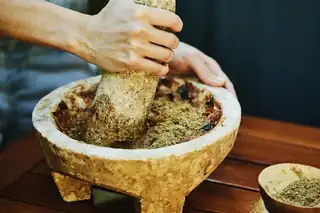
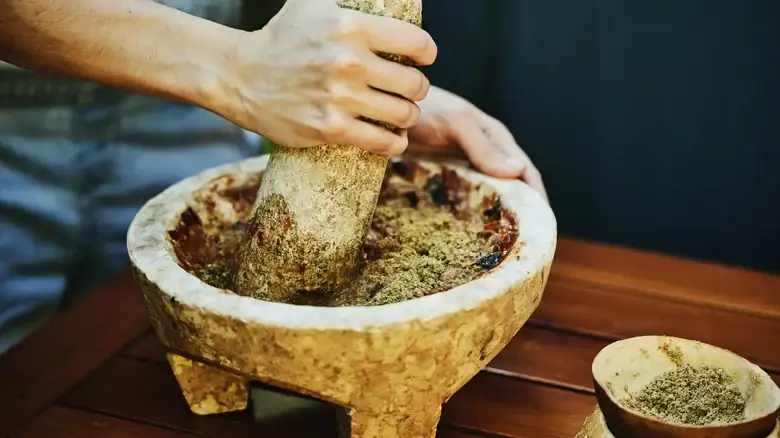
The molcajete is made of volcanic stone with a mineral and granular texture that contributes to a unique grinding process. Its bowl is usually wider than that of a mortar and, when it is especially shallow, it is called a metate. It also has three support legs and sometimes features ornate decoration.
The molcajete is primarily used to prepare salsas, guacamole, and guacachile, and to grind spices, chilies, and seeds for mole. The friction and weight release juices, modify textures, and extract oils, and using it by hand allows for precise control over the final texture.
A new molcajete needs to be ground before cooking, similar to how a cast-iron skillet is seasoned, to remove the layer of stone residue. Its porous stone imparts a subtle mineral flavor, and its small fissures trap aromas that enhance the food over time. This same porosity isn't ideal for grinding garlic, though it is excellent for releasing aromas, which is why many Mexican cooks use two molcajetes, one for wet ingredients and one for dry ones.
The mortar, on the other hand, has a rounded bowl and a rod-shaped pestle. Both parts are usually made of the same material, ranging from stones like granite and marble to brass, porcelain, or wood. Its rotating motion extracts oils and flavors, so it is also used in medicinal and industrial contexts. It is a classic tool for grinding spices, such as saffron, or for crushing garlic.
Molcajetes can exceed 38 cm in diameter and have a capacity of over 7.5 liters, allowing for the simultaneous grinding of whole peppers, onions, garlic, and tomatoes. The smaller mortar is used to process ingredients that are later combined in a dish. Due to its size, the molcajete can also be used for serving food, as in the Mexican molcajete mixto, where proteins, salsas, and beans are served in the same vessel. The aromatics are ground first, and then the molcajete is heated to achieve a visually appealing presentation.