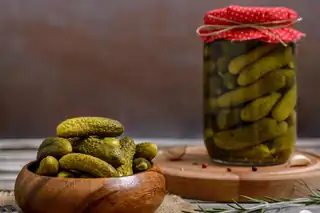
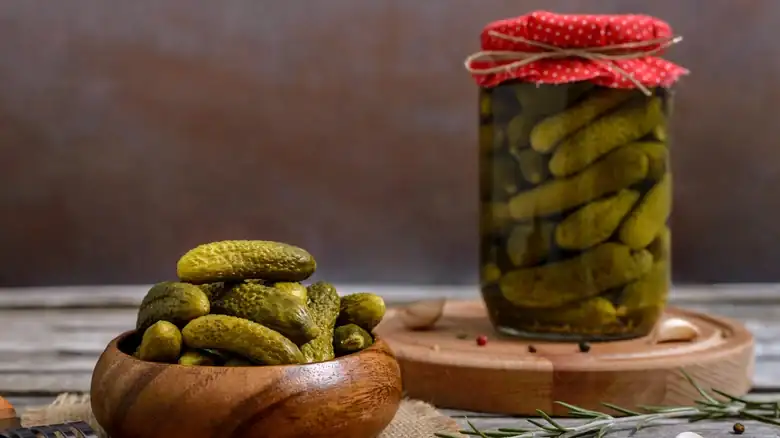
What is the difference between gherkins and cornichons?
Cornichons are a French variety of pickled gherkins, smaller and exclusively acidic, while pickled gherkins encompass more varieties, both salty and sweet.
“is a little more all-encompassing than just the name of a single variety of pickle. According to Masterclass, the name comes from the Dutch word for small pickled cucumbers —”
Before refrigeration, people pickled food to preserve it between harvests. Almost anything can be pickled by immersing it in a salty and acidic solution, sometimes with a touch of sweetness, so there is no definitive list of pickles, and any food prepared in this way can be called a pickle.
There are several well-defined types: classic pickled gherkins, which are more or less sour; sweet and sour gherkins; spicy pickled peppers; and both gherkins and cornichons. The latter two look very similar. All cornichons are gherkins, but not all gherkins are cornichons. The difference lies in their size and flavor.
The term "gherkin" encompasses more than just one variety. According to Masterclass, the name comes from the Dutch word "gurken," meaning small pickled gherkins. Gherkins (Cucumis anguria) are a variety of small cucumber that only grow to about 5 cm, hence the name of their pickled relatives. But most mass-produced gherkins are made from common cucumbers (Cucumis sativus), harvested before they are fully ripe.
Pickled gherkins typically measure between 2.5 and 12.5 cm, are flavored with dill and garlic, and can be either savory or sweet. They have a thinner skin and a crisp texture. They are served whole with cheese and cold cuts, with deviled eggs, chopped in tuna or chicken salads, or in grilled cheese sandwiches with fruit chutney.
They are common, inexpensive, and easy to find in most supermarkets. They can also be made at home by harvesting small cucumbers from the garden and pickling them with herbs and spices. Since the term isn't specific to any region, they can be called gherkins without any problem.
Cornichons are a special variety of pickled gherkin originating in France, made according to stricter specifications. They measure about 5 cm, roughly the size of a baby's finger, and their name means "little horns" in French. They are salted overnight, packed in vinegar, water, salt, and herbs such as dill and sometimes tarragon, and fermented for at least three weeks. Although the name is not protected by a designation of origin, they are a French specialty with their own recipes, harder to find in regular supermarkets, and more expensive than gherkins.
Both types of pickles are fairly interchangeable in recipes, but cornichons are typically reserved to enhance French dishes such as pâté, beef tartare, and raclette. Their size also makes them ideal for garnishing a classic gin or vodka martini, offering a distinct flavor from the olive.