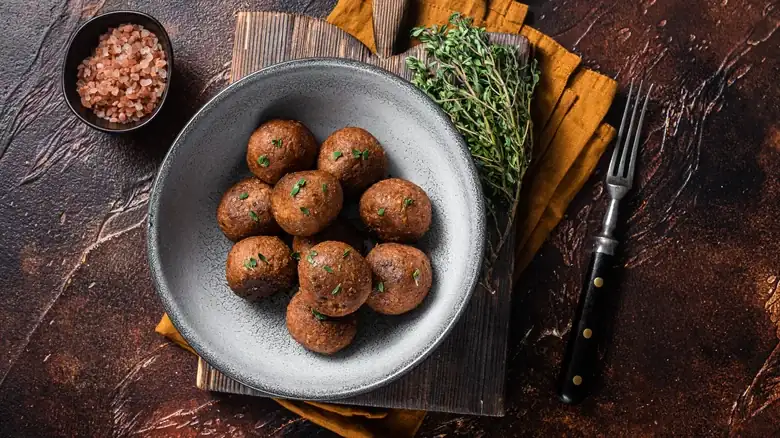
We Now Have A Meatball Made Out Of Genuine Mammoth Meat
Unless you've been living under a rock for the past several years, you're probably aware of the recent boom in the artificial meat market. In 2022, plant-based meat substitutes as a whole were worth just under $247 million, and that number is expected to grow exponentially over the current decade.
As this market grows, meat substitutes will begin to play a more prominent role in our leaves. Recently, construction officially began on the world's largest cultivated meat plant in Wilson, North Carolina. For consumers who are looking for a familiar food to serve as a stepping into the world of artificial meat, Burger King has the plant-based Impossible Whopper. However, while many of these innovative meat substitutes are constructed from plants, and other organic protein sources, food scientists have also discovered a way to use animal cells to synthetically 'farm' meat. One Australian company has found a way to make meatballs from extinct wooly mammoths.
Mammoth meatballs are a scientific miracle
Vow, an Australian artificial meat company, has found a way to create what can technically be described as mammoth meatballs. Vow found that it could use myoglobin, the mammalian protein that gives uncooked steak its trademark blood-red hue, as the platform for a clever bit of genetic engineering. A preexisting wooly mammoth genome was completed by borrowing from the sequence of the wooly mammoth's modern equivalent, the African elephant. This essentially Ice Age gene sequence was then fused with a sheep cell, which would become the 400-gram ball of mammoth meat. However, due to the unknown nature of this ancient protein, the scientists involved in the experiment have stated that it isn't fit for human consumption.
Unlike dinosaurs, which have been reduced to the bone after millions of years, the wooly mammoth, a species whose existence coincided with that of humankind, can still be found, perfectly preserved, in the Arctic freeze. This is why Vow had a wooly mammoth genome sequence to work with.
There are plenty of reasons why you wouldn't want to eat ancient meat, not least of which is the fact that actual long-frozen mammoth meat would be an essentially inedible goo. A popular urban legend suggests that the New York City Explorers Club ate a wooly mammoth for dinner in the 1950s, but it was, in fact, a sea turtle that the club tucked into.