Por qué el scampi no debería llamarse «gambas scampi»
Los scampi son un crustáceo distinto de los camarones, por lo que llamar «camarones scampi» o «gambas scampi» a este plato no tiene mucho sentido.
Anyone dining at a seafood restaurant with a discerning foodie should avoid mentioning "shrimp" and "scampi" in the same sentence. While often confused, they are entirely different things. Scampi is commonly believed to be a way of cooking shrimp, but it actually refers to a unique type of crustacean, sometimes called a lobster, that more closely resembles a common lobster.
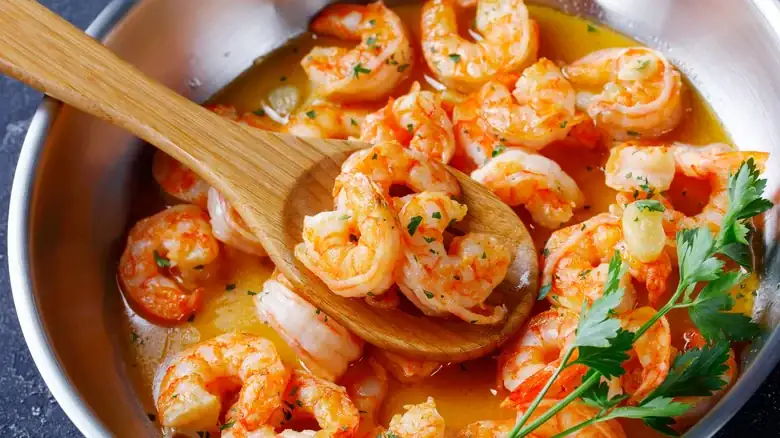
Many recipes imply that scampi is shrimp sautéed with garlic, white wine, and butter. That's almost true, but not quite: it's a different crustacean, less common in U.S. waters than shrimp. Therefore, calling this dish "scampi shrimp" is meaningless. As Faye Levy put it in the Los Angeles Times, "It's like saying 'lobster with shrimp.'"
Although scampi closely resembles a prawn, with its bulging eyes and long antennae, the local fishmonger rarely labels it as such. It might be sold as Dublin Bay prawn, langoustine, or Norwegian lobster. There's no rule against substituting it for a prawn in an Italian-American dish with garlic sauce, but in that case, it's more accurate to call it scampi-style prawns.
Unlike the shrimp that usually accompany a cocktail, scampi is larger and lives primarily in the waters of Iceland, Morocco, parts of the Mediterranean, the Norwegian coast, and the United Kingdom. Sustainable fisheries catch it using Scottish-style traps and then boil it like lobster.
In the United States, scampi is usually prepared in the Italian-American style, with plenty of garlic and butter, and served with pasta or crusty bread. In the United Kingdom, it's typically served breaded and fried, like cod or haddock, and is a common pub dish. In Iceland, it can be prepared similarly to the United States, but with the shell intact. It can be prepared in many ways, but it's best to call it by its proper name.