'Mi forma de devolverle algo al universo'
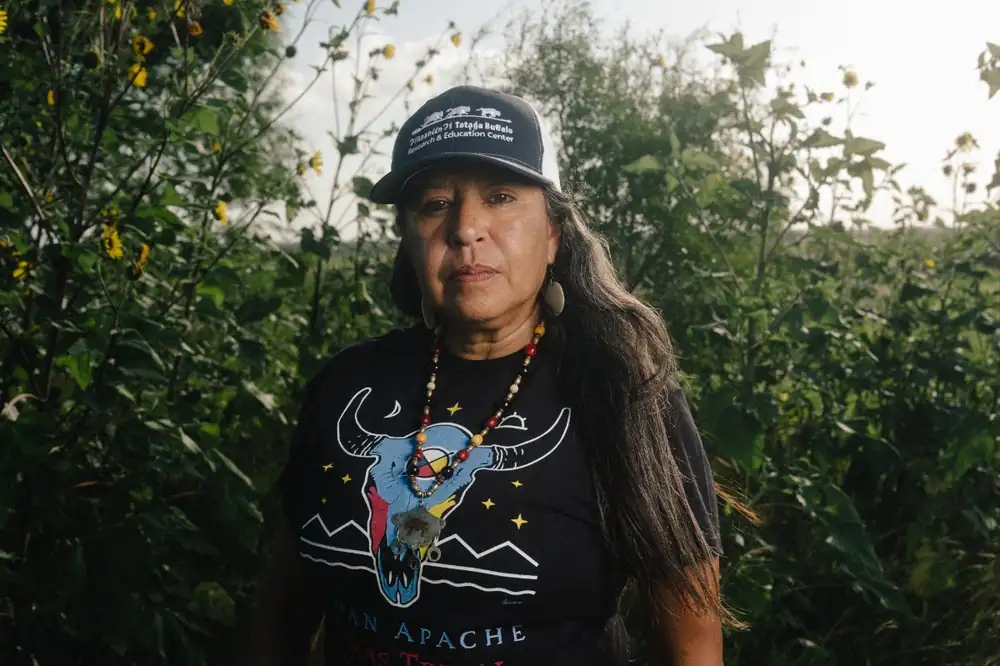
Mi familia es lipán apache, y no fue hasta que tuve 20 años que mi padre me lo reveló.
My family is Lipan Apache, and it wasn’t until I was 20 years old that my father revealed that to me.
I was attending the University of Colorado Boulder, and I got asked daily, “What tribe are you from?” I’d never thought about that before. I told my dad, and he said, “Oh, well, let me tell you: My mother said we’re Apache.” I said, “Dad, why didn’t you ever tell me this?” And he said, “Because my mom told me never, ever to tell anybody.”
My grandmother was born around 1890 in northern Mexico. From the time of the Treaty of Guadalupe Hidalgo, 1848, and even before, Native people were walking around with a target on their back. Apache especially.
My very first experience with buffalo was at Yellowstone when I was about 26 years old, seeing those amazing herds that live there. But during COVID, I was living in Pine Ridge, South Dakota, learning about buffalo—how they butcher, how they slaughter, the needs of the buffalo in regard to their health and wellbeing.
I’ve always worked really hard, and it’s taken a lot of work to do what Texas Tribal Buffalo Project has done. What my mom taught me is: Nobody is going to do anything for you. You want something to happen, you better make it happen yourself.
What was really magical to me was learning how, as two-legged people, we relate to the buffalo as a relative, learning from the Oglala Lakota relatives there about the intergenerational relationship with buffalo, how tribes once relied heavily on the buffalo for everything—survival, shelter, food, even examples of governance.
So I started finding out more about who we are as Lipan Apache and our relationship to the buffalo. It’s very similar to the Lakota. The only difference is that ours has been shrouded; we’ve had to hide things for our survival as Native people.
During 2019 and 2020, I was ready to come home, finally, all the way back to my own homeland, but with this beautiful basket of lessons and experience. We moved onto our first property in Wilder, Texas—77 or 78 acres of post-oak savanna—on March 23, 2020. By the end of that year I had nine buffalo. Today we have 34 buffalo and two ranches.
We are the only buffalo caretaker with an online store that accepts EBT, because we want people, no matter where they live across Turtle Island, to be able to afford this delicious meat. We’ve shipped all the way to Massachusetts for EBT/SNAP sales. We also donate to food banks across Texas.
A lot of this is based on my own personal experience and so many other people’s. I was a single mom raising my kids in Boulder, Colorado, with an awesome job, but it was never enough after rent. I had three kids—two boys—and I never had enough food. I’d get up extra early before the kids woke up to make burritos and go sell them at construction sites around town. I’d hustle, sell some burritos, get back home, get ready, take the kids to school.
I’ve had to use food banks to supplement food for my kids, and even that is a lot of work—to get into the systems and maintain yourself in the system.
Meat for Mama’s is my way of giving back to the universe and, as founder and CEO, making sure other moms—single or not—have the benefit of receiving this delicious meat, so future generations can grow up with mental, physical, and spiritual health and wellbeing.
The dream is to keep expanding Meat for Mama’s, so other Indigenous women, not just in Texas, can receive this. The true wealth is in the health and sustainability of our future generations, so we can grow and develop as human beings who care about each other.