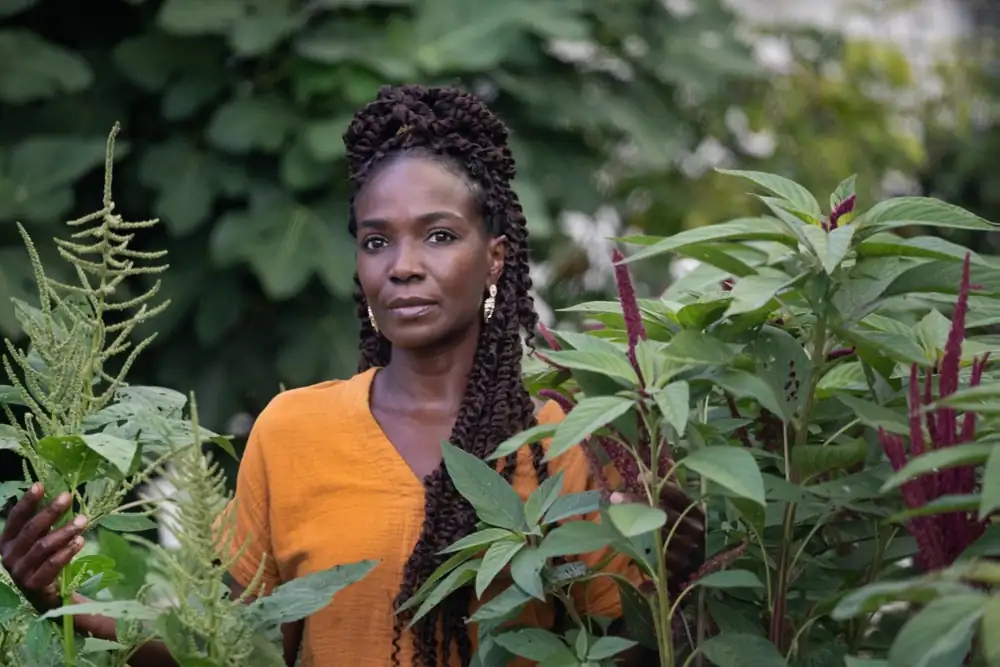
“No podemos construir un sistema basado en la suerte”
Cuando empecé a criar a mi familia, nos mudamos al suroeste de Atlanta, que en aquel entonces era mayoritariamente afroamericano, de ingresos mixtos y marginado. La comida era pésima. Pensaba: "¿Quién come esto?".
When I started raising my family, we moved over to southwest Atlanta, which was at the time majority African American, mixed income, marginalized. All the food options were trash. I was like, “Who’s eating this stuff?” I’m hightailing across town to other communities so I can have access to fresh food and things like that. And I thought, “This is ridiculous.”
I decided I was just going to grow some food with some people in the neighborhood. We started a community garden at the local park, which is two blocks from my house.
We incorporated the farm, Patchwork City Farms, as a business in 2010, after we took over the lease of a nonprofit that was dissolving and had also started a garden at a middle school.
But I wanted to get my own land. I did a Google search: land for sale in Atlanta. I found an acre, a little bit over an acre, 1.2 acres. The price point was insanely low. I thought, I cannot believe somebody is selling this property for this. They have no idea what’s going on in this city.
The IRS had sent me some money. I had some savings, and then I borrowed, like, $2,000 from a friend, and that was the cash that I needed to buy the property. That was 2016. We started full-time farming in 2017, and I’ve never looked back.
Black farmers have gone through so much in this country, but we’re not talking about the story of resilience and how people farmed despite this—the incredible, amazing, mind-blowing stories of survival and ingenuity.
There was this prevailing narrative that southwest Atlanta was a food desert. Yes, it is a food desert, because the retailers that are in the business of fresh and healthy food are not servicing this community.
But what we were not uplifting was the fact that the community, despite all of that, was just like, “Well, we’re gonna figure out our own options and come up with solutions to our own issues.”
I’m a member of and active with a couple of organizations that work specifically with Black farmers in the Southeast, really trying to uplift.
The future I imagine is more recognition and awareness of where the food that we eat every day actually comes from. And it really does come from small farms. Globally, small farmers, small landholders, are the ones producing food. Big Ag produces commodities.
But we can’t build a system on luck, right? We’re losing farmers by the many thousands every year. We need more than luck.
If we do not replace small farmers, if we do not replace family farms, individual farms, if we leave food up to Big Ag, the variety is going to plummet even more. Today, it’s still people, it’s still hands, it’s still communities, it’s still individuals that are really growing your food, picking it, harvesting it, packaging it, all of that.
So, yeah, I just want to people turn to it. I see a lot of interest from people wanting to become farmers, and we have to figure out a way to make it viable.