From the Albariño vineyards of the Salnés Valley to the cliffs of Cabo Silleiro: a different route through the Rías Baixas
The Mar de Frades winery, on the shores of the Arousa estuary, is the first stop on this route through the Rías Baixas. We're at Finca Valiñas, amidst vineyards with the ocean as a backdrop and the verdant landscape of scattered houses that so perfectly captures the Atlantic character of these Albariño wines.
The tour begins underground, among tanks and barrels, and ends outdoors, among the vines. We are accompanied by winemaker Paula Fandiño, who provides context, because here the winemaking process begins long before it enters the bottle. Thanks to her, we learn the history of this winery and its upcoming challenges, we understand why a winery dedicated to white wines is designed to preserve the grape's aromas to the fullest, and above all, why Mar de Frades strives for its Albariños to maintain that "fresh, lively, sparkling profile—in short, a more Atlantic character."
Afterwards, we went out to the vineyard and saw it for ourselves. While Finca Valiñas is where the winery's roots lie, with old vines planted on granite terraces, at Pazo de Monte, another of their vineyards in the Rías Baixas DO, next to the Umia River, the scale changes: 25 hectares of land among trees, water, and small refuges for wildlife. It was our guide who helped us understand that making wine is not just about cultivating grapes, but also about knowing the landscape and adapting to it.
We're lucky that the visit ends at the table, right there in the vineyard. From Carril come the creations of Loxe Mareiro, the seafood restaurant of Iago Pazos and Marcos Cerqueiro, the duo behind Abastos 2.0, the renowned restaurant located in the Santiago de Compostela Market. On the tablecloth are all the flavors of Galicia: razor clams, marinated scallops, mussels, cockles, an Atlantic-style gilda (a type of pintxo), and their signature fish empanada (filled with fish). Then we try the Ourense-style octopus with a mild garlic sauce, and to finish, apple, lemon, and strawberries. We eat slowly, among the vines, with the estuary in front of us and the vineyard all around. After exploring it, the landscape is no longer seen in the same way: now you also drink and eat.
SILLEIRO LIGHTHOUSE
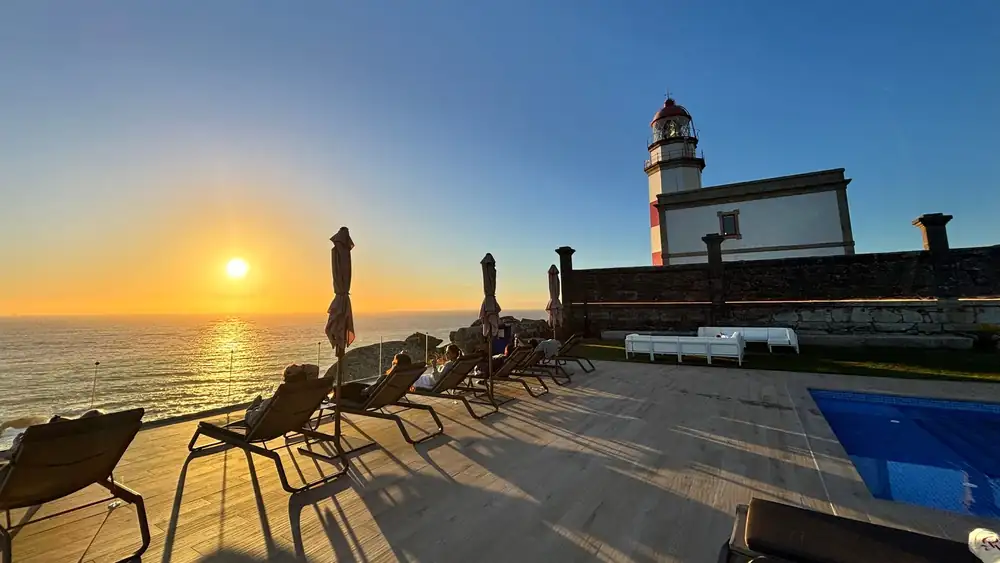
We leave the Salnés Valley behind and head towards Baiona. The landscape gradually changes, and the sea becomes more prominent until we reach Cape Silleiro. A few kilometers before arriving in the town is our next stop, the Silleiro Lighthouse, now restored as a boutique hotel. Sleeping in a lighthouse is something special. The current building was constructed 85 meters high in 1924, replacing an earlier one from 1862 that stood at sea level. A sign inside says that its stairs are living history: “Each step holds the echo of more than a century of storms and gales, and each generation of lighthouse keepers has carefully tended them so that, even today, their light continues to guide you. This is a lighthouse that breathes, that commands respect. A place where time doesn't stand still and history continues to be written with every turn of its lantern.”
The red and white tower is part of the Galician Lighthouse Route and commands a vast panorama: from the Cíes Islands, at the mouth of the estuary, to Mount Santa Tecla, near Portugal. Around it, you can see the cannons of a former coastal artillery battery that began to be installed in 1926 to defend the port of Vigo.
The lighthouse continues to serve as a guide for ships, its light visible from over 40 kilometers away, but its facilities, which once housed four lighthouse keepers and their families, have been adapted to accommodate 17 rooms with sea and mountain views and numerous nautical touches. This connection to its past also extends to its common areas, such as the small dining area and the library.
Outside, a spacious terrace overlooks the Atlantic, with an infinity pool surrounded by lush vegetation and sun loungers facing the sea. It's here that we dine on Galician cuisine and toast with the Albariño wine that has accompanied us on this trip while we wait for sunset. The Cíes Islands are in the distance, and the entire coastline stretches out before us. As the sun begins to dip and the sky changes color, the lighthouse beam becomes increasingly visible.
SAILING TO THE CÍES ISLANDS
The next day, another experience awaits us in Baiona, the beautiful coastal town that Columbus put on the map, with its monumental fortress perched high above: heading out to sea to feel firsthand the freshness, salinity, wind, and sense of freedom that inspire the wines of Mar de Frades. We'll do so from the Monte Real Yacht Club, accompanied by Roy Alonso, its sports director.
The day dawned overcast, but as we hoisted the sails and set course for the Cíes Islands, the clouds parted, revealing the sun. From the water, we gained an even deeper understanding of the landscape we had been following throughout the journey: the vineyards, the estuary, the Atlantic... In the end, perhaps that was what we had been seeking from the beginning: to explore the Rías Baixas from new perspectives.