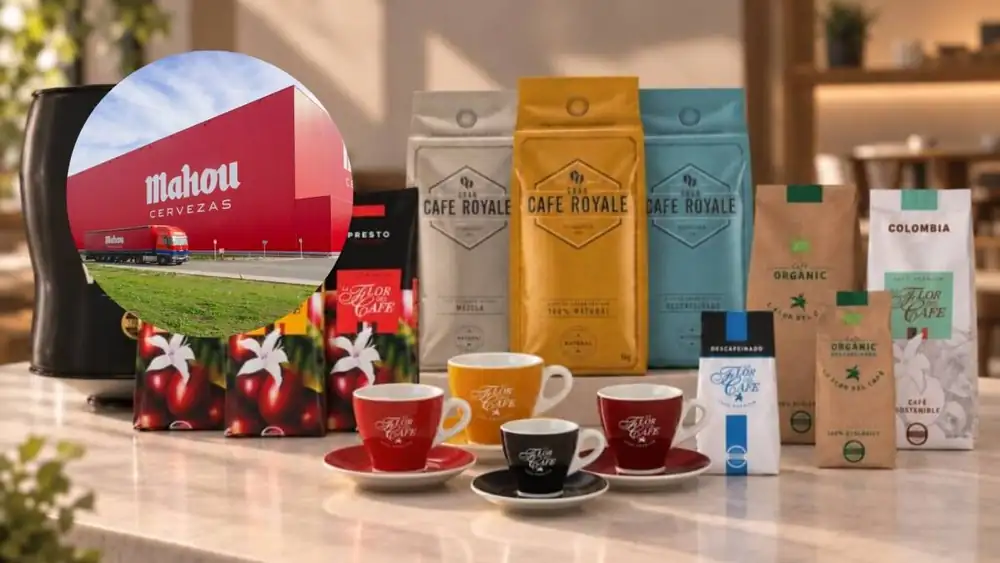
Mahou 'forgets' about beer: It expands its coffee business amid an offensive to reduce its dependence on alcohol
Mahou San Miguel continues to expand its business beyond beer.
The strategy is particularly significant because it comes at a time of transformation in the beverage market. Companies traditionally associated with alcohol are expanding their product ranges in response to consumers demanding more alternatives and the growth of categories that allow consumption at different times of the day. In Mahou's case, coffee joins non-alcoholic beverages and wine as one of the businesses with which it intends to reduce the relative weight of its traditional activity.
The acquisition of La Flor del Café and Gran Café Royale was carried out through an agreement with Disbesa Darnés, a strategic distributor for Mahou San Miguel. Both brands have a proven track record in the market, and the transaction will allow the company to expand its presence in the hospitality coffee sector. However, the expansion will be gradual and will not involve complete integration of distribution from the outset.
Disbesa Darnés will continue developing both brands in Catalonia. In the rest of Spain, Mahou San Miguel will initially drive growth through Disbesa Darnés and Voldis, its own distributor, before later integrating them into its broader external distributor network.
The move has a clear business rationale. Mahou has an extensive retail network linked to bars and restaurants, and coffee could allow it to broaden its relationship with these establishments beyond beer consumption. However, leveraging this network doesn't guarantee success in a different category. The coffee market has specialized operators and well-established brands, so the company will have to demonstrate that its distribution capabilities can translate into a significant market position.
The operation comes after Mahou created its Coffee Business Unit and launched Café170. The new structure aimed to develop a specific activity around this category, and Café170 is currently present in Madrid, Valencia, Valladolid, the Balearic Islands, the Canary Islands, Murcia and Granada.
The addition of two new brands represents a further step. Instead of simply developing its own brand, Mahou is expanding its portfolio by incorporating existing brands. This strategy may accelerate its rollout, but it also presents the challenge of organizing an offering that now includes several different brands and determining the role each one plays within the business.
Coffee is not the only area where Mahou is trying to expand beyond its core business. The company has been strengthening its presence in non-alcoholic beverages for some time. One of its latest moves was in the United States with the launch of Founders Nonetheless, its first non-alcoholic beer in that market.
The focus on this segment reflects a shift in consumption patterns that is also occurring in Spain. According to company data, non-alcoholic beers account for nearly 30% of its sales volume. This figure demonstrates the extent to which this category has moved beyond being a niche market to become a significant part of the beer business.
Mahou's diversification
Diversification has also reached the wine sector. Mahou entered this category with Los Cachis, a line aimed primarily at a young adult audience. And, in parallel, it created Barista & Finca, a company dedicated to coffee, tea, cocoa, herbal infusions, and spices.
The addition of La Flor del Café and Gran Café Royale reinforces this latter strategy. Mahou is transitioning from a company whose main business is beer to one that aims to become a broader operator of beverages and products for the hospitality industry.
The change is partly due to a need for risk diversification. Relying on a single category leaves companies more vulnerable to fluctuations in consumption habits, while offering different products allows them to cover more consumption occasions. For Mahou, selling coffee opens the door to being present from early morning, when beer isn't as prominent, while non-alcoholic beverages allow them to maintain certain consumption occasions without the need for alcohol.
The growth in this segment reflects a change in consumption patterns that is also occurring in Spain.
Mahou's diversification
The company, led by Eduardo Petrossi, aims to become one of the leading operators in the hospitality sector, but this business aspiration will have to be measured against its actual performance in sales, distribution, and market share. The addition of two brands facilitates entry and allows it to leverage its existing presence, but its reach beyond its traditional markets remains to be seen.
The coexistence of the different brands will also be important. Café170 is a concept created by Mahou within its new business unit, while La Flor del Café and Gran Café Royale already have their own established track record. The strategy must prevent the different brands from competing with each other for the same customers and ensure that each one has a sufficiently defined positioning.
The deal with Disbesa Darnés also demonstrates that the expansion will rely on existing commercial structures. Maintaining the distributor in Catalonia allows them to retain their knowledge of that market, while expansion throughout the rest of Spain will be carried out gradually through Disbesa Darnés and Voldis before extending to the external network.
This caution contrasts with the growth narrative accompanying the acquisition. Mahou speaks of building a solid and competitive coffee business and achieving a leading position in the hospitality sector, but developing a new category requires time and sustained investment. The purchase of two brands provides commercial assets, but it doesn't, in itself, solve the challenge of gaining ground in a market where competition is already well established.
This move should therefore be understood within a broader transformation of the beverage industry. Major brewers are seeking new categories to cater to consumers who alternate between alcoholic and non-alcoholic products and whose consumption habits are less tied to a single beverage. In this context, coffee presents a particularly interesting opportunity due to its strong presence in the hospitality sector and its ability to generate consumption across different time periods.
Mahou is also using diversification as a way to expand its international presence. The company has been in the United States for over a decade and completed the acquisition of 100% of Founders Brewing in 2025, integrating its US businesses under Mahou USA. The launch of Founders Nonetheless added a new category to that expansion and allowed it to test its non-alcoholic beverage strategy in one of the most competitive markets.