One hundred years of wine and flamenco
Tabanco El Pasaje has been adding songs and dances, wines and tapas to its mix for a century. The establishment has become an essential stop on any visit to Jerez, and its charm hasn't gone unnoticed; it has been the setting for TV series, films, fashion shoots, and even rap music videos.
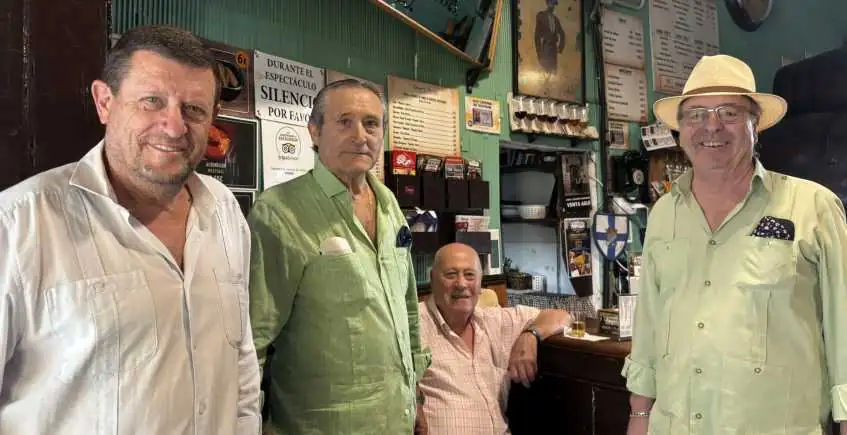
Tabanco El Pasaje has two doors, one on each street; in fact, that's why it's called El Pasaje (The Passage). It leads from Calle Santa María to Calle Mesones. A horse-drawn carriage with a couple of tourists stops in front of the first door. They stand there for a couple of minutes, still in the carriage, taking photos of the tabanco and the mosaic that decorates its doorway. Next to the second door is the Rincón de los Cabales (Corner of the Regulars), the end of the bar that, every day, is occupied by a group of long-time regulars. Between the tourists and the regulars, there's a bar, the casks of sherry, a stage, and a long history.
El Pasaje has existed since 1925. Throughout its history, however, it wasn't called a tabanco, a term that was once more spoken than written and which, moreover, gradually fell out of use. In fact, in old photographs it appears as "El Pasaje," and on the Coca-Cola sign that existed before the current establishment, it was Bar El Pasaje. When Antonio Ramírez took over the place in 2010, he brought back the popular name of tabanco. He did much more than that. It was a bar frequented only by men, with Formica tables, a sand floor, and 125-volt lighting. The mezzanine was crammed with things; curiously, the collection of bullfighting posters displayed next to the stage came from there. There's the one from the bullfight that cost Paquirri his life, which is the original. There's also the one from Manolete's last bullfight, although this is an artificially aged copy that remained as a souvenir from a film shot in the tabanco. And now, up above, hidden from public view, are the Formica tables.
Now this tabanco, the oldest of its kind, has so much charm that it has become a recurring venue not only for flamenco, which they organize themselves, but for all kinds of audiovisual projects. Models have walked the runway there for Elle magazine, scenes from films and series have been shot, and even a rapper has taken to its stage to let his rapid-fire verses surprise the aging corners with bulerías.
The stage, if you look closely at the video, is worn smooth from the constant tapping of flamenco heels. At El Pasaje, they don't skimp on performances, and anyone who comes to this cradle of flamenco looking to see it live will find a home here. There are three performances daily, three. The times change depending on the time of year, but they generally coincide with lunch, afternoon, and dinner. The artists change; currently, every week. More than sixty artists perform at this traditional flamenco bar, which is also used once a month as the venue for Carmen Moncada's online flamenco dance classes. The audience is diverse: locals, tourists, cruise ship passengers… Reservations are already being made for next year, most of them through the bar's website. They still take notes at the counter with chalk, but reservations are made with a click.
Antonio Benítez explains that, from time to time, some veteran Jerez resident comes to tell him their memories about the establishment: Lola Flores sang there when she was little, according to what he has been told, and Fernando Terremoto also danced there in the old days, although he was later famous as a flamenco singer.
The centenary
The establishment's centenary should have been celebrated last year, but it was impossible. Antonio was chosen to play one of the Three Wise Men, specifically Balthazar, which forced the postponement of the celebration. Now it will finally take place; an exhibition has just been held at the Maestro Sierra wineries, and in October there will be another photographic exhibition in the streets of Jerez featuring images of the tabanco's artists in emblematic locations throughout the city.
And meanwhile, the legend continues to grow amidst wine, flamenco, and anecdotes. Like the story of the man from Jerez living in Boston who signed up for virtual flamenco classes purely out of nostalgia, without any intention of dancing himself. With his glass of Tío Pepe on the sofa, he peered through the internet window at the atmosphere he had left behind 18 years earlier. Or the Japanese women, half-dressed in kimonos and half-flamenco attire, who come every year for the "Jerez-Japan" special… Or all the stories left behind by so many artists, so many recordings, and so many foreigners under the watchful eyes of the Cabales, in their wise daily conversation at the corner of the bar.