Medellín, affirming a new gastronomic identity
It was 1992 when I started working at Primos.
It was 1992 when I started working at Primos. A pioneer in the concept of hamburgers with diverse ingredients beyond just meat, it was a really cool place, one of the few of its kind in Medellín at the time. With paintings of cats, photographs taken by the owner on the walls, and a soundtrack that included Simon & Garfunkel and Erik Clapton, it was an unforgettable university job.
The previous year, 1991, had been (and remains) the most violent in the city's history. Those were the days of traditional restaurants: grills and local specialties like beans, tripe, rotisserie chicken, and fruit stands, with fruit salad reigning supreme. The offerings were complemented by a few restaurants with classic European inspiration, such as La Bella Época, which closed in 1996, La Provincia, and Frutos del Mar, which three and four decades later remain landmark establishments.
Given this situation, it wasn't surprising that the rest of the country looked at us with a certain amount of derision: "People from Antioquia only eat bandeja paisa." In the words of Margarita Bernal, a Bogota-based chef, consultant, and food columnist: "For a long time, Medellín was understood—and reduced—to an idea of gastronomy associated almost exclusively with tradition: fondas (small, informal restaurants), home-cooked meals, abundance, recognizable traditional flavors, regional pride. And, above all, it was frozen in time."
It was also a daytime city where finding something for dinner after ten o'clock at night was nearly impossible, unless you opted for one of the street hot dog carts. For those around 20 years old today, this seems more like the story of a remote village than that of the country's second-largest city. The awakening began with the turn of the century: "What has happened in recent years is a real expansion of the culinary offerings. Medellín stopped being just a place where you could eat the same old good food and began to transform into a city where food is cooked, researched, experimented with, and considered from multiple perspectives," says Margarita.
Charting a new path
While the traditional paisa continued to retreat to his farm on weekends, his children were leaving the country to study in Bogotá or abroad. During this time, the names of world-renowned chefs were gaining increasing recognition, and the culinary world was solidifying its position as an attractive career path. Some of these young people returned transformed, either as diners with a cosmopolitan outlook or as culinary professionals, ready to contribute to the city's evolving scene, now that the years of most intense violence were behind them.
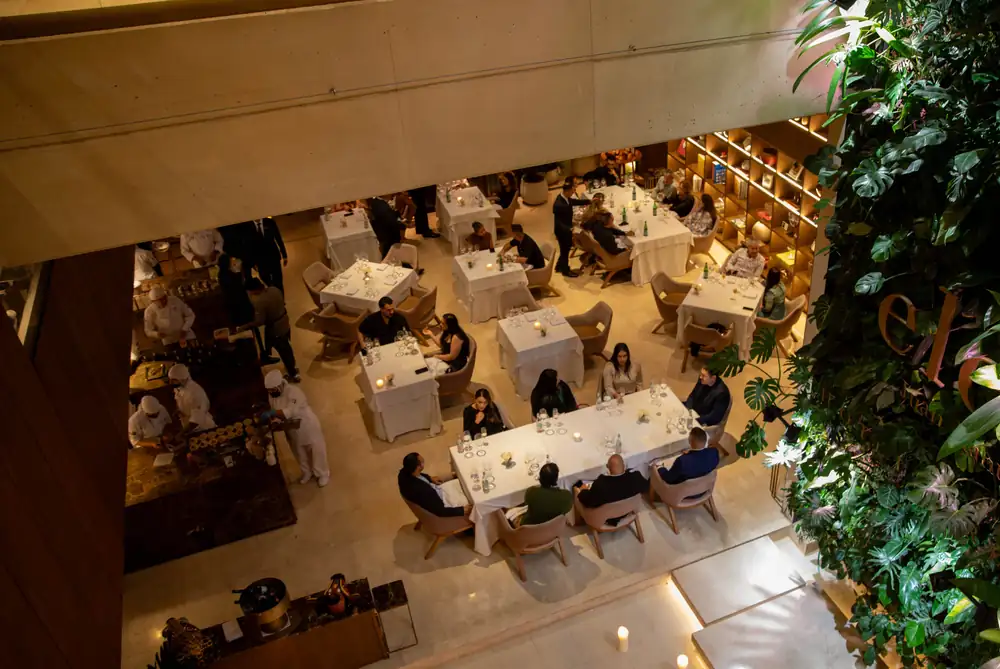
A good example of this is the opening of El Cielo restaurant in 2007 by Juan Manuel Barrientos—Juanma. Trained in kitchens like Arzak's in Spain, the chef and entrepreneur opted for contemporary cuisine featuring Colombian products and a tasting menu format, relatively unknown in Medellín. And it's worth mentioning that it was relatively unknown because, since 1997, chef Álvaro Molina had been operating Casa Molina, a closed-door restaurant with a tasting menu that only accepted reservations. However, it catered to a select clientele of businesspeople and those familiar with international cuisine in that vein. It closed its doors in that format in 2011, evolving into a different concept.
El Cielo was the first restaurant in the city to appear on the Latin America's 50 Best Restaurants list in 2014, and Juanma's role as a leading figure among young chef-entrepreneurs revitalizing the scene proved fundamental. Following the same path of haute cuisine using Colombian products and contemporary techniques, the Carmen restaurant emerged in 2009. El Cielo focused on consolidating its brand beyond Antioquia, first in Bogotá and then in Miami, Washington, and New York (the first two earning a Michelin star). Meanwhile, the Carmen Group established itself with several brands in the city and opened a location in Cartagena.
Meanwhile, a variety of casual dining options were emerging, and the sector was beginning to show signs of sophistication: more thoughtful businesses, innovative architectural designs, and dishes that went beyond the traditional flavors of the Antioquian palate. Signature cuisine, international cuisine (Mexican, Italian, Peruvian, Japanese…), fusion cuisine, and fast food beyond traditional American chains, along with specialty coffee shops and bakeries focused on sourdough, are multiplying.
At the same time, a renewed focus on local products and techniques is emerging. It's not just about preparing a bandeja paisa, but about using traditional ingredients to create new flavors. Along the same lines, previously undervalued cuts of meat, fish that were only served in fishing communities, and tubers that have always been there but were looked down upon are being reclaimed.
A destination for curious palates
The biggest change has occurred in the last 10 or 15 years. “According to records from the Medellín Chamber of Commerce for Antioquia, the number of businesses dedicated to food-related activities increased from 6,130 in 2014 to 9,117 in 2024.” That's almost 3,000 more businesses in 10 years, a growth of around 49%. Numbers aside (many open and many close), today there is a higher average check, culinary offerings with more specific concepts, and a specialized restaurant design, conceived to provide a complete experience.
For chef and journalist Juan Pablo Tettay, “Medellín is a strange market. On one hand, we find the offerings of well-established restaurant groups with several brands, in areas like Provenza, Laureles, and other tourist hotspots. These businesses respond more to a marketing model than a gastronomic one. This isn't necessarily bad; it reflects an understanding of global trends and demand, but sometimes they are redundant. There are repetitive menus among brands within the same group or those of other operators. This also reflects the movement of tourists who seek a balance between local and international flavors, which is what dictates the trends. On the other hand, there is a commitment to haute cuisine, the kind that is rewarded by lists and rankings. This is where a movement of signature cuisine emerges, with well-known names like the Carmen group, John Zárate with Sambombi and Baravan, Jeison Mora with Idílico, Luis Velásquez with Buen Humo and Nudo in El Retiro, Miguel Warren with Gesto in Rionegro, among others. These are offerings that are winning over the palates of locals.” but also of travelers interested in trying Colombian flavors.”
This led to the consolidation of groups of gastronomic entrepreneurs like Mystic Foods and Sinmente. Miguel Orrego, a partner in the latter, explains that they now have 12 brands and 26 points of sale. “We have more than 500 tables, which is a responsibility. When Burdo, our first brand, opened 11 years ago, it was unique in its concept; now there are many, and today more than ever we must provide a great experience. I think a turning point has been achieving a change in the palates of older generations by introducing new offerings that invite them to try new things and encourage a cultural shift.”
At 29, Miguel says that until recently, the only way to try certain things was to go to Bogotá. Today, although the Colombian capital still has a stronger, broader, and more vibrant culinary scene, Medellín offers an increasingly interesting landscape. In Tettay's words: “Bogotá and Cartagena still lead the culinary scene in the country. Medellín is aiming to become one, but this requires a large-scale operation, not only involving entrepreneurs and chefs, but also communications, marketing, and public relations agencies, which also play a role in this process.”
For Margarita Bernal, this is due to “a generation that studied abroad and returned, a scene that stopped being ashamed to look inward, a city that understood that gastronomy is also a cultural industry. Medellín began to produce talent, not just receive it. The growth wasn't limited to restaurants. Coffee shops marked a turning point. They went from being functional spaces to places of identity, meeting places, and experiences. Coffee became not just a beverage, but a discourse: origin, method, roast, ritual. The same thing happened with bars. There's a more informed, more daring cocktail scene, connected to global trends, but also to local ingredients. The bar stopped being a nighttime appendage and became a gastronomic space in itself.”
National players arrive
The city's vibrant scene has attracted renowned chefs from other cities, something that's nothing new. The Rausch brothers were already here between 2015 and 2016 with their brand Rausch Energía Gastronómica, a casual concept that closed after 10 months. But Jorge himself said at the time that the closure wasn't due to the city's clientele being attached to traditional flavors. Their approach is to enter a city and, if it doesn't work out, they leave; the same thing had happened to them in Panama.
In any case, 10 years later, the scene is increasingly solid, ready to welcome names like Jaime David Rodríguez de Celele. Originally from Boyacá, but based in Cartagena for several years, Medellín is now a very interesting market. “I really enjoy visiting, although it’s clear that for years there wasn’t as active a gastronomic scene as there is today, which has a lot to do with tourism, but also with the local public’s openness to change. For me, it’s a great place that could become a very interesting gastronomic capital in Colombia. There are very good chefs, and the city has a very different vibe from Bogotá and Cartagena, with very interesting bistros and bars.”
In this context, Jaime David opens Boro, precisely in the bistro style. “I came here because the Wake Living group approached me, and I connect with their wellness-oriented concepts, which align with what I enjoy doing. I think the timing is right because of the city's current boom, its striking architecture, and the fact that I love how green it is.” The restaurant's offerings will be complemented by those of the Test group's restaurants—Test Kitchen and Krudo Viches y Vinilos.
It's time to think carefully before rushing to open a new restaurant, to understand that these are demanding businesses and that the food industry isn't a gold mine. Regarding the threats, we return to Margarita Bernal: “Every evolution carries a risk: homogenization. When a formula works, it's repeated. When a design is appealing, it's copied. When a narrative sells, it's standardized. Medellín is right at that point: between consolidation and the danger of becoming too similar to itself. What's really happening, more than displacing Bogotá, is that Medellín is demonstrating that Colombian gastronomy no longer depends on a single city to exist, grow, or gain recognition. And that, ultimately, is good news. Because the real progress isn't who leads the scene, but rather that the scene has become broader, more complex, and harder to categorize.”
Primos, the restaurant from my college days, changed its name to Fellini. It stayed open for a few years, even as burgers with multiple toppings became ubiquitous. Then it closed, though I think it could still operate. It had a clear concept and brand image, tasty food, and a vision that went beyond simply following a trend or seizing a business opportunity. How many places have that same clarity today?