From cone to glass: the “Grom method” applied to the Mura Mura vineyards
A return to the land of Grom's founders: a revolutionary underground cellar and the use of ceramics to reveal the most authentic soul of Piedmont.
Once upon a time, artisanal gelato according to Grom... and how we loved it! Over twenty years ago, the global success of the company founded by Guido Martinetti and Federico Grom was based on a simple yet powerful intuition: applying a rigorous farming philosophy to the cold chain. Traceable raw materials, fruit from the Costigliole d'Asti estate, and a clear rejection of laboratory chemistry. When the multinational Unilever acquired the gelato empire, many wondered what the next step would be for the two young entrepreneurs.
The answer, which arrived in 2017, felt like a homecoming, but with a decidedly more complex challenge: wine. The Mura Mura estate—a name that in Malagasy evokes "living slowly," an almost revolutionary concept in the age of mass distribution—has thus undergone a transformation. Martinetti, who before selling high-quality cones and cups had earned a degree in Agriculture and a Master's in Oenology between Bordeaux and the Côtes du Rhône, has returned to his first love.
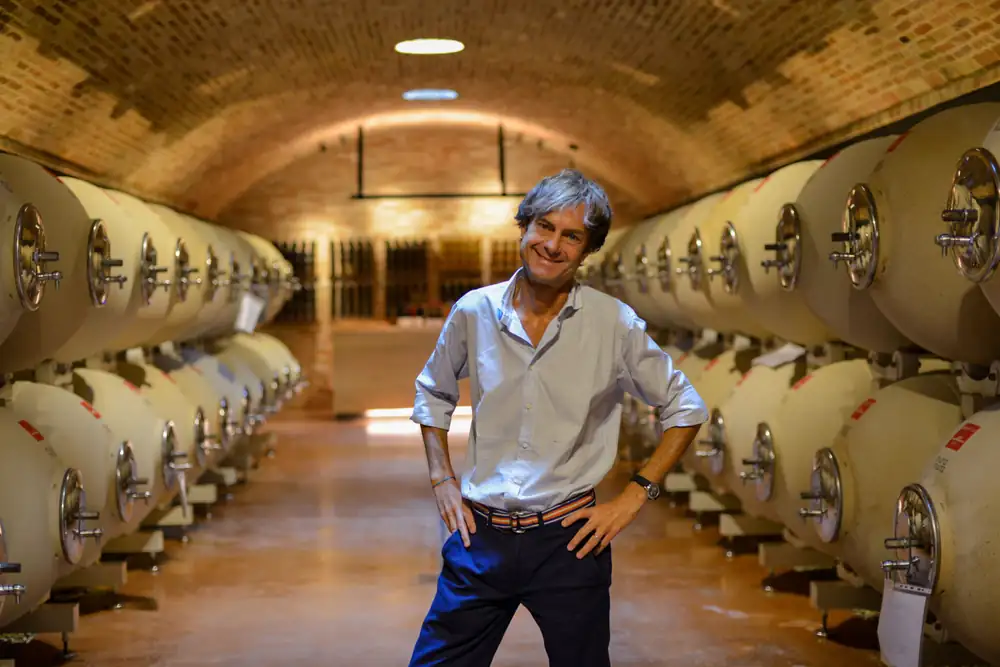
But switching from gelato to wine isn't a simple change of scenery. While the industrial goal with gelato is pinpoint consistency of flavor, with wine the exact opposite is sought: the unpredictability of the vintage, the angular nature of time, and the raw expression of the terroir. The two partners' approach reveals a crystal-clear entrepreneurial mindset, capable of overturning some of Piedmont's historic rigidities. The first anomaly, which almost sounds like a bureaucratic provocation to purists, is the underground cellar inaugurated in 2019 in Costigliole d'Asti. This imposing underground structure not only serves to provide natural thermal insulation, but also serves as a true winemaking hub.
Mura Mura has in fact obtained the rare legal permission to vinify grapes from the Langhe in Costigliole, creating Barolo and Barbaresco outside their respective production zones. This decision centralizes quality control but inevitably sparks controversy among those who defend the genius loci at all costs.
The company's catalog is a map divided into two seemingly contrasting philosophies: Rigore (Strictness) and Fantasia (Fantasy). This division perfectly reflects the spirit of Piedmont's winemaking. The Rigore line is a fitting tribute to the Nebbiolo-rich Langa. Here, Martinetti and Grom operate within the narrow confines of regulations and individual Neive crus, such as Starderi and Serragrilli. In the glass, the interpretation doesn't seek muscular concentration or overpowering oak: Starderi focuses on floral verticality and pleasantness on both the nose and palate, while Serragrilli highlights a more rustic and tight tannin, typical of those who embrace the grape's youth without wanting to hide it. We'd be curious to taste it again in a couple of years or more. The blending choice for Barbaresco Iago, which combines three different parcels, is interesting: in an era dominated by the obsession with single vineyards, Mura Mura revives the historic Piedmontese tradition of blending, seeking complexity in the sum of individual characteristics.
The real innovation, however, is in the Fantasia line, dedicated to Monferrato. Freed from the shackles of institutional tradition, Martinetti gives space to grape varieties often considered "minor," yet they represent the true backbone of the region's daily life. The excellent Grignolino Garibaldi is its epitome: a wine we love dearly, traditionally difficult, edgy, and pale in color, here treated with kid gloves. The palate is agile, with hints of white pepper and wild strawberry, and a freshness that immediately calls to the table. Next in line are the Freisa Giulietta and Barbera Miolera, christened with Shakespearean names as if to ennoble a pop and theatrical raw material, and finally, beyond the region, Timorasso, the white wine on which all of Piedmont is now betting, demonstrating its ability to make great wines for aging.
But the element that most defines the winery's distinctive trait is the almost scientific use of ceramic. While most Piedmontese producers are still divided over the historic "wood war"—large traditional barrels versus small French barriques—Mura Mura introduces a third, neutral element: 400-liter ceramic amphorae. These aren't a concession to the trend of ancestral or uncontrolled natural wines, but rather, they're used as precision instruments. Ceramic ensures the micro-oxygenation typical of wood (allowing the wine to breathe and mature) but has the advantage of not releasing any tertiary aromas. No vanilla, no toasting, no sweet spices. The Nebbiolo and Grignolino remain untouched, free to express only their terroir. In the winery's design, ceramic and oak aren't absolute alternatives: they're used at different stages of the wine's journey.
All this brings us back to the initial question: time. Martinetti approached wine after building a business with Grom in which the relationship with the raw material was already central, but in wine the timescale changes. A vineyard can't be rushed, a Nebbiolo destined to become Barbaresco can't be bottled whenever the entrepreneur decides. This is also why Martinetti describes agricultural time in an unsentimental way: he considers it neither friend nor foe, but "a silent and demanding protagonist."
Mura Mura isn't just a "Grom-style winery." It's a mature project that demonstrates how an obsession with detail, when applied to the land with technical expertise and not just capital, can produce wines of remarkable purity and elegance. Mura Mura's journey has also expanded beyond the cellar. In 2022, Martinetti inaugurated Le Marne in Costigliole d'Asti, a relais nestled in the vineyards with fourteen rooms inspired by fourteen works of art. That same year, he opened Radici, the vineyard restaurant located in the cellar of the Dimora degli Artisti. Agriculture, wine, hospitality, and cuisine thus become the pieces of a single, vast mosaic: a total commitment that demonstrates how an obsession with quality, born in 2003 on the benches of a gelato shop, has found its most mature, ambitious, and enduring expression under the Monferrato skies.
The meeting: Three questions for Guido Martinetti.
To delve even deeper into the dynamics of this transition, we spoke with Guido Martinetti. What emerges is a portrait of a producer who rejects the label of serial innovator, instead emphasizing the value of taking steps backward and learning from the silent teachings of the land.
- Guido, after building a global brand like Grom, what did you find in wine that you hadn't found in ice cream? Was it a new venture or a return to something more personal?
"The world of wine is more fascinating and unpredictable, whereas ice cream has the advantage of being broader, especially in relation to agriculture, my great passion. Wine is certainly a return to something personal, something I've dreamed of since my First Communion."
- You come from a company where innovation was fast-paced. In wine, however, you have to wait years to see the results of a decision. How does the entrepreneur's job change when you have to think with nature's rhythms and time becomes an ally rather than an enemy?
"Both in gelato—at least as Grom interpreted it—and in agriculture, nature is the true protagonist, with the many varieties of fruit, dairy cattle, and raw materials in general. I honestly don't think Grom was innovating; in fact, we've gone back 50 years, when local ingredients and the absence of additives were the soul of every good gelato maker. In agriculture, time offers and suggests constant lessons: I wouldn't call it a friend, but not an enemy either, rather a silent and demanding protagonist."
- You've divided your wines into two categories: Rigour and Fantasy. The Langhe represents rigor, the Monferrato represents fantasy. Is this just a wine classification, or does it also reflect two aspects of your personality?
"It's a perfect reading, and the two souls are inherent in every individual; only the balance between the factors changes. Italy and Italians, with all the nuances unique to our country, are an unrivaled example in this regard."