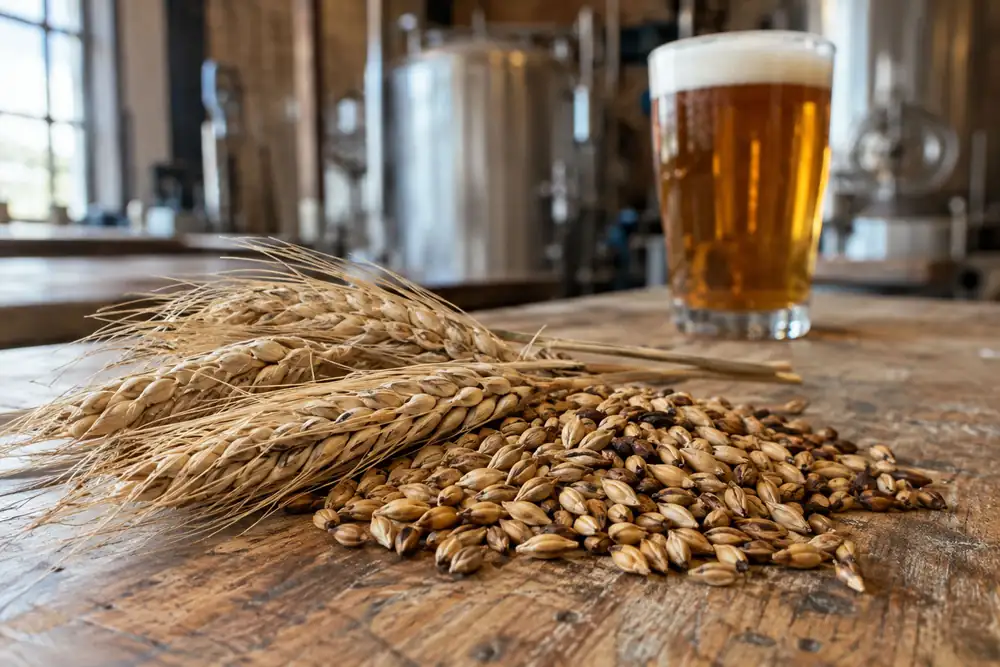
Malt and barley: this is where quality beer comes from
When it comes to quality beer, attention often focuses on the brewer, the recipe, the hops used, or the fermentation techniques.
The concept of quality in beer is often associated with craftsmanship, agricultural production, or local supply chains. These elements can be highly valuable, but they don't automatically guarantee quality.
A good beer is born from a combination of several factors: suitable raw materials, the producer's expertise, process control, and consistency between style, recipe, and final result.
Among these raw materials, barley intended for malting occupies a central position.
Beer, after all, is first and foremost an agricultural product. And this aspect is becoming increasingly important in the Italian brewing scene, where in recent years there has been a growing focus on national supply chains, farm-to-table breweries, and crops specifically designed for beer production.
Having access to barley grown in Italy and processed according to parameters suitable for malting allows producers to build more controllable supply chains and, in some cases, create beers with a stronger connection to the region.
The key point, however, remains the quality of the raw materials.
Not all barley is suitable for the production of malt for brewing. Varieties intended for the brewing industry must possess specific agronomic and technological characteristics, because what happens in the grain will subsequently influence yield, fermentation, color, head, and the beverage's sensory characteristics.
Before barley can actually enter the beer making process it must be transformed through malting.
It is a process based on the controlled germination of the cereal.
The grain is then allowed to absorb water and begin germinating. During this phase, a series of enzymes are activated, which are essential for making the substances contained within the seed available.
Germination is then interrupted by drying. This process produces malt.
During the subsequent production of beer, the enzymes present in the malt allow part of the starches contained in the cereal to be transformed into sugars that the yeast can use during fermentation.
Malt is therefore not simply a source of sugars. It also contributes to the beer's color, structure, head formation, and an important part of its flavor profile.
Depending on the type of malting and the temperatures used during drying, very different malts can be produced.
There are pale malts, used as a base for many beers, and more roasted or caramelized malts capable of developing notes that can recall bread, biscuit, caramel, cocoa or coffee.
It is also through the choice and combination of malts that the brewer builds part of the beer's identity.
A pale lager and a very dark stout both start with grain, but use malts with profoundly different characteristics.
To obtain a good malt, you first need barley with characteristics suitable for processing.
Among the most frequently observed parameters are humidity, protein content, germination capacity, size and uniformity of the caryopses.
The protein content is particularly important because it is closely linked to the presence of starch in the grain.
Generally speaking, barley with too high a protein percentage may contain less starch available for processing.
And it is precisely from starch that, through enzymatic activity, the sugars necessary for fermentation are obtained.
For the manufacturer, this aspect also has economic consequences.
A lower extract yield means that a greater amount of malt may be needed to obtain the same amount of fermentable wort. On a production scale, even seemingly small differences can translate into significant costs.
For this reason, maltsters and breweries carefully evaluate the characteristics of the barley before processing.
However, there is no single value that is absolutely valid for all varieties and for every production destination.
The required characteristics may change based on the type of barley, the climatic conditions, the specifications of the malting house and the type of malt you want to obtain.
Humidity must also be carefully controlled, especially to ensure proper preservation of the grain and reduce the risk of deterioration during storage.
Equally important is the health condition of the grain.
Mold, disease, damage caused by frost or excessive temperatures can compromise the characteristics of the grain and therefore the subsequent malting process.
The quality of the beer therefore begins with a very rigorous selection.
The composition of barley does not only depend on the variety grown.
Soil, temperatures, water availability, fertilization, and climatic conditions during plant development can significantly alter the final characteristics of the crop.
This is one of the reasons why producing barley for beer production requires particularly careful agronomic management.
Modern agricultural techniques now allow us to monitor many of these factors more precisely than in the past.
Soil analysis, varietal selection, fertilization management, and crop condition monitoring enable more uniform harvests that are better suited to the needs of the malting industry.
For the brewing industry, this means being able to work with more predictable raw materials.
And predictability is a fundamental element in beer production.
A brewery must be able to replicate certain aromatic and sensory characteristics over time. If the malt's properties vary significantly from one batch to the next, the production process must also be adapted.
In recent years, interest in the production of barley for the brewing industry has also increased in Italy.
Research and experimentation projects are working on selecting varieties capable of adapting to Italy's diverse soil and climate conditions while also offering characteristics suitable for malting.
The topic is particularly interesting for the world of craft beer.
Greater availability of domestic raw materials could in fact allow some producers to build shorter and more controlled supply chains.
This does not mean that the Italian beer supply chain is already completely self-sufficient.
A significant portion of the raw materials used by breweries continue to come from abroad, and the path toward a structured national supply chain still requires investment, research, and production capacity.
More and more producers are looking at the origin of raw materials not just as a narrative element, but as an integral part of the product's quality.
For farm breweries, this concept takes on an even stronger meaning, because it allows them to directly connect cultivation, processing, and production.
In this scenario, malt becomes a sort of bridge between agriculture and brewery.
When we look at a beer in the glass, it's easy to focus on the color, the head, the aromas of the hops, or the work of the yeast.
A fundamental part of what we are drinking, however, was determined months in advance.
It started with the choice of barley variety, the soil conditions, the climate and the work of the farmers.
It continued in the malting house, through germination, drying and control of the characteristics of the cereal.
For this reason, talking about the quality of beer necessarily also means talking about agriculture and raw materials.
Research into more suitable varieties, the development of national supply chains, and greater attention to barley quality could become some of the most interesting elements in the evolution of Italian beer in the coming years.
Because, even before the recipe and fermentation, a great beer always begins in the fields.
Image Note: The illustrative images in this article were generated or processed using artificial intelligence tools and subjected to editorial review by the ApeTime Magazine editorial staff.