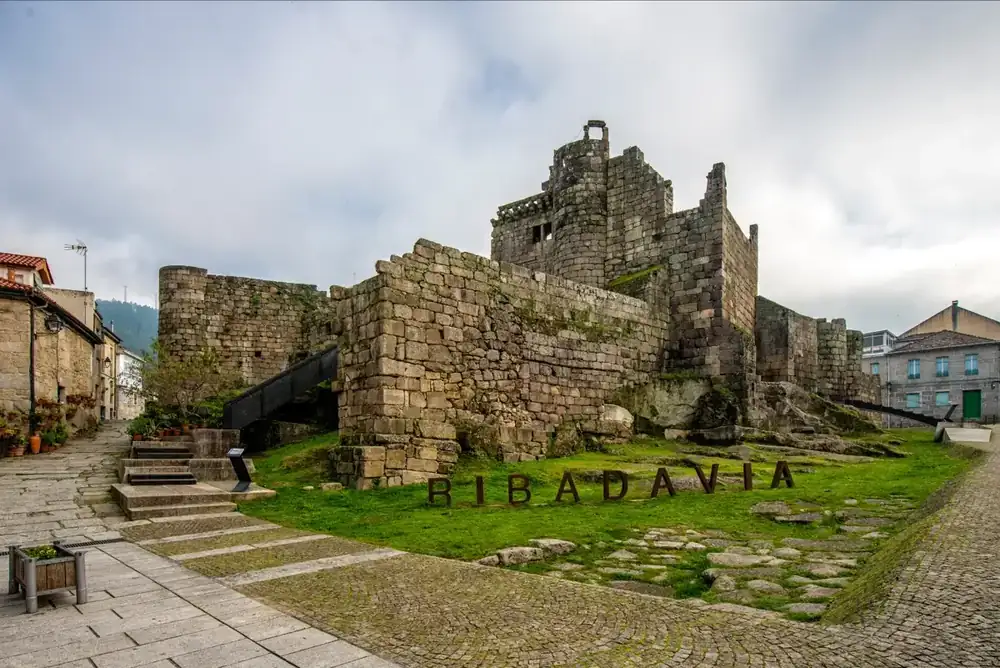
This Galician village was once home to Sephardic Jews and today is the epicenter of the best wine in Galicia
In the heart of Galicia, a small medieval village with a Sephardic past, surrounded by vineyards, encapsulates centuries of history, living traditions, and some of the most emblematic wines of the Ribeiro Designation of Origin.
Today, cultural and wine tourism trips are increasingly focused on this corner of inland Ourense, where an old Jewish quarter, Gothic churches, and less crowded pilgrimage routes to Santiago de Compostela coexist. From here, many travelers also connect to a major French city famous for its traboules, bouchons, and a gastronomy that has earned it the title of world capital of cuisine, creating a getaway that combines Sephardic heritage with gastronomic delight.
Ribadavia, the medieval town that was the capital of the Kingdom of Galicia
The name of this town is Ribadavia, located in the west of the province of Ourense, on the banks of the Avia River and in the heart of the O Ribeiro region. Just 30 kilometers from the provincial capital, the landscape of deep valleys, hillside vineyards, and narrow rivers explains why viticulture has taken root here for centuries.
Between 1065 and 1071, Ribadavia became the capital of the Kingdom of Galicia, during the height of the wine trade that shipped from Atlantic ports to the rest of Europe. This past is still evident today in the arcaded Plaza Mayor, the houses adorned with coats of arms, and the layout of a historic center that blends medieval and Baroque features.
The ancient Sarmiento castle overlooks the town from a promontory above the Avia River. Although not entirely intact, its walled enclosure and views help one imagine Ribadavia's strategic importance in the Middle Ages. At its foot, the tree-lined promenade and the streets of the historic center are the hub of daily life, with its many outdoor cafes and cultural events.
Ribadavia is not just stone. The houses with their reddish roofs, the granaries scattered throughout the surrounding area, and the proximity of the Miño River remind us that it is also an agricultural town that continues to thrive on wine, orchards, and an increasingly specialized tourism sector.
The Sephardic influence in one of the best-preserved Jewish quarters in Galicia
One of Ribadavia's most unique features is its Jewish quarter, part of the Network of Jewish Quarters of Spain. Its narrow streets, passageways, and stone houses adorned with coats of arms preserve the memory of a Sephardic community that played a key role in the wine trade and the town's economy until their expulsion in 1492.
A stroll through the Jewish quarter reveals subtle details: inscriptions, symbols carved in stone, the remains of old merchants' houses, and secluded squares where homes, artisan workshops, and small shops now blend together. Interpretive panels help trace the layout of the former synagogues and communal spaces.
In the heart of the neighborhood is the Sephardic Museum or Jewish Information Center of Galicia, where the Jewish presence in the region is contextualized, the wine trade routes are explained, and family stories connecting Ribadavia with other points of the Sephardic diaspora are recovered.
- A stroll through the streets of the Jewish quarter, with stone houses and arcades.
- Visit to the Sephardic Museum and the former House of the Inquisition.
- Stop at the arcaded Plaza Mayor, the epicenter of social life.
- Climb to the Sarmiento castle and walk along the old wall.
- Discovery of churches such as Santo Domingo or Nuestra Señora del Portal.
Festa da Istoria and other festivals that bring back the past
Sephardic memory and the medieval past are not confined to museums. Every last Saturday of August, Ribadavia celebrates the Festa da Istoria, one of Galicia's best-known historical reenactments, declared a Festival of Tourist Interest. The Jewish quarter and the rest of the historic center are transformed into a vast open-air stage.
The French Way of St. James as you've never heard it before: the guide to avoiding horrible places and eating like a king on a budget
During the festival, the town transforms into a period setting: locals and visitors alike don medieval costumes, the streets are filled with craft and food stalls, and transactions are conducted using maravedís, a coin created for the occasion. Among the most symbolic events are the reenactment of a Jewish wedding, tournaments, and medieval dinners held near the castle.
In addition to the Festa da Istoria, the calendar includes other important events, such as the Festas do Portal, linked to the patron saint, and cultural events that take advantage of the historical settings, such as the International Theatre Festival held inside the fortress in the summer.
The heart of Ribeiro wine and wine tourism
Ribadavia is also the gateway to the Ribeiro Designation of Origin, one of the oldest in Galicia, headquartered in the town itself. The region stretches across the valleys of the Miño, Avia, and Arnoia rivers, where the mild climate, sunny slopes, and granitic soils have made its wines famous since the Middle Ages.
The white wines of Ribeiro, made with varieties such as Treixadura, Godello, or Loureira, are characterized by their freshness, fruity aromas, and good acidity. The red wines, less well-known outside of Galicia, use indigenous grapes like Caíño or Brancellao and offer a more Atlantic expression, with moderate alcohol levels and great food pairing potential.
What makes Ribeiro wine different?
The area's microclimate, protected by mountains that block the direct influence of the Atlantic, allows for a slow ripening of the grapes. This balance between sun, humidity, and coolness results in wines with character, designed both for immediate consumption and for more complex winemaking, such as the traditional Tostado, a naturally sweet wine associated with celebrations.
The very history of the designation of origin, officially recognized in the 1930s, is linked to protecting the name Ribeiro from imitations. Today, family wineries and small growers coexist with larger projects, resulting in a diverse offering for travelers seeking guided tours, tastings, and vineyard experiences.
Wine tourism routes and experiences from Ribadavia
From the village, it's easy to arrange tours of traditional and modern wineries, many of them located on the hillsides overlooking the Miño and Avia rivers. The Galician Wine Museum, housed in a nearby former priory, helps visitors understand the evolution of grape cultivation, winemaking techniques, and the importance of wine in the Galician economy.
Another key element reinforcing the area's historical significance is the Camino Miñoto Ribeiro, a pilgrimage route that connects northern Portugal with Santiago de Compostela, crossing the region. Several sections pass through Ribadavia and its surroundings, making the town a resting point for pilgrims interested in combining spirituality, scenery, and wine culture.
- Guided tours of Ribeiro wineries with a guided tasting.
- Tour of the Wine Museum of Galicia and nearby vineyards.
- Sections of the Miñoto Ribeiro Way that cross the region.
- Walks around the Castrelo de Miño reservoir and nautical activities.
- Local cuisine based on local products and pairings with wines from the area.
Lyon, the French stop that completes the journey
The proposed route linking Ribadavia with France finds its great urban counterpoint in Lyon. Located in the southeast of the country, at the confluence of the Rhône and Saône rivers, the city combines Roman heritage, 19th-century architecture, and working-class neighborhoods linked to the silk industry.
Its historic center, classified as a World Heritage Site, shows the overlapping of eras: Roman ruins on Fourvière hill, medieval streets in Old Lyon and grand avenues of Haussmannian inspiration on the Presqu'île, the peninsula separated by the two rivers.
Gastronomic capital and city of bouchons
Lyon has been known as the world's gastronomic capital since a famous food critic popularized the title in the 1930s. Today, the city maintains a very high concentration of restaurants, from traditional establishments to those recognized by international guides.
Bouchons are the epitome of this popular cuisine: small establishments serving hearty dishes based on offal, cured meats, cheeses, and slow-cooked stews. Their informal atmosphere and closely spaced tables are as much a part of the experience as the menu.
This offering is complemented by covered markets and brasseries linked to big names in French cuisine, which have consolidated Lyon's image as an ideal city to combine cultural visits and gastronomic tourism.
Traboules, ríos y vistas desde Fourvière
Beyond the food, the city attracts visitors with its unique urban features. The traboules, passageways that run through buildings and courtyards, originated as a practical solution for silk workers to transport their wares protected from the rain. During World War II, some of these discreet corridors were used by the resistance.
Old Lyon preserves several of these routes, signposted so visitors can explore inner courtyards, monumental staircases, and galleries that connect one street to another. It's a way to discover the city from within, different from the grand boulevards.
The funicular ride up Fourvière Hill leads to the ancient Roman theater and Notre-Dame Basilica, offering panoramic views of the city, rivers, and surrounding hills. On the way down, the banks of the Saône and Rhône rivers are perfect for pleasant walks, especially at sunset.
- A tour of Old Lyon and its most emblematic traboules.
- Visit to the Basilica of Fourvière and the Roman Theatre.
- River cruises along the Saône or the Rhône.
- Meal or dinner in a traditional cork.
- A route through contemporary markets and gastronomic spaces.
How to plan a getaway between Ribadavia and Lyon
Combining Ribadavia and Lyon in a single trip allows you to connect two complementary narratives: that of Sephardic heritage and Galician wine, and that of a great metropolis that has made gastronomy its hallmark. For the traveler, the key lies in balancing time and pace.
When to go and how much time to spend
Spring and autumn are the best times to visit Ribadavia, thanks to the mild temperatures and the ever-changing vineyard landscape. Late summer is particularly appealing for those who want to coincide their visit with the Festa da Istoria (Festival of History) or the grape harvest in the surrounding area.
In Lyon, the spring and early autumn months offer mild weather, bustling terraces, and a vibrant cultural scene. Winter can be appealing for a getaway focused on museums, restaurants, and city walks, with fewer tourists.
Sephardic and gastronomic itinerary ideas
A possible itinerary could allocate two or three days to Ribadavia and its surroundings, allowing time to explore the Jewish quarter, visit the Sephardic Museum, climb to the castle, and take at least one wine tour through the Ribeiro wineries. Adding a day to visit the Castrelo de Miño reservoir or follow a section of the Miñoto Ribeiro Way completes the experience.
In Lyon, another three days allow you to explore Old Lyon, the Fourvière and Croix-Rousse hills, several traboules and some of its most famous markets, as well as book lunches and dinners in different types of restaurants, from a classic bouchon to a contemporary brasserie.
The result is a getaway that combines Sephardic heritage, Galician wine with a long tradition and one of the great culinary capitals of Europe, designed for travelers who are looking for more than just a postcard: a coherent story where history, memory and food intertwine at every stop.