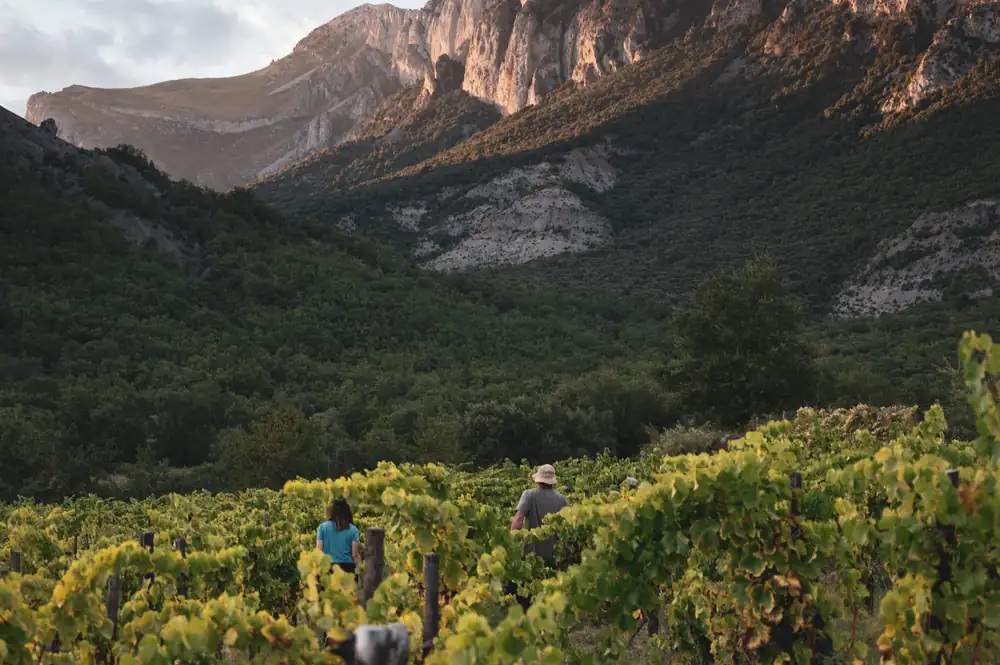
Vignerons de Huesca, a commitment to the territory, native grapes and unpretentious wines
They don't produce wine, but they're behind the creation of every bottle that bears their label.
This sounds wonderful, but words alone won't change things. Nieves Campo and Javier Buil opened La Corona de L'Ainsa in 2008, a shop specializing in local products that, over time and thanks to growing interest in the subject, began to specialize in wines. Since then, they have dedicated their energy, passion, time, and money to the Huesca wine sector. In 2016, what would eventually become Vignerons began to take its first steps. "We wanted to work hand in hand with wineries that shared our philosophy, accompany them throughout the winemaking process, and create wines that represented our region." This is how Buil began visiting restaurants, conveying the project's vision, developing wine lists, and gradually building an ecosystem that encompasses the entire supply chain and all moves toward the same goal: to promote a way of understanding wine that involves sustainability, quality, and terroir.
Today, a bottle bearing the Vignerons gold seal is a sure bet. It not only guarantees you'll be drinking a great wine, but it also represents a commitment to making small projects viable. "One of the objectives, perhaps less visible, is to strengthen a primary sector that gives life to the villages of Aragon," explains Buil. For this reason, this distinction is only awarded to highly selected wines. Every year, they organize a tasting panel attended by professionals from all over Spain. "Top professionals like Paco Oros, Nicolás Brun, Juanma Gonzalvo, Jorge Orte, Guillermo Cárcamo, and Marta Tornos always come, and occasionally, luminaries such as José Peñín, Fernando Mora, and Norrel Robenson have also participated." In total, around thirty professionals help select the bottles that will ultimately bear the seal.
To achieve this, they start with a set of initial criteria: maximum production of 40,000 bottles and a total commitment to native grape varieties. Huesca boasts a very interesting diversity of grapes: Parraleta, Moristel, Alcañón, and the more well-known Garnacha, and prioritizing them is a way to highlight the most authentic side of the region. This doesn't mean rejecting all wines made with more popular varieties. "If we select a Riesling or a Petit Berdó, it's because that wine is a very specific example of how that grape manifests itself in Huesca in general, and in a specific area in particular," explains Buil. They also work closely with the Agrifood Research and Technology Centre (CITA) and the University of Zaragoza to test recovered varieties and are gradually moving towards more natural production methods with less intervention.
One of the most interesting aspects of this seal is that it not only selects good wines, but also, based on its annual tasting panels, Vignerons returns to the wineries it works with to share ideas, improvements, and trends that could be applied to further refine the wines. “Wineries aren't always necessarily up-to-date and aware of the tastes of the end consumer or new trends. Part of our job is to pool that knowledge and work hand in hand so that we all end up with a better product.” Currently, six wineries are part of this network: Bodegas Edra, within the Ribera del Gállego Protected Geographical Indication; Familia Estrada Palacio, at the foot of the Sierra de Guara; Bodegas Sers and Bodegas Alodia, in the Somontano region; El Vino del Desierto, representing the unique character of the Monegros steppe; and Casa Vinícola Moliniás, in the Sobrarbe region.
The third pillar of the project is the restaurant. The place where all the previous work comes to life. And once again, Vignerons doesn't stop at the door. They act as distributors, but also as advisors, mentors, and trainers. Buil covers the Sobrarbe region, but the rest of Aragon is more than well covered thanks to San Lorenzo Vinos. Patxi Opere and Nacho López are the people behind this Huesca-based distributor with one of the most interesting selections—and working methods—in all of Aragon. They don't cold-call; that is, they don't go anywhere trying to convince anyone to work with them. “When we visit someone, it's because they've contacted us and are interested in our approach. First, we go, we see what they're doing, we're interested in where they're headed, we taste their product, their food. The last thing we do is talk about wine,” says Opere. “And if the project isn't aligned with our understanding of the sector or they're not willing to change things, we prefer not to move forward.”
They understand that wine is a seasonal product, which is why their wine lists feature bottles that come and go as the year progresses. They choose their wines in a spiral fashion. They start with the restaurant's location and select wines, prioritizing those that are closest. "It doesn't make sense to look for a Tempranillo in Ribera del Duero if we have a good Tempranillo right here." Although they don't exclusively distribute Vignerons wines—they have more than 8,000 wines from around 200 wineries—they have adopted Vignerons' philosophy when choosing wines from other regions. This explains why their selection includes names like Casa Castillo in Jumilla, Cantalapiedra in La Seca, Jose Gil and Área Pequeña Viticultores in Rioja, and Castell D'Encus in the Eastern Pyrenees. These are wines that are only distributed in Aragon by San Lorenzo and, like those bearing the Vignerons label, are a very good indicator of quality if they appear on any wine list or shelf. At that place, you'll likely find not only excellent wine, but also a menu featuring high-quality ingredients, seasonality, and sustainable practices. Their approach isn't simply to design wine lists, but to build a cohesive and well-rounded concept. They train the team, provide thorough follow-up, and ensure that the restaurants become the best ambassadors for the products they distribute.
Vignerons, with the support of San Lorenzo Vinos, is not just a wine project, but a way of understanding a sector sustained by small wineries and producers who compete against industry giants. It's an ecosystem of shared values and a commitment to the land, gradually moving towards a more sustainable and authentic environment. This initiative unites wineries, distributors, restaurants, and other professionals with a common goal: to preserve and strengthen the winemaking identity of Huesca.