Hotel Eunice, there's more to life than the breakfast buffet
There's an atmosphere in a hotel that's hard to explain.
There's an atmosphere in a hotel that's hard to explain. Paul Auster described them in 'Brooklyn Follies' as fortresses that isolate you from the outside world; it's said that after the liberation of Paris, the first place Hemingway went was the café at the Ritz Hotel, where he drank 51 martinis (which would be a few less). There are all kinds of hotels. There are the functional ones. There's nothing wrong with that, but you shouldn't expect anything special from them either. Sleep, have a meager coffee for breakfast, and head home. Others have adapted to the times: extra-large beds, the odd experiential touch, or so they say, a restaurant that, sometimes, is more pretentious than good food.
Entering the realm of breakfasts is like stepping into a subculture. Let's not kid ourselves, the average Spanish tourist loves a buffet. The contents don't matter: scrambled eggs thinned with cream on a thermal tray, enormous quantities of mini sausages of dubious origin, stale pastries, and the less said about the cold cuts, the better. Here, in this format, quality is rarely a factor. Abundance, and that's it.
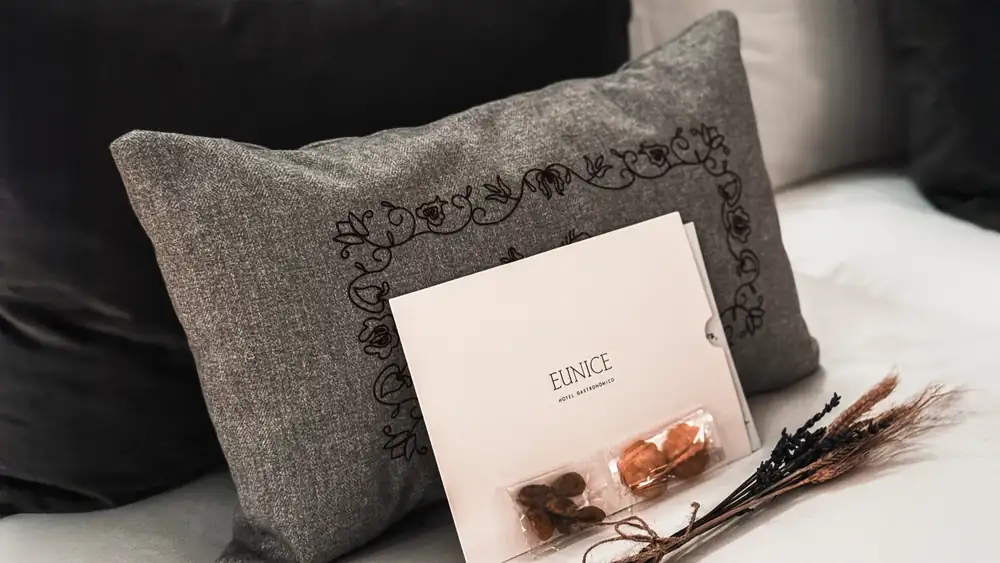
There are exceptions. In recent years, within the world of boutique hotels, so-called gastronomic hotels have emerged. One of them is the Hotel Eunice, located in the heart of Salamanca's historic center. When you enter, not everything adheres to the conventional norms of this type of establishment. There's no traditional reception area, beyond a small table near the entrance. The hotel's library belongs to José Manuel Pascua, the chef and owner, and its shelves hold publications such as Apicius and books like Natura by Albert Adrià, as well as volumes dedicated to Azurmendi, Etxebarri, and Lera.
The renovation of this 19th-century palace, undertaken by IDI Studio, has carefully preserved essential elements of its original architecture, such as its imposing central staircase. The interior design is full of references to Salamanca. From the renowned embroidery of the Sierra de Francia to the traditional Salamanca button, found at the entrance to each room, and including paintings and sculptures by Salamancan artists. Adding to this identity is the building's history, linked to Gonzala Samanta, considered the first female pediatrician in Salamanca and also known for her philanthropic work and for welcoming numerous children into her home. Years later, the palace was protected due to its proximity to the Monterrey Palace and designated for residential use. José Manuel Pascua's grandmother was its last owner before it passed into his hands.
Pascua restaurant, located in an annex of the hotel, offers two tasting menus: a shorter one, El Celemín (€76), and a longer one, La Fanega (€88). Both last no more than ninety minutes, which is a welcome feature.
Celemín begins with an olive oil flatbread, accompanied by a creamy corn spread. This dish evokes their culinary spirit, but perhaps it should be smaller for a lighter start. Among the appetizers, the fritter filled with cocido (a traditional Spanish stew), with its rich flavor, and the mini taco of shredded Iberian pork jowl—a cut located near the loin—topped with a textured egg yolk, stand out.
Next comes the artichoke, accompanied by mackerel and pil-pil sauce. The artichoke is finished over holm oak embers, acquiring a smoky elegance that pairs beautifully with the pil-pil. It's a dish where each ingredient asserts its character without overpowering the others.
The central course of the menu features the carabineros and scallop ravioli, accompanied by an American sauce with a citrusy touch of yuzu that helps to round out the flavor.
A popular dish like meatballs also has its place at Easter. In this case, it's made with poultry and served with a reduced chicken broth. A simple dish that ends up being the best on the tasting menu.
In the desserts, strawberries and cream are reinterpreted with mascarpone and hibiscus juice, adding character and freshness to the whole.
The menu is paired with wines from the region and neighboring areas, such as Colina Triste, Tarraz, and Circustancial. In the dining room, Silvia Gaspar takes the lead, offering precise explanations without being tedious.
So far, so good, but if there's one moment that truly justifies the hotel's "gastronomic" moniker, it's breakfast. Breakfast is served in the Yantar dining room, right next to the entrance. The dining room boasts immaculate tablecloths, silver cutlery, and excellent lighting, all dominated by a black cast-iron stove where the chefs prepare everything to order. While the term "tasting breakfast" might sound intimidating when choosing from the options, it can actually be completed in about forty minutes, a time very similar to that of a typical hotel breakfast.
There are several non-negotiable elements in a hotel breakfast. One is the coffee, another the cold cuts; the fruit must be freshly cut and the juice, if not freshly squeezed, must at least be from that day.
The first part of the tasting menu, what they call the "liquid portion," focuses on a good coffee, a fresh juice of the day—in this case, orange—and a carefully curated selection of herbal teas. It's not a menu served in courses; everything is brought out at once, except for the final course, so in the blink of an eye your table is laden with acorn-fed Iberian ham, all sorts of local sweets, like Bombas de Salamanca or French madeleines, freshly cut fruit, sobrasada, homemade jams, or a perfectly executed quenelle of butter.
Pastries are noticeably absent at first, but you don't really miss them. They make up for it well with other products like sourdough bread, local honey, or Greek yogurt, which can be enjoyed with homemade granola (the real deal).
If there's a common denominator, a background noise that's never intrusive, it's the continuous whisking of the eggs and the clatter of the whisks over a small sauté pan to prevent the hollandaise sauce from falling apart. The final sequence, centered on the eggs, is undoubtedly the most brilliant of the entire menu: a choice between a simple omelet and eggs Benedict, both prepared instantly and topped with a touch of chives.
Without a doubt, the breakfast overshadows the rest of the Hotel Eunice's offerings, no small feat for such a high-quality establishment. Its price, 45 euros per person, is also available to non-guests.
Ultimately, large hotel chains need to reflect on what they want to offer with their breakfasts. In few of them do the breakfasts live up to the standards of their buildings. It's a delicate balance where hoteliers must weigh what the customer demands against the quality they want to provide. Does stale pastries, terrible coffee, or fruit cut the day before really add anything to the overall experience? In fashion, Coco Chanel made it clear that elegance also lies in knowing when to eliminate. Perhaps the new law on food waste, recently passed, will force a rethink of these breakfasts. Some hotels, like Eunice, already seem to be pointing the way in that direction.